Highlights
- Plasma phosphorylated tau217 (pTau217) levels measured by Lumipulse G assays correlate strongly with postmortem pTau217 in the temporal cortex, validating plasma pTau217 as a quantitative surrogate of cerebral tau pathology.
- The pTau217Mid/Aβ1-42 plasma ratio provides a comparable or better fit for predicting cortical pTau217 pathology than plasma pTau217Mid alone, enhancing diagnostic accuracy for Alzheimer disease (AD).
- Plasma pTau217 metrics differentiate AD from non-AD dementias, including frontotemporal lobar degeneration, with high diagnostic performance (AUC 0.88-0.94).
- Plasma pTau217 correlates more specifically with tau aggregate density than with amyloid-β plaque burden, supporting tauopathy specificity in plasma biomarker measurements.
Background
Alzheimer disease (AD) is characterized neuropathologically by extracellular amyloid-β (Aβ) plaques and intracellular neurofibrillary tangles composed of hyperphosphorylated tau protein. Early and accurate detection of tau pathology is essential for diagnosis, prognosis, and monitoring therapeutic response. Plasma biomarkers for phosphorylated tau at threonine 217 (pTau217) have emerged as promising tools for noninvasive detection of AD-related tau pathology. Despite their demonstrated clinical utility, validation of plasma pTau217 as an accurate marker of brain-based tau pathology requires direct correlation with cortical pTau217 postmortem measurements. The Lumipulse G platform enables quantification of pTau217 in plasma and brain tissue homogenates, facilitating this key validation step.
Key Content
Postmortem Validation Study of Plasma and Cortical pTau217
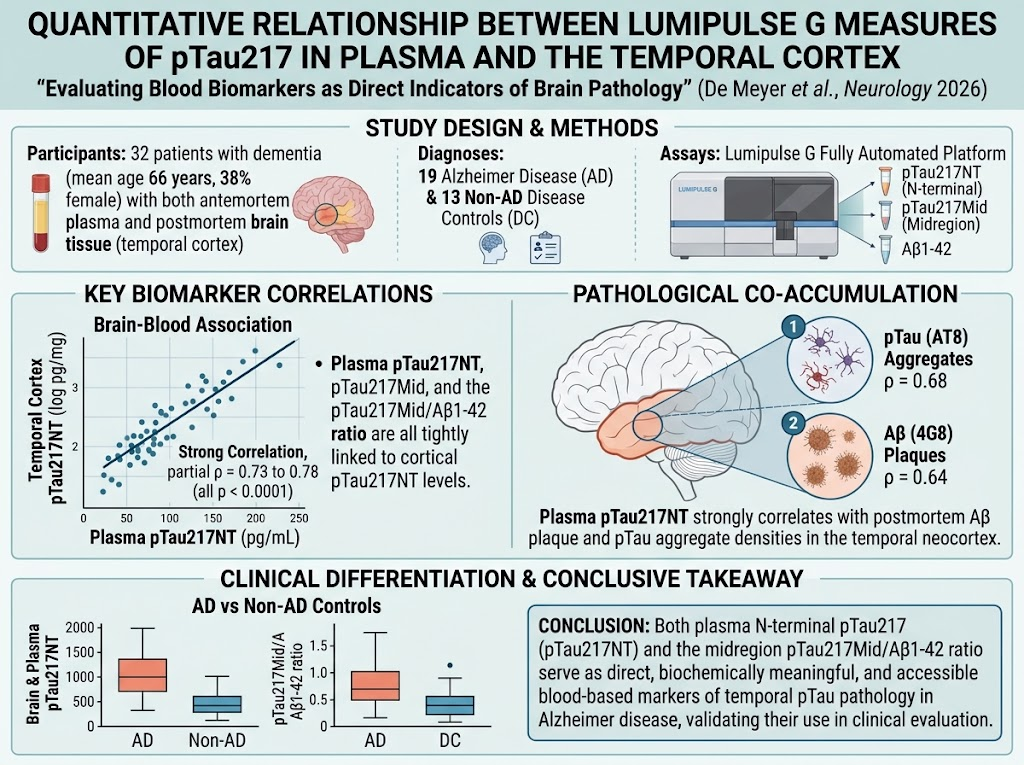
A recent retrospective study led by De Meyer et al. (2026) involved 32 dementia patients with paired antemortem plasma samples and postmortem inferior temporal cortex tissue available. Diagnoses included 19 AD cases and 13 non-AD dementias (frontotemporal lobar degeneration with tau or TDP-43 inclusions). Using novel Lumipulse G immunoassays targeting N-terminal pTau217 (pTau217NT) and midregion pTau217 (pTau217Mid), researchers quantified pTau217 levels in plasma and brain homogenates. They additionally measured plasma Aβ1-42 to calculate the pTau217Mid/Aβ1-42 ratio. Advanced statistical models, including generalized additive models and partial Spearman correlations with bootstrapped confidence intervals, assessed the quantitative relationships between plasma and cortical pTau217.
Strong Correlations Between Plasma and Cortical pTau217
Plasma pTau217NT, pTau217Mid, and pTau217Mid/Aβ1-42 ratios correlated significantly with pTau217NT in temporal cortex homogenates (partial Spearman ρ ranging 0.73 to 0.78, p<0.0001). Models using plasma pTau217NT or the pTau217Mid/Aβ1-42 ratio better predicted cortical pTau217NT levels compared to plasma pTau217Mid alone, as indicated by improvements in Akaike and Bayesian information criteria. This suggests that including Aβ1-42 concentrations enhances the plasma biomarker’s ability to reflect brain tau pathology.
Diagnostic Performance in Differentiating AD from Non-AD Dementias
All plasma pTau217 measures demonstrated high accuracy in discriminating AD patients from those with non-AD dementias with area under the curve (AUC) values between 0.88 and 0.94. This strong diagnostic performance bolsters plasma pTau217 as a clinically valuable biomarker capable of distinguishing AD tauopathy in complex differential diagnoses.
Specificity for Tau Pathology Relative to Amyloid Burden
Plasma pTau217 markers correlated moderately to strongly with neocortical densities of Aβ plaques (4G8 immunostaining) and tau aggregates (AT8 staining) (partial Spearman ρ = 0.57–0.69, p < 0.0012). Crucially, after controlling for concurrent pathology, only correlations between plasma pTau217 and tau aggregate density remained statistically significant (ρ = 0.39–0.45, p 0.19). This specificity supports the premise that plasma pTau217 reflects tauopathy rather than amyloid burden per se.
Related Evidence on Plasma pTau217 Biomarkers in Clinical Trials and Cognitive Reserve Studies
Supporting evidence from recent clinical trials and biomarker studies enhances the translational context:
- Valiltramiprosate (ALZ-801) Trials: A phase 3 study (De Meyer et al. 2026) demonstrated that treatment with ALZ-801 significantly reduced plasma pTau217 and pTau217/Aβ42 ratios in APOE4 carriers with mild cognitive impairment, with reductions sustained over four years. These biomarker modulations correlated with clinical improvements and volumetric MRI metrics, underscoring plasma pTau217 as a pharmacodynamic marker responsive to amyloid-targeted intervention.
- Cognitive and Brain Reserve Modulation: Large cross-sectional analyses observed that higher brain reserve mitigates the cognitive impact of elevated plasma pTau217 levels, suggesting interplay between pathology burden and reserve capacity influencing clinical expression. This complements the neuropathological validation by highlighting clinical relevance of plasma pTau217.
- Zervimesine Phase 2 Trial: Exploratory analyses demonstrated plasma biomarker shifts, including reductions in pTau217 and neuroinflammation markers, primarily in patients with lower baseline plasma pTau217 levels, aligning biomarker changes with clinical benefit and reinforcing plasma pTau217 as a marker to stratify therapeutic response.
Expert Commentary
This comprehensive postmortem validation bridges a critical gap in Alzheimer’s biomarker research by quantitatively linking plasma pTau217 measurements to direct cortical tau pathology. The superior performance of plasma pTau217NT and the pTau217Mid/Aβ1-42 ratio indicates that combining tau and amyloid plasma measures optimizes accuracy in capturing neuropathological tau burden. The strong correlation with tau aggregates but not amyloid plaques after adjustment confirms plasma pTau217 as a selective marker of tauopathy, which is pivotal for both diagnosis and tracking disease progression.
The high diagnostic accuracy in differentiating AD from other tauopathies and frontotemporal dementias validates its utility in complex clinical contexts. Integrating these findings with clinical trial evidence from ALZ-801 and zervimesine implies plasma pTau217 could serve as a biomarker both for early detection and therapeutic monitoring.
Limitations include the modest sample size, retrospective design, and focus on a single brain region; future studies should expand cohorts and assess longitudinal dynamics. Methodological advances such as highly sensitive Lumipulse G assays facilitate broader clinical application. The mechanistic underpinning relates to pathological tau phosphorylation patterns integral to neurofibrillary tangle formation, with plasma pTau217 likely reflecting neuronal release and clearance dynamics.
Conclusion
Robust correlations between plasma pTau217 levels measured by Lumipulse G assays and temporal cortical pTau217 pathology establish plasma pTau217 as a valid and practical biomarker of cerebral tau pathology in Alzheimer disease. The enhanced predictive value of plasma pTau217 normalized to Aβ1-42 suggests combinatorial plasma biomarker approaches improve diagnostic and monitoring performance. This validation supports plasma pTau217’s translational potential in clinical diagnosis, differential diagnosis, and as a surrogate endpoint in AD clinical trials. Expanding research to larger, prospective cohorts with diverse dementias will further refine its clinical applicability and foster its integration into precision medicine frameworks for AD.
References
- De Meyer S, Tomé SO, Lahaije B, et al. Quantitative Relationship Between Lumipulse G Measures of pTau217 in Plasma and the Temporal Cortex. Neurology. 2026 Oct 5;107(8):e218598. doi: 10.1212/WNL.0000000000218598. PMID: 42837647.
- De Meyer S, et al. Plasma Biomarker Effects of Oral Valiltramiprosate/ALZ-801 in Early Alzheimer’s Disease from Phase 3 and Phase 2 Trials: Analysis of Core Biomarkers and Correlations with Clinical and Neuroimaging Outcomes. Drugs. 2026 Oct;86(10):1705-1721. doi: 10.1007/s40265-026-02381-3. PMID: 42678603.
- Rattan A, et al. Cognitive and Brain Reserve as Modifiers of Early Alzheimer Disease-Related Cognitive Vulnerability. Neurology. 2026 May 12;106(9):e214833. doi: 10.1212/WNL.0000000000214833. PMID: 41980229.
- Bell S, et al. Impact of zervimesine on the neuroinflammatory biomarker GFAP and related proteomic molecular correlates in plasma of participants from a phase 2 clinical trial in Alzheimer’s disease. Alzheimers Res Ther. 2026 Apr 6;18(1):112. doi: 10.1186/s13195-026-02025-4. PMID: 41943055.