Highlight
The PRISM model offers an innovative, structured approach to classifying open-angle glaucoma (OAG) spanning from healthy individuals to end-stage disease. It integrates risk factor evaluation with advanced structural diagnostics and functional testing, introducing a dynamic disease progression modifier to guide monitoring intensity and therapeutic urgency.
This system bridges gaps in traditional glaucoma staging by incorporating pre-perimetric optic nerve changes detected on optical coherence tomography (OCT) and accounts for macular vulnerability, which has been under-recognized in prior schemes.
The seven-stage classification, coupled with a (+) Disease modifier to denote active progression, aligns clinical severity with biological disease extent and temporal dynamics, thus supporting personalized patient management and outcomes optimization.
Study Background
Open-angle glaucoma is a leading cause of irreversible blindness worldwide, characterized by progressive retinal ganglion cell damage and optic neuropathy. Traditional diagnostic and classification systems depend heavily on intraocular pressure (IOP) thresholds and visual field loss, ignoring the rich information from risk profiling and early structural changes detectable by OCT.
Landmark clinical trials, such as the Ocular Hypertension Treatment Study (OHTS), have shifted perspective toward multifactorial risk-driven approaches but have yet to be fully integrated into clinical classification systems, especially concerning pre-perimetric stages and macular vulnerability.
There is a pressing unmet need for a comprehensive, evidence-based glaucoma staging model that harmonizes evolving diagnostics, incorporates progression velocity, and optimizes therapeutic decision-making based on biological severity rather than arbitrary cutoffs.
Study Design
The authors synthesized data from pivotal randomized clinical trials and utility analyses related to OAG risk factors, structural and functional diagnostics, and progression metrics. Existing classification systems were critically analyzed to identify key gaps, primarily focusing on the pre-perimetric period and macular involvement.
Using this evidence base, the PRISM (Progression-Integrated, Structural Model) framework was developed to define seven discrete stages, each anchored by objective structural and functional criteria, risk-factor thresholds, and progression dynamics.
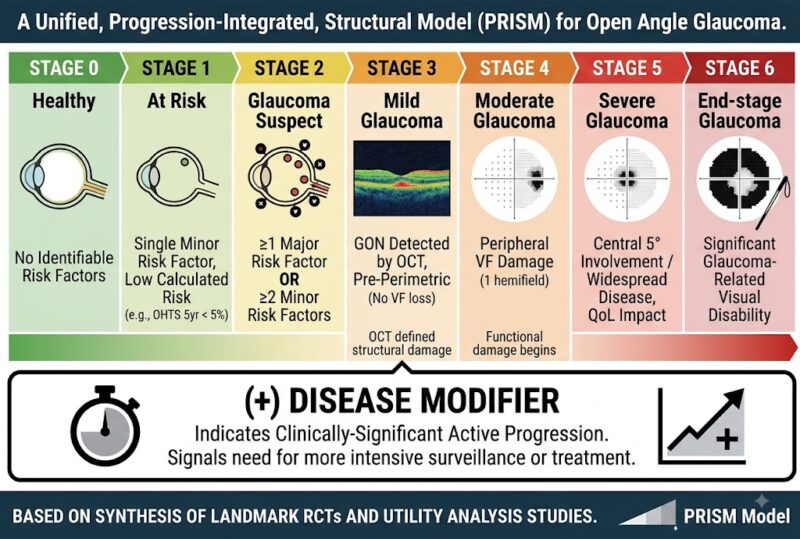
The system classifies disease on a continuum from Stage 0 (healthy, no risk factors) to Stage 6 (end-stage glaucoma with substantial visual disability). A novel (+) Disease modifier indicates active, clinically significant progression warranting more intensive surveillance or intervention.
Key Findings
The PRISM staging system stratifies the continuum of OAG as follows:
- Stage 0 (Healthy): Individuals with no identifiable glaucoma risk factors.
- Stage 1 (At Risk): Presence of a single minor risk factor with low calculated 5-year risk (<5%), for example, slight IOP elevation not meeting traditional arbitrary thresholds.
- Stage 2 (Glaucoma Suspect): At least one major risk factor or two or more minor risk factors present, reflecting a higher risk profile but no structural optic nerve damage.
- Stage 3 (Mild Glaucoma): Evidence of glaucomatous optic neuropathy (GON) on OCT structural imaging without confirmed visual field loss, identifying the pre-perimetric window earlier than existing schemes.
- Stage 4 (Moderate Glaucoma): Visual field defects limited to one hemifield, predominantly peripheral, aligned with moderate optic nerve changes.
- Stage 5 (Severe Glaucoma): Involvement of central 5-degree visual field and/or widespread visual defects, correlating with substantial loss of quality of life.
- Stage 6 (End-stage Glaucoma): Extensive glaucomatous damage causing significant visual disability and functional impairment.
A notable innovation is the (+) Disease modifier, inspired by retinopathy of prematurity staging, which flags active, clinically significant progression independent of stage. This signals clinicians to escalate surveillance or therapeutic interventions promptly.
By moving beyond traditional sole reliance on IOP or visual field criteria, the PRISM model embraces structural OCT findings and formalized risk assessment methodologies (such as the OHTS risk calculator), offering an evidence-based and biologically coherent classification.
Expert Commentary
The PRISM model appears well-positioned to address longstanding limitations in glaucoma classification. Incorporating pre-perimetric OCT-detected glaucomatous optic neuropathy ensures earlier identification of disease, potentially allowing timely intervention before irreversible visual field loss occurs.
The risk-based staging reduces dependence on arbitrary IOP cutoffs, reflecting the multifactorial nature of glaucoma pathogenesis. Integrating disease velocity as a modifier further aligns staging with prognosis and management priorities.
Potential challenges include the need for widespread availability and standardization of OCT imaging and robust risk calculators in diverse clinical settings. Also, the model requires prospective validation in large, heterogeneous cohorts to establish clinical utility and impact on outcomes.
Compared with existing systems like the Hodapp-Anderson-Parrish scale relying mainly on visual fields, PRISM’s multimodal approach could become a new standard, especially with technological advances in imaging and data analytics.
Conclusion
The PRISM framework offers a unified, progression-integrated structural model for OAG classification that bridges clinical, structural, and risk domains. Its seven-stage system captures the entire glaucoma continuum—from healthy through at-risk to end-stage disease—and includes a dynamic progression modifier to guide surveillance and treatment intensity.
This paradigm shift reflects the evolving understanding of glaucoma biology and diagnostic technology, emphasizing early structural changes and multifactorial risk. By providing a biologically aligned and evidence-based classification, PRISM holds promise for enhancing personalized glaucoma management, improving patient outcomes, and optimizing resource utilization.
Future research should focus on validating the model prospectively, assessing its impact on clinical decision-making, and integrating additional biomarkers such as macular vulnerability assessments to further refine staging precision.
Funding and Clinical Trials
The original study by De Moraes CG and Liebmann JM did not specify funding sources or clinical trial registrations in the abstract. Further inquiry into the full publication may provide this information.
References
- De Moraes CG, Liebmann JM. A Unified, Progression-Integrated, Structural Model (PRISM) for Classification of Open Angle Glaucoma and Individuals at Risk. Am J Ophthalmol. 2026 Aug 10; PMID: 42575407.
- Ocular Hypertension Treatment Study (OHTS) Collaborative Group. Risk factors for primary open-angle glaucoma in the OHTS. Arch Ophthalmol. 2002;120(6):714-20.
- Hodapp E, Parrish RK 2nd, Anderson DR. Clinical decisions in glaucoma. St. Louis: Mosby; 1993.
- Heijl A, Leske MC, Bengtsson B, et al. Reduction of intraocular pressure and glaucoma progression: results from the Early Manifest Glaucoma Trial. Arch Ophthalmol. 2002;120(10):1268-79.
- Weinreb RN, Aung T, Medeiros FA. The pathophysiology and treatment of glaucoma: a review. JAMA. 2014 May 14;311(18):1901-11.