Highlight
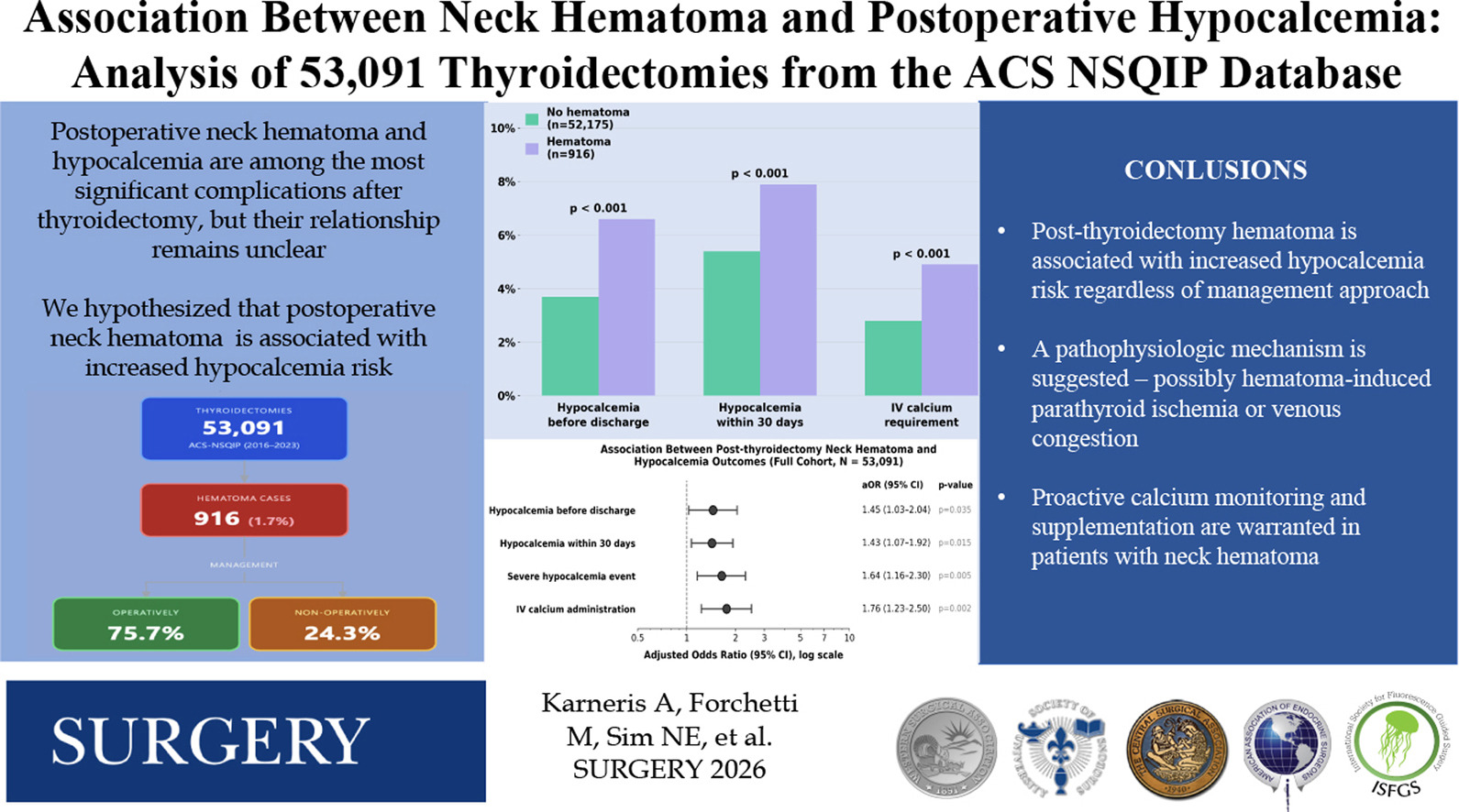
- Post-thyroidectomy neck hematoma occurs in approximately 1.7% of surgeries and is linked to a significantly increased risk of postoperative hypocalcemia.
- Both operative and nonoperative management of neck hematoma show consistent associations with hypocalcemia, suggesting the hematoma itself may contribute to parathyroid dysfunction.
- Patients with Graves’ disease are particularly vulnerable to severe hypocalcemia after developing neck hematoma.
- Proactive calcium monitoring and supplementation are recommended for patients who develop postoperative neck hematoma to mitigate hypocalcemia-related complications.
Study Background
Thyroidectomy, a common surgical procedure for various thyroid disorders including nodular disease and Graves’ disease, carries risks of notable complications such as neck hematoma and hypocalcemia. Neck hematoma, though relatively infrequent, is a potentially life-threatening event due to airway compromise. Postoperative hypocalcemia, often resulting from inadvertent injury or ischemia to the parathyroid glands, remains a frequent and clinically significant sequela, necessitating close biochemical and clinical surveillance.
Despite the clinical importance of these complications, the relationship between neck hematoma and subsequent hypocalcemia has been underexplored on a large scale. Understanding whether hematoma formation independently contributes to hypocalcemia risk could refine postoperative management strategies and improve patient outcomes.
Study Design
This investigation was a retrospective cohort study utilizing data from the American College of Surgeons-National Surgical Quality Improvement Program (ACS-NSQIP) database, encompassing thyroidectomy cases from 2016 through 2023. The dataset included 53,091 patients, predominantly female (76.8%) and White (70.2%), with a median age of 53 years.
The primary exposure was postoperative neck hematoma, identified within the specified postoperative period. The hematoma cohort was subdivided into patients managed operatively and nonoperatively. The study examined multiple hypocalcemia-related endpoints, including biochemical hypocalcemia detected before discharge, severe hypocalcemia events, and clinical interventions such as intravenous calcium administration.
Analyses involved chi-square or Fisher exact tests for categorical comparisons and multivariable logistic regression to adjust for potential confounders. Subgroup analyses focused on patients without concurrent neck dissection and on those diagnosed with Graves’ disease.
Key Findings
Neck hematoma complicated 1.7% (916/53,091) of thyroidectomy procedures. Among these, approximately a quarter (24.3%) were managed without reoperation.
Patients experiencing a postoperative neck hematoma demonstrated significantly higher rates of hypocalcemia across all measured metrics. For example, hypocalcemia before hospital discharge was observed in 6.6% of hematoma patients compared to 3.7% without hematoma (P < .001). Severe hypocalcemia events occurred in 5.2% versus 3.3%, respectively (P = .005). Notably, these associations persisted even when hematomas were managed nonoperatively, strengthening the argument that hematoma presence itself may compromise parathyroid function.
In a focused analysis of 22,157 nonreoperative open thyroidectomy cases without neck dissection — a scenario minimizing surgical manipulation of parathyroids — the relationship remained robust: hypocalcemia before discharge occurred in 6.0% with hematoma versus 2.8% without (P < .001), and severe hypocalcemia events were nearly doubled (6.5% vs 2.8%, P < .001).
These findings were particularly pronounced among patients with Graves’ disease, who exhibited marked susceptibility to calcium disturbances; intravenous calcium supplementation was required in 16.2% of hematoma patients versus 5.8% without hematoma (P < .001).
Expert Commentary
The findings of Karneris et al. contribute compelling evidence that neck hematoma after thyroidectomy is not merely a surgical site complication but also a potential trigger for parathyroid dysfunction leading to hypocalcemia. The authors hypothesize that hematoma-related compression or ischemia may impair parathyroid gland perfusion or disrupt venous return, culminating in transient or sustained hypoparathyroidism.
This mechanistic insight aligns with prior smaller studies indicating regional vascular compromise of parathyroid glands as a determinant of postoperative hypocalcemia. The strong association in patients without neck dissection supports the notion that hematoma-induced ischemia, rather than direct surgical trauma, may significantly contribute.
From a clinical perspective, this study underscores the importance of rigorous calcium monitoring and early supplementation in patients who develop a neck hematoma, regardless of whether the hematoma necessitates surgical evacuation. Furthermore, patients with Graves’ disease warrant heightened vigilance due to higher vulnerability.
Limitations of this study include its retrospective design, reliance on registry data lacking detailed operative nuances, parathyroid gland-specific data, and long-term calcium status. Nonetheless, the very large cohort and robust statistical approach confer considerable validity to the associations.
Conclusion
Post-thyroidectomy neck hematoma associates with a significantly increased risk of postoperative hypocalcemia, including severe calcium disturbances. This holds true even in cases managed conservatively without hematoma evacuation. The data suggest pathophysiological mechanisms involving parathyroid ischemia or venous congestion related to hematoma presence.
Clinical protocols should incorporate proactive surveillance of calcium levels and early supplementation strategies in patients who develop neck hematomas after thyroidectomy, with particular attention to those with Graves’ disease. Prospective studies are needed to further elucidate the underlying mechanisms and to evaluate targeted interventions to reduce hypocalcemia risk in this patient subgroup.
Funding and Clinicaltrials.gov
The study utilized publicly available ACS-NSQIP data and received no specific external funding. No clinical trial registration applies as this is a retrospective cohort analysis.
References
- Karneris A, Forchetti M, Sim NE, et al. Association between neck hematoma and postoperative hypocalcemia: Analysis of 53,091 thyroidectomies from the American College of Surgeons-National Surgical Quality Improvement Program database. Surgery. 2026 Sep 3:110604. PMID: 42791097.
- McHenry CR. Postoperative hypocalcemia following thyroid surgery: pathophysiology and prevention. J Surg Oncol. 2018;117(2):209-214.
- Lang BH, Yih PC, Lo CY. Post-thyroidectomy hypocalcemia: a novel surgical and biochemical guideline for prevention and treatment. Ann Surg Oncol. 2014;21(2):409-415.
- Edafe O, Antakia R, Laskar N, et al. Systematic review and meta-analysis of predictors of post-thyroidectomy hypocalcemia. Br J Surg. 2014; 101(4):307-320.