Highlight
- Complete radiographic response of lateral pelvic lymph nodes (LPLNs) after total neoadjuvant therapy (TNT) is associated with favorable oncologic outcomes.
- Baseline LPLN positivity does not predict worse disease-free or overall survival once nodes have downstaged post-TNT.
- Management strategies can be guided by post-TNT nodal status rather than initial imaging findings, potentially supporting watch-and-wait approaches in select patients.
- Comparable outcomes observed between surgical resection and watch-and-wait cohorts in patients with downstaged LPLNs.
Study Background
Locally advanced rectal cancer often involves regional lymph node metastases, including lateral pelvic lymph nodes (LPLNs), which historically have been associated with poorer prognosis and higher local recurrence rates. Traditional management of LPLN involvement includes lateral pelvic lymph node dissection (LPLND) alongside total mesorectal excision (TME). However, concerns about morbidity and functional impairments have sparked interest in alternative strategies.
Total neoadjuvant therapy (TNT), which integrates systemic chemotherapy with chemoradiotherapy before surgery, improves tumor downstaging and systemic control. LPLNs often respond morphologically to TNT, sometimes demonstrating complete radiographic regression. In this evolving landscape, the optimal management of patients whose LPLNs are initially positive but exhibit complete nodal response post-TNT remains unclear. This uncertainty includes whether to proceed with surgical dissection or consider organ-preserving approaches such as watch-and-wait.
Study Design
This retrospective cohort study analyzed 325 stage III rectal cancer patients treated at a high-volume center between 2016 and 2025. All patients completed TNT and underwent baseline and restaging magnetic resonance imaging (MRI) to assess LPLN status.
Patients were divided into two groups:
- LPLN-negative group: No suspicious LPLNs on baseline MRI and no nodal involvement on restaging MRI.
- LPLN-positive group: At least one LPLN ≥7 mm with malignant features on baseline MRI but achieving complete nodal response on restaging MRI.
Patients with persistent LPLN positivity or requiring LPLND were excluded to focus on those with complete nodal downstaging. The primary outcome was disease-free survival (DFS). Secondary outcomes included distant metastasis-free survival (DMFS), overall survival (OS), and local control metrics such as local recurrence and local regrowth-free survival.
Key Findings
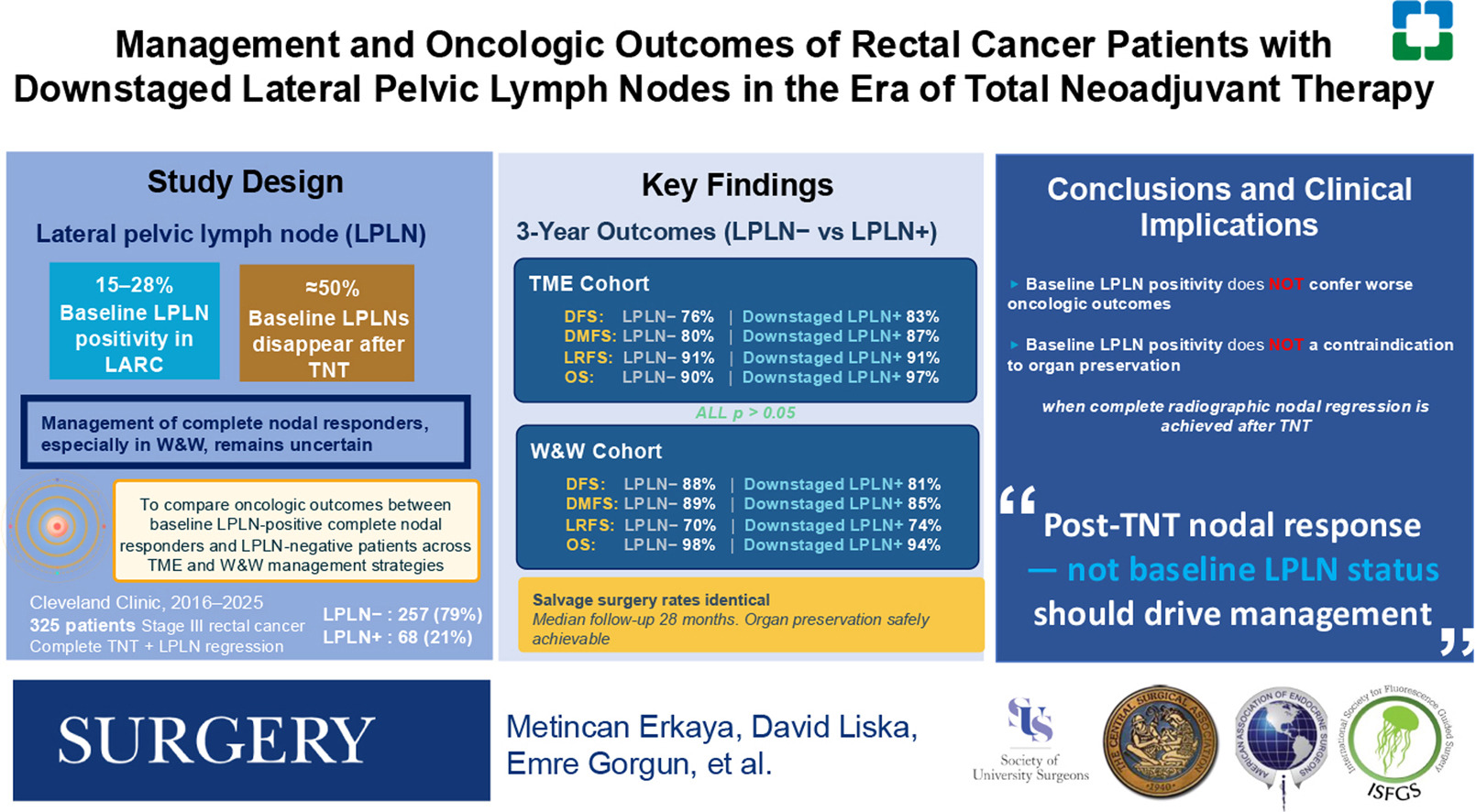
Among the 325 patients, 68 (21%) had initially positive LPLNs that completely responded to TNT, while 257 (79%) were initially LPLN-negative. The LPLN-positive group had larger tumors (median 6 cm vs. 5 cm, P = .003) and a higher proportion of low-lying rectal tumors (62% vs. 39%, P = .004), highlighting more advanced disease at baseline.
Surgical Cohort Outcomes (n=226)
In patients who underwent surgery, three-year DFS was similar between groups (83% in LPLN-positive vs. 80% in LPLN-negative, P > .05). Other outcomes, including DMFS (87% vs. 80%), local recurrence-free survival (91% vs. 91%), and OS (97% vs. 90%), showed no statistically significant differences. These results suggest that complete LPLN downstaging post-TNT can mitigate the adverse impact of baseline nodal positivity on oncologic outcomes.
Watch-and-Wait Cohort Outcomes (n=99)
Among patients managed nonoperatively with watch-and-wait, salvage surgery rates were equivalent (19% vs. 19%, P = .99). Three-year DFS (81% vs. 88%), DMFS (85% vs. 89%), local regrowth-free survival (74% vs. 70%), and OS (94% vs. 98%) were statistically comparable between LPLN-positive and LPLN-negative groups. These findings support the safety of organ preservation in patients who achieve nodal complete response after TNT.
Expert Commentary
This study addresses a critical knowledge gap in rectal cancer management by providing contemporary data on the prognostic significance of downstaged LPLNs after TNT. The equivalence in survival and control outcomes challenges the traditional paradigm that baseline LPLN involvement mandates aggressive surgical dissection. Instead, post-TNT imaging findings appear more predictive of patient prognosis.
Experts emphasize that meticulous MRI assessment and multidisciplinary evaluation are crucial to safely stratify patients for watch-and-wait strategies. Nevertheless, larger prospective studies and longer follow-up are needed to validate these findings and clarify optimal follow-up surveillance protocols.
Potential limitations include retrospective design and single-center experience, which may limit generalizability. Variability in MRI interpretation and treatment regimens might also influence applicability across diverse clinical settings.
Conclusion
In rectal cancer patients with initially positive LPLNs who achieve complete radiographic remission after TNT, baseline LPLN positivity does not portend adverse oncologic outcomes. Post-treatment nodal status should play a pivotal role in tailoring management strategies, allowing selective omission of lateral pelvic lymph node dissection and expansion of organ preservation approaches without compromising survival or local control. These findings support more personalized and less morbid treatment paradigms in the era of TNT.
Funding and ClinicalTrials.gov
The study did not report specific funding sources. Clinical trial registration information was not provided.
References
- Erkaya M, Oruc M, Hammad AF, et al. Management and oncologic outcomes of rectal cancer patients with downstaged lateral pelvic lymph nodes in the era of total neoadjuvant therapy. Surgery. 2026 Sep 3;110621. PMID: 42805858.
- Kawada K, Shiomi A, Tamura T, et al. Optimal management of lateral pelvic lymph nodes in locally advanced rectal cancer. Int J Clin Oncol. 2021;26(2):287-293.
- Kim MJ, Jeong SY. Clinical significance of lateral pelvic lymph node metastasis in rectal cancer. Ann Coloproctol. 2019;35(6):302-307.
- Smith JJ, Ruby JA, Goodman KA, et al. Nonoperative management of rectal cancer with complete clinical response after neoadjuvant chemoradiation. Ann Surg. 2012;256(6):965-972.