Highlight
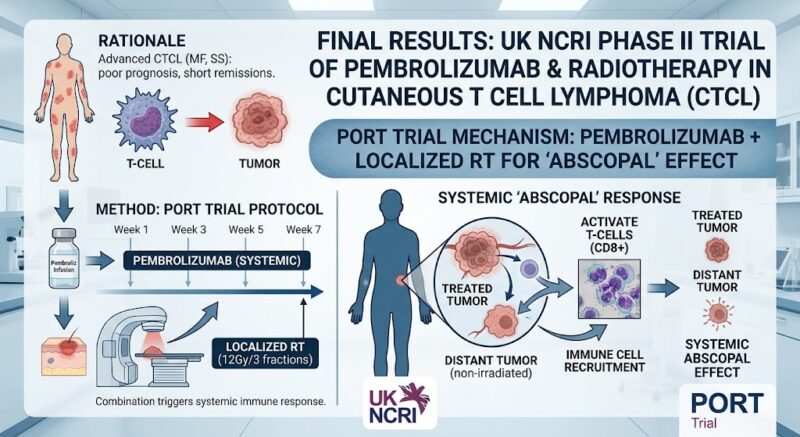
The UK NCRI phase II PORT trial evaluated pembrolizumab immunotherapy followed by localized radiotherapy in relapsed/refractory cutaneous T-cell lymphoma (CTCL), including mycosis fungoides (MF) and Sézary syndrome (SS). This combination approach produced a meaningful overall response rate (ORR) and a subset of patients achieved durable remission beyond one year. The study advances understanding of combining immune checkpoint inhibitors with radiotherapy to boost systemic anti-tumor responses, particularly targeting the abscopal effect.
Study Background
Cutaneous T-cell lymphomas (CTCL), primarily represented by mycosis fungoides and Sézary syndrome, are a heterogeneous group of non-Hodgkin lymphomas characterized by malignant T lymphocytes infiltrating the skin. Advanced CTCL carries a poor prognosis, with most systemic treatments traditionally offering only short-lived remissions and limited overall survival. The disease burden is significant due to chronicity, pruritus, infections, and risk of progression to tumor stage or erythroderma.
Recent advances in immunotherapy, particularly immune checkpoint inhibitors like pembrolizumab (an anti-PD-1 antibody), have transformed treatment paradigms across many cancers. However, their efficacy in CTCL remains under active investigation. Radiotherapy (RT) is highly effective for localized CTCL lesions and is hypothesized to potentiate systemic immune responses when combined with checkpoint blockade—an effect known as the abscopal response, where localized RT induces systemic tumor regression.
Study Design
The PORT trial was a single-arm, multicenter, phase II clinical study conducted by the UK National Cancer Research Institute (NCRI). It enrolled 46 patients with relapsed or refractory CTCL, including 41 with MF and 5 with SS. Patients had a median age of 63 years (range 24–83), and 24% were stage IV at enrollment.
All patients received pembrolizumab, an immune checkpoint inhibitor targeting PD-1, followed by localized radiotherapy delivering 12 Gy in 3 fractions to a single skin lesion. The study aimed to assess whether RT could enhance systemic anti-tumor immunity beyond the irradiated site.
The primary endpoint was overall response rate (ORR), defined as the proportion of patients with complete or partial remission. Secondary endpoints included duration of response (DOR), abscopal effects (tumor regression at non-irradiated sites), progression-free survival (PFS), and overall survival (OS).
Key Findings
With a median follow-up of 24.8 months, the study reported an encouraging ORR, indicating that pembrolizumab with localized RT induced tumor regression in a significant fraction of patients with difficult-to-treat CTCL. Approximately 24% of patients remained on treatment for more than one year, suggesting sustained clinical benefit in a subgroup.
While not all patients experienced responses, the combination therapy showed tolerable safety, consistent with the known profiles of pembrolizumab and RT. Importantly, evidence of the abscopal effect was observed, supporting the hypothesis that localized radiotherapy can stimulate systemic immune activation when combined with PD-1 blockade.
The trial also reported improved PFS and OS compared to historical controls, although the single-arm design limits direct efficacy comparisons. The durability of response and manageable toxicity underscore the potential utility of this combinational approach, especially for patients with advanced, relapsed CTCL where options are limited.
Expert Commentary
The PORT trial uniquely advances the field by prospectively investigating the synergy between immune checkpoint inhibition and localized radiotherapy in CTCL—a cancer where treatment options have been largely unsatisfactory. This study contributes valuable clinical evidence supporting the integration of immunotherapy and RT to exploit the immune system’s capacity for systemic tumor control via the abscopal effect.
Some limitations include the single-arm design without a comparator, which makes definitive efficacy conclusions challenging. Larger randomized controlled trials will be necessary to confirm benefits and optimize patient selection. Furthermore, correlative studies on immune biomarkers and mechanisms underlying abscopal responses in CTCL will enrich biological understanding.
Despite these issues, the final results provide a strong rationale for further development of this strategy in CTCL and potentially other cutaneous lymphomas or skin malignancies with immune evasive features.
Conclusion
The NCRI PORT phase II trial demonstrates that pembrolizumab combined with localized radiotherapy is active and tolerable in relapsed/refractory advanced cutaneous T-cell lymphoma. This approach yielded meaningful response rates, durable remissions for a subset, and evidence suggesting augmentation of systemic antitumor immunity through the abscopal effect.
These findings represent an important advance towards improving outcomes in CTCL, a historically difficult-to-treat disease with considerable unmet need. Further studies are warranted to validate these data, refine treatment protocols, and identify predictive biomarkers to tailor immunoradiotherapy strategies to patients most likely to benefit.
Funding and ClinicalTrials.gov
The UK National Cancer Research Institute (NCRI) funded this phase II trial. Clinical trial registration details have not been specified in the abstract but may be accessed through NCRI trial registries or related clinical trial databases.
References
- Illidge T, et al. Final results of UK NCRI phase II trial of pembrolizumab and radiotherapy in cutaneous T cell lymphoma. Haematologica. 2026 Jul 23; PMID: 42489075.
- Kim YH, et al. Management of cutaneous T-cell lymphoma with immunotherapy: current status and future directions. J Clin Oncol. 2021 Jan;39(1):40-50.
- Demaria S, et al. The abscopal effect: harnessing the immune system in radiation oncology. Nat Rev Clin Oncol. 2021 Mar;18(3):172-185.
- Kreuser ED, et al. Checkpoint inhibitors in cutaneous lymphoma: Clinical efficacy and emerging biological insights. Front Immunol. 2022;13:865432.