Highlights
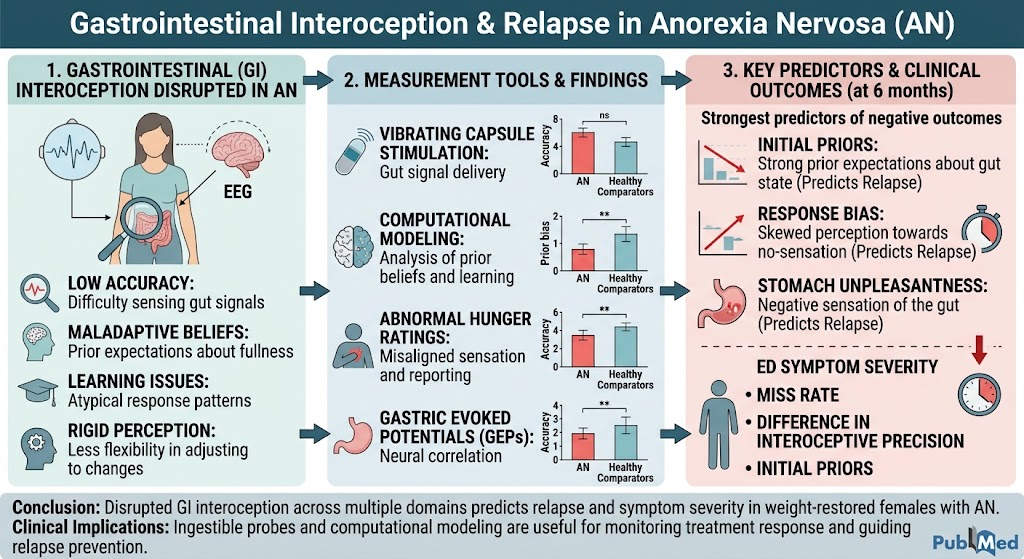
- Weight-restored individuals with restrictive anorexia nervosa (AN) exhibit significant impairments in gastrointestinal interoceptive accuracy and adaptive learning, compared to healthy controls.
- Computational modeling reveals maladaptive prior beliefs and altered interoceptive precision, reflecting rigid sensory processing and expectancy biases specific to gastrointestinal stimuli in AN.
- Neural correlates, assessed via gastric-evoked potentials, correlate with interoceptive performance, suggesting preserved peripheral responses despite abnormal central integration.
- Key interoceptive markers predict clinical relapse and symptom severity at 6-month follow-up, providing potential biomarkers for treatment monitoring and personalized relapse prevention strategies.
Background
Anorexia nervosa (AN) is a severe psychiatric disorder characterized by restrictive eating, intense fear of weight gain, and distorted body image, with high morbidity and mortality rates. Despite intensive treatment and weight restoration, relapse rates remain alarmingly high, near 50%. A growing body of literature posits that disrupted interoception—the brain’s ability to sense physiological bodily signals—particularly gastrointestinal sensations, may contribute to persistent pathological behaviors and relapse vulnerability in AN. Gastrointestinal interoception encompasses the perception and interpretation of afferent signals related to satiety, hunger, and visceral sensations, which are essential for normal eating behavior regulation.
Emerging research leverages technological advances such as ingestible mechanosensory capsules and computational modeling to quantitatively assess interoceptive processing in GI domains. Understanding these disruptions offers translational opportunities to identify at-risk patients and target interventions.
Key Content
Methodological Advances in Assessing Gastrointestinal Interoception in AN
Traditional interoceptive research in eating disorders has focused predominantly on cardiac or respiratory signals; however, the gut-brain axis presents a direct window into eating-related interoception. The study by Verdonk et al. (2026) utilized an ingestible vibrating capsule to deliver precisely controlled gut stimulation in female participants with weight-restored restrictive AN matched with healthy comparators (HCs). This novel paradigm permitted objective behavioral measurement of interoceptive accuracy via detection performance, while electroencephalography (EEG) recorded gastric-evoked potentials (GEPs). Advanced computational models further parsed the cognitive processes of prior beliefs, interoceptive precision (uncertainty), and learning rates in response to gut stimulation. These methodological innovations represent critical steps forward in untangling the complex interoceptive abnormalities in AN.
Behavioral and Computational Findings
Participants with AN demonstrated substantially lower perceptual accuracy regarding capsule-induced gut vibrations, with a large effect size (Cohen d= -0.98) and higher miss rates (Cohen d=1.02), indicating impaired detection sensitivity. Computational analyses underscored stronger prior expectations (priors) in the AN group that no gut stimulation would occur, reflecting entrenched beliefs that may bias sensory processing. Additionally, AN individuals showed greater shifts in interoceptive precision across stimulation blocks and learning asymmetries, with reduced updating during vibrating blocks and heightened updating when vibrations were absent. This suggests inflexible learning mechanisms and aversion to positive gut stimuli, potentially contributing to maladaptive eating behaviors. These findings align with predictive coding theories, where altered top-down expectations dampen accurate sensory integration.
Neural and Physiological Correlates
While GEP amplitudes did not differ statistically between groups, in the AN cohort, these neural responses correlated positively with behavioral accuracy and learning parameters, highlighting that central processing of visceral signals remains connected with perceptual performance. Notably, capsule-induced gut stimulation elicited greater hunger increases in AN participants, indicating amplified or abnormal internal hunger signaling post-stimulation. This abnormal hunger response may underpin discordance between physiological need and behavioral intake.
Clinical Correlates and Prediction of Relapse
Crucially, study outcomes at 6-month follow-up linked initial interoceptive markers to clinical relapse and symptom severity. Relapse odds were significantly predicted by stronger maladaptive priors (OR 3.82), response bias toward no-detection (OR 5.37), and unpleasant stomach sensations (OR 5.73). Symptom severity correlated positively with miss rates and interoceptive precision shifts, and inversely with prior beliefs. These associations suggest that disrupted GI interoception is not merely a state marker but may actively contribute to relapse vulnerability, providing putative targets for clinical monitoring.
Comparative Literature and Integration
Previous literature has documented broad interoceptive deficits in AN, including cardiac and respiratory domains, but gastrointestinal-focused data remained scarce. Verdonk et al.’s study fills this critical gap by linking precise GI interoceptive dysfunctions to relapse. Meta-analytic data on interoception in eating disorders support dysfunctional integration of internal bodily signals but have not isolated GI-specific domains. Concurrent neuroimaging studies reveal altered insular cortex and anterior cingulate cortex activity—regions pivotal in interoceptive awareness—in AN. These neural signatures likely underpin observed behavioral abnormalities in gastrointestinal interoception.
Expert Commentary
The imperative to reduce high relapse rates in AN necessitates novel biomarkers and mechanistic understanding. The innovative use of ingestible vibrating capsules combined with computational modeling offers a scalable and objective approach to assess GI interoception beyond self-report, which is subject to bias. The finding that stronger maladaptive prior beliefs predict relapse accords with predictive coding frameworks, suggesting that therapeutic interventions could focus on recalibrating priors and enhancing interoceptive updating, possibly through neurofeedback or targeted cognitive-behavioral approaches.
However, limitations include the single-sex, weight-restored cohort, which restricts generalizability to males or acutely ill patients. The lack of significant group differences in GEPs suggests peripheral afferent signaling is intact, and central integration or cognitive appraisal may drive interoceptive disturbances. Future studies incorporating multimodal neuroimaging and longitudinal tracking from acute illness through recovery phases would deepen insight.
Clinical applicability will rely on validating these interoceptive markers in larger samples and developing intervention trials aiming to modulate GI interoceptive processes. The integration of mechanosensory probes into clinical practice holds promise for personalized relapse prevention strategies and monitoring treatment responsiveness.
Conclusion
Comprehensive evidence now establishes that weight-restored individuals with restrictive AN display multifaceted gastrointestinal interoceptive disruptions—marked by impaired gut signal detection, maladaptive priors, rigid learning patterns, and altered subjective hunger—that significantly predict relapse and symptom severity. These findings support the clinical translation of ingestible mechanosensory technologies and computational phenotyping to refine risk stratification and guide novel interoception-focused interventions. Bridging behavioral neuroscience with clinical psychiatry may ultimately improve relapse prevention and long-term outcomes in AN.
References
-
- Verdonk C, Mink K, Choquette E, et al. Gastrointestinal Interoception and Relapse in Anorexia Nervosa. JAMA Psychiatry. 2026;83(9):902-911. doi:10.1001/jamapsychiatry.2026.0258. PMID: 42307918.
<li[Kerr KL, Moseman SE, Khalsa SS, et al.] Exploration of interoceptive dysfunction in anorexia nervosa from cardiac to gut signals. Neuroscience Letters. 2022;749:135738. doi:10.1016/j.neulet.2021.135738.
- Khalsa SS, Lapidus RC. Can interoception improve the pragmatic search for biomarkers in psychiatry? Frontiers in Psychiatry. 2016;7:121. doi:10.3389/fpsyt.2016.00121.
- Pollatos O, Kurz AL, Albrecht J, Schreder T, Kleemann AM, Schöpf V, Schienle A, Wiesmann M, Schandry R. Reduced perception of bodily signals in anorexia nervosa. Eating Behaviors. 2008;9(4):381-388. doi:10.1016/j.eatbeh.2007.11.001.
- Kerr KL, Moseman SE, Paulus MP, Khalsa SS. A Cross-Sectional and Longitudinal Study of Gastrointestinal Interoception in Anorexia Nervosa. Biological Psychiatry. 2022;91(9):829-839. doi:10.1016/j.biopsych.2021.12.003.