Highlight
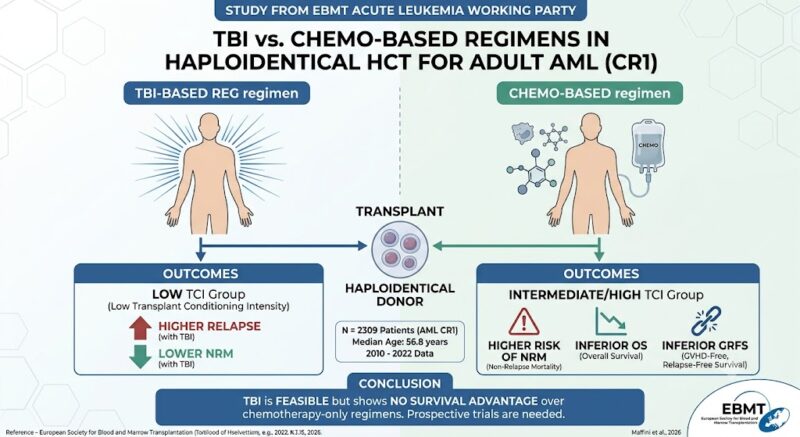
- In adults with acute myeloid leukemia (AML) undergoing haploidentical hematopoietic cell transplantation (HCT) in first remission, total body irradiation (TBI)-based conditioning is feasible but does not outperform chemotherapy-only regimens in terms of overall survival.
- For patients receiving low transplant conditioning intensity (TCI), TBI regimens resulted in higher relapse risk but lower non-relapse mortality (NRM) compared to chemotherapy.
- In intermediate to high TCI settings, TBI was associated with increased NRM and worse overall and graft-versus-host disease-free relapse-free survival (GRFS), indicating a potentially detrimental effect in this subgroup.
- The findings emphasize the need for prospective trials to define the optimal conditioning approach for haploidentical HCT in AML.
Study Background
Acute myeloid leukemia (AML) is an aggressive hematologic malignancy characterized by clonal proliferation of myeloid precursors. Allogeneic hematopoietic cell transplantation (HCT) provides a potentially curative option, especially when performed in first complete remission. Haploidentical related donor transplantation has expanded donor availability and become increasingly common due to improved graft-versus-host disease (GVHD) prophylaxis and transplantation techniques. Conditioning regimens are critical to eliminate residual leukemic cells and facilitate engraftment; these typically include total body irradiation (TBI)-based or chemotherapy-based approaches.
TBI achieves systemic radiation exposure destroying malignant and normal hematopoietic cells, whereas chemotherapy-based regimens use immunosuppressive agents without radiation. Despite their different toxicity profiles, it remains uncertain whether TBI-based conditioning confers superior outcomes compared with chemotherapy-based regimens in haploidentical HCT for AML. This retrospective registry analysis addresses this clinical question using data from the Acute Leukemia Working Party (ALWP) of the European Society for Blood and Marrow Transplantation (EBMT).
Study Design
This investigation comprised a retrospective cohort analysis of 2309 adult patients (age 18 to 82 years, median 56.8 years) with AML in first complete remission undergoing haploidentical allogeneic HCT from 2010 through 2022. Data were sourced from the EBMT ALWP database, encompassing multiple European transplant centers.
Patients were stratified by the conditioning regimens used: total body irradiation (TBI)-based versus chemotherapy (chemo)-based protocols. Conditioning intensity was quantified using the transplant conditioning intensity (TCI) score, categorized as low (TCI 1–2) or intermediate/high intensity (TCI 2.5–6). The primary endpoints were overall survival (OS), relapse, non-relapse mortality (NRM), and graft-versus-host disease-free relapse-free survival (GRFS).
Multivariate analyses adjusted for confounders including age, disease risk, graft source, and transplantation year to assess the impact of conditioning regimen on transplant outcomes.
Key Findings
The large cohort included 2309 patients and allowed subgroup analyses according to conditioning intensity.
Low Intensity Conditioning (TCI 1–2)
– Patients receiving TBI-based conditioning exhibited a significantly higher risk of disease relapse compared with chemotherapy (hazard ratio [HR] 1.49; 95% confidence interval [CI] 1.03–2.16; p=0.033).
– Conversely, TBI was associated with a lower risk of non-relapse mortality (NRM) versus chemotherapy (HR 0.56; 95% CI 0.36–0.89; p=0.013).
– These contrasting effects suggest that although TBI in low intensity conditioning reduces early transplant-related deaths, it may not optimally suppress residual leukemia.
Intermediate to High Intensity Conditioning (TCI 2.5–6)
– TBI conditioning significantly increased the risk of non-relapse mortality (HR 1.71; 95% CI 1.07–2.74; p=0.026), indicating higher toxicity or complications.
– TBI was associated with inferior overall survival (HR 1.61; 95% CI 1.08–2.42; p=0.02).
– Similarly, graft-versus-host disease-free relapse-free survival (GRFS) was worse with TBI (HR 1.43; 95% CI 1.03–1.95; p=0.034), suggesting increased morbidity.
These outcomes imply that high-intensity TBI-based regimens may impart excessive toxicity overshadowing any anti-leukemic efficacy.
General Observations
– The study confirms that TBI-conditioned haploidentical HCT is feasible across a wide adult age range in AML.
– Despite feasibility, no clear survival advantage was observed for TBI-based regimens compared with chemotherapy-alone approaches.
– The differential effects based on conditioning intensity highlight the nuanced balance between disease control and treatment-related toxicity.
Expert Commentary
Haploidentical HCT has become an important modality to overcome donor shortages. Conditioning regimen selection remains crucial, balancing leukemia eradication and toxicity.
The results contrast with data from matched sibling or unrelated donor HCT settings where TBI sometimes shows improved outcomes, suggesting donor source and graft dynamics influence regimen efficacy. Additionally, emerging GVHD prophylaxis strategies such as post-transplant cyclophosphamide may variably interact with conditioning types.
Limitations include the retrospective design and registry data heterogeneity, which may introduce selection biases and confounding. Detailed information on TBI dosimetry, chemotherapy agents, and supportive care protocols were not fully captured.
Prospective randomized clinical trials comparing TBI versus chemotherapy conditioning in the haploidentical HCT setting are urgently needed to define optimal standards.
Conclusion
This comprehensive EBMT registry analysis reveals that in adult AML patients undergoing haploidentical HCT in first complete remission, TBI-based conditioning regimens are feasible but offer no clear survival benefit compared to chemotherapy-based regimens. The risk–benefit profile varies by conditioning intensity with TBI showing higher relapse risk at low intensity but greater toxicity at higher intensities. These findings underscore the importance of individualized conditioning selection and mandate prospective studies to optimize transplantation outcomes in this evolving field.
Funding and Clinical Trial Registration
The study utilized data from the EBMT ALWP registry. Specific funding sources and clinical trial registrations were not detailed in the reported publication.
References
1. Maffini E, Labopin M, Raiola AM, et al. Allogeneic hematopoietic cell transplantation from haploidentical donors with total body irradiation versus chemo-based regimens for adult AML patients in first complete remission. Bone Marrow Transplant. 2026 Jul 20. PMID: 42477157.
2. Locatelli F, Pagliara D. The ever-increasing role of haploidentical stem cell transplantation in hematologic malignancies. Blood. 2016.
3. Bacigalupo A, et al. Conditioning regimens and GVHD prophylaxis in haploidentical transplantation. Curr Hematol Malig Rep. 2019.
4. Pasquini MC, et al. Outcomes of patients with AML receiving matched unrelated donor or haploidentical donor transplantation: conditioning regimen considerations. Biol Blood Marrow Transplant. 2018.