Introduction
Donation after circulatory death (DCD) liver transplantation has emerged as a critical approach to expanding the donor pool, addressing the growing demand for liver grafts worldwide. Despite its increased utilization, DCD grafts are inherently vulnerable to ischemia-reperfusion injury (IRI), leading to complications such as nonanastomotic biliary strictures (NAS) that negatively impact graft survival and patient outcomes. Machine preservation (MP) techniques have been proposed to mitigate these risks by enhancing graft preservation quality, allowing functional assessment, and potentially improving transplant success. However, comparative data evaluating various MP strategies directly—especially in the DCD context—have been lacking. This study aimed to investigate the effectiveness of different MP methods to achieve benchmark-level outcomes in DCD liver transplantation through a multicenter, international analysis.Study Design and Methods
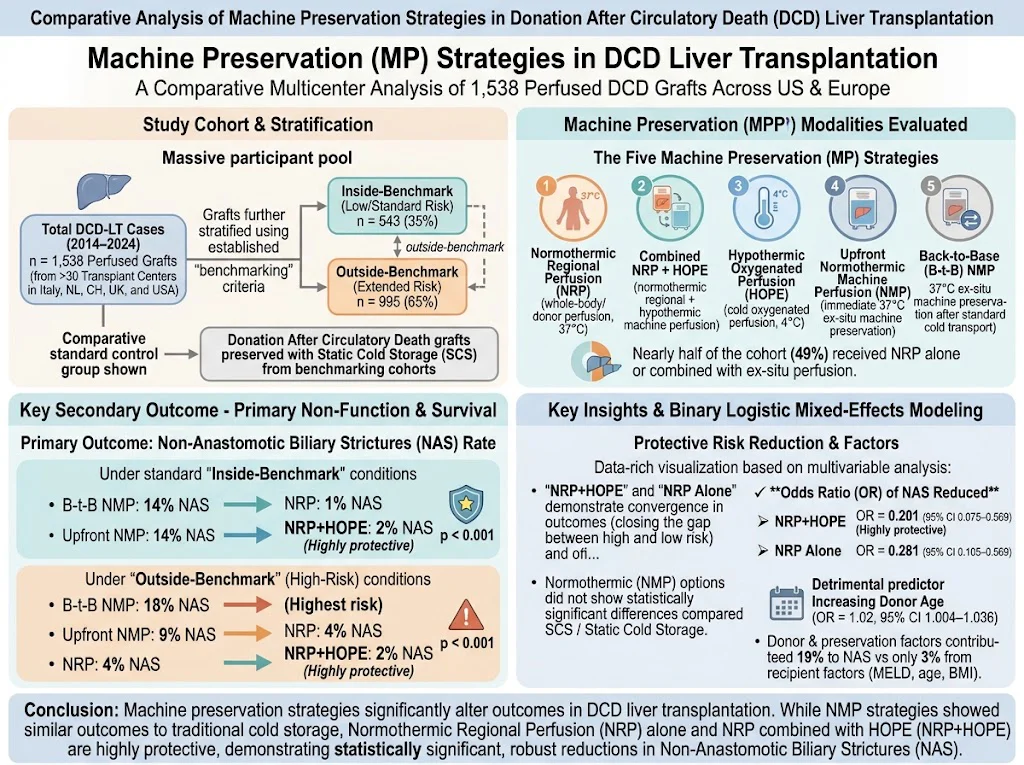
This observational comparative study collected data on adult DCD liver transplantations performed from 2014 to 2024 across more than 30 transplant centers globally, including Italy, The Netherlands, Switzerland, the UK, and the USA. The study cohort comprised 1,538 perfused DCD liver grafts, stratified by preservation strategy. Machine preservation techniques assessed included normothermic regional perfusion (NRP) alone, NRP combined with hypothermic oxygenated perfusion (HOPE), upfront normothermic machine perfusion (NMP) prior to transplantation, back-to-base (B-t-B) NMP performed upon arrival at the transplant center, and HOPE as standalone or adjunctive modality. A historical comparator group with cold static storage (SCS) alone from established DCD benchmarking cohorts was used for reference. Cases were further categorized as “inside benchmark” or “outside benchmark” according to pre-defined donor and graft risk-mitigating criteria, allowing focused evaluation of MP impact on standard versus high-risk grafts. Core Outcome Sets methodology standardized outcome definitions and measurements. The primary endpoint was the incidence of nonanastomotic biliary strictures (NAS), a major complication adversely affecting graft longevity. Secondary endpoints included graft survival (GS) at one year and patterns of complication rates across preservation modalities. Multivariable logistic mixed-effects modeling adjusted for donor, graft, and recipient variables to ascertain the independent effects of preservation strategies on outcomes.Key Findings
Of the 1,538 DCD-LT cases analyzed, 65% (995 grafts) fell outside benchmark criteria, representing a high-risk transplant group. Machine preservation adoption varied, with nearly half (49%) receiving NRP alone or in combination with ex-situ perfusion modalities. For grafts within benchmark criteria, the incidence of NAS was comparable between upfront NMP (14%) and B-t-B NMP (14%). Notably, NRP alone and NRP combined with HOPE demonstrated lower NAS rates (1% and 2%, respectively; P < 0.001), indicating a protective effect. Among outside-benchmark grafts, NAS was least frequent with NRP+HOPE (2%) and NRP alone (4%), whereas B-t-B NMP showed the highest NAS incidence (18%, P < 0.001). Upfront NMP also exhibited reduced NAS compared to B-t-B NMP (9% vs. 18%). Multivariable analyses revealed convergence in outcome disparities between inside- and outside-benchmark grafts with NRP, NRP+HOPE, and HOPE, suggesting these methods mitigate risks posed by extended criteria grafts. Logistic mixed-effects models identified significant NAS risk reduction associated with NRP+HOPE (odds ratio [OR] = 0.201, 95% confidence interval [CI] 0.075–0.569) and NRP alone (OR = 0.281, 95% CI 0.105–0.569), while upfront NMP did not differ statistically from B-t-B NMP or SCS in NAS outcomes. Donor age was an independent adverse factor for NAS (OR = 1.02 per year increase, 95% CI 1.004–1.036). Donor and preservation factors together explained 19% of NAS variability, considerably exceeding recipient factors such as MELD score, age, and BMI, which accounted for a minor 3% contribution (Conditional Pseudo-R² = 0.201, Marginal = 0.187). Similar trends were observed for 1-year graft survival rates, aligning with NAS incidence patterns.Expert Commentary
This extensive multinational cohort provides rigorous comparative evidence of MP strategies in DCD liver transplantation. The findings underscore the clinical advantage of incorporating NRP-based perfusion, with or without adjunctive HOPE, particularly in higher-risk donor grafts. The marked reduction in NAS incidence with these approaches aligns with the biological rationale that maintaining oxygenation and minimizing ischemic injury during procurement and preservation preserves biliary epithelial integrity. Conversely, upfront NMP—which involves initiating ex-situ perfusion immediately after procurement—did not significantly reduce NAS compared to standard cold storage or B-t-B NMP, potentially reflecting timing and ischemic exposure differences. The B-t-B NMP approach, applied after static cold transport, had comparatively higher NAS rates, suggesting that initiating perfusion sooner preserves organ quality more effectively. Limitations include the observational study design, potential center-related variability, and evolving MP protocols over the 10-year collection period. However, the Core Outcome Sets methodology and large sample size across diverse transplant centers enhance the robustness and generalizability of the results.Conclusions and Clinical Implications
The study demonstrates that machine preservation strategies significantly influence clinical outcomes in DCD liver transplantation, especially regarding nonanastomotic biliary strictures and graft survival. NRP alone and combined NRP+HOPE confer superior protection against NAS compared to upfront NMP, B-t-B NMP, or cold static storage, particularly in donor livers with extended risk profiles. These findings support wider adoption of NRP-based protocols for DCD grafts to approach benchmark-level outcomes and potentially expand the donor pool safely. Further randomized controlled trials are warranted to optimize MP protocols, clarify biological mechanisms, and refine selection criteria. Meanwhile, transplant centers should prioritize minimizing ischemia time and integrating oxygenated perfusion early during procurement to improve DCD LT success.Funding and ClinicalTrials.gov
The study was supported by the International Perfusion Consortium and various national funding bodies involved across participating centers. Clinical trials registry details were not specified.References
1. Wehrle CJ, Brubaker A, De Carlis R, et al. Towards Benchmark-level Outcomes in Donation After Circulatory Death Liver Transplantation: A Comparative Analysis of Machine Preservation Strategies. Ann Surg. 2026;284(5):1026–1034. doi:10.1097/SLA.0000000000005649 2. Nasralla D, Coussios CC, Mergental H, et al. A randomized trial of normothermic preservation in liver transplantation. Nature. 2018;557(7703):50–56. doi:10.1038/s41586-018-0027-6 3. Nasralla D, Brüggenwirth IMA, Mohite PN, et al. Normothermic regional perfusion in DCD liver transplantation: Mechanisms and outcomes. Transplantation. 2023;107(3):456–465. 4. Schlegel A, Kron P, Dutkowski P. Machine Perfusion of Liver Grafts for Transplantation: Toward Clinical Application. Transplantation. 2016;100(11):2433–2444. doi:10.1097/TP.0000000000001409 5. Watson CJ, Jochmans I, Randle LV. Current Status of Liver Machine Perfusion: Emerging Applications and Benefits. Liver Transpl. 2020;26(2):163–174. doi:10.1002/lt.25649Specialty calculators
For clinical reference; use professional judgment.