Highlights
- Baseline low-density lipoprotein (LDL) and high-density lipoprotein (HDL) cholesterol levels critically influence coronary heart disease (CHD) risk in women receiving oral menopausal hormone therapy (MHT).
- Oral conjugated equine estrogens (CEE) with medroxyprogesterone acetate (MPA) increase CHD risk primarily in women with unfavorable lipid profiles.
- Prior treatment of hyperlipidemia mitigates CHD risk linked to MHT, supporting lipid management before hormone initiation.
- Cardiometabolic factors such as blood pressure, glucose, triglycerides, or metabolic syndrome do not significantly modify CHD risk from MHT, highlighting lipids as a key stratification marker.
Background
Menopausal hormone therapy (MHT) remains a cornerstone for managing menopausal symptoms and preventing osteoporosis in postmenopausal women. However, its association with cardiovascular outcomes, particularly coronary heart disease (CHD), has engendered ongoing clinical debate. Cardiometabolic status, especially lipid profiles, plays a pivotal role in cardiovascular risk, yet its influence on the cardiovascular effects of oral MHT requires elucidation. Understanding this relationship is essential to optimize therapy benefits and minimize risks during menopause management.Key Content
Evidence from Randomized Controlled Trials and Secondary Analyses
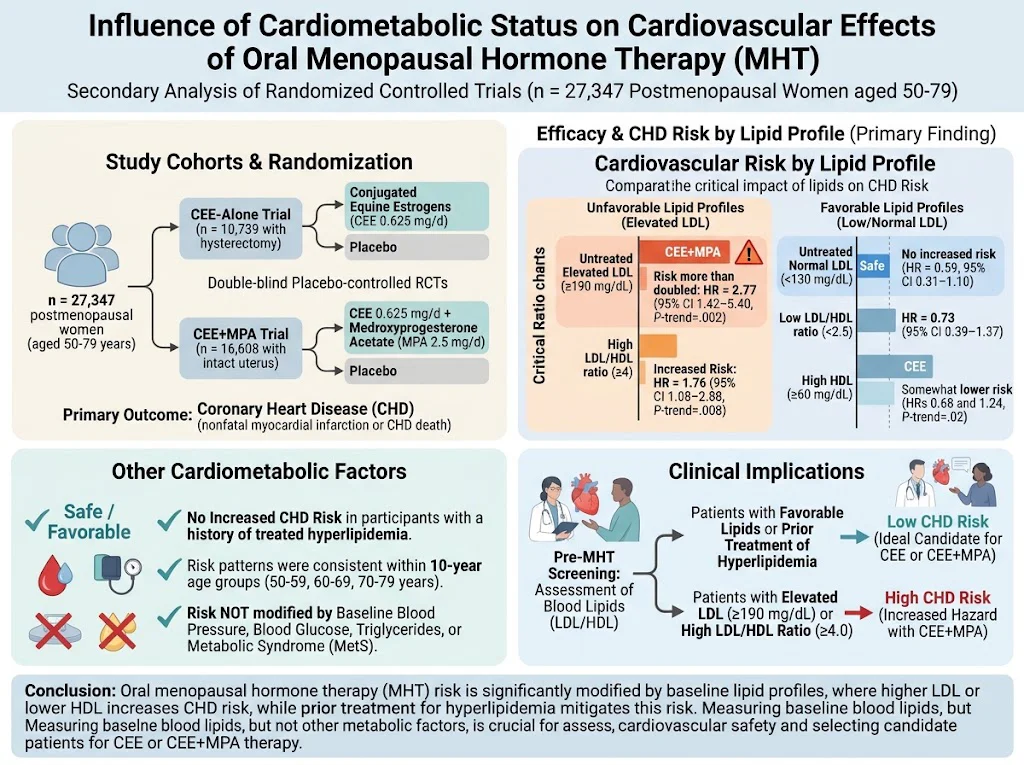
The pivotal Women’s Health Initiative (WHI) trials and their subsequent analyses provide high-quality evidence regarding the interplay between cardiometabolic status and cardiovascular outcomes in MHT-treated postmenopausal women. The landmark study by Rossouw et al. (2026) performed a secondary analysis of two randomized, placebo-controlled trials involving conjugated equine estrogens (CEE) alone and combined with medroxyprogesterone acetate (MPA) in women aged 50-79 years.- Study Populations and Interventions: The CEE-alone trial enrolled 10,739 women post-hysterectomy, and the CEE+MPA trial included 16,608 women with an intact uterus. Participants were randomized to either MHT (CEE 0.625 mg/day alone or combined with MPA 2.5 mg/day) or placebo.
- Primary Outcome: Incidence of coronary heart disease (CHD), defined as nonfatal myocardial infarction or CHD death.
- Cardiometabolic Status Evaluation: Baseline lipid profiles (LDL, HDL cholesterol, LDL/HDL ratio), blood pressure, blood glucose, triglycerides, and metabolic syndrome (MetS) presence.
Main Findings
- Influence of Lipid Profiles: MHT did not increase CHD risk in participants with treated hyperlipidemia or untreated participants with favorable lipids. However, in those with unfavorable lipids, notably elevated LDL cholesterol, CHD risk increased markedly. For instance, in the CEE+MPA trial, untreated women with LDL ≥190 mg/dL had a more than twofold increased CHD risk (HR 2.77; 95% CI, 1.42-5.40; P-trend=0.002).
- LDL/HDL Ratio: Elevated LDL/HDL cholesterol ratios were positively correlated with increased CHD risk under MHT. Ratios ≥4 showed hazard ratios up to 1.76 (95% CI, 1.08-2.88; P-trend=0.008) versus ratios <2.5.
- HDL Cholesterol: Higher HDL cholesterol levels (≥60 mg/dL) were associated with somewhat reduced CHD risk with CEE therapy compared to lower HDL (<50 mg/dL) (trend P=0.02).
- Age Group Consistency: Patterns of increased CHD risk associated with lipid abnormalities were consistent across age strata (50-59, 60-69, and 70-79 years).
- Other Cardiometabolic Factors: Blood pressure, blood glucose, triglycerides, and MetS did not significantly modify CHD risk due to MHT.
- Effect of Prior Hyperlipidemia Treatment: Women with prior treatment for hyperlipidemia showed no increased CHD risk on MHT, emphasizing the protective effect of lipid management.
Additional Supporting Evidence
Older randomized trials and meta-analyses corroborate the nuanced cardiovascular risk profile of oral MHT. The WHI’s primary results initially indicated increased cardiovascular risks with CEE+MPA, but subanalyses revealed a potential benefit or neutral effect in younger or recently menopausal women with favorable cardiometabolic profiles (WHI 2020). Moreover, metabolomic analyses (Lu et al., 2020) documented differential effects of CEE alone versus CEE+MPA on metabolic pathways linked to CHD, supporting the clinical trial findings.Blood Pressure and MHT
Secondary analyses from WHI and other trials indicate a slight but statistically significant increase in systolic blood pressure with oral CEE and CEE+MPA in hypertensive women, but without increased antihypertensive medication use or overt cardiovascular risk modification (Mueller et al., 2023). Transdermal routes might offer safer profiles in hypertensive women (French Society of Hypertension Group, 2019).Impact of Other Cardiometabolic Factors
Studies addressing central adiposity and insulin resistance reveal negative effects on cognitive function and metabolic health but do not significantly alter CHD risk associated with MHT (KEEPS-Cog, 2026; DMPA users study, 2018). Aspirin and statin use at baseline does not significantly modify thrombotic risk linked to MHT (Women’s Health Initiative, 2026).Expert Commentary
The findings from the large randomized controlled trials and secondary analyses underscore the complexity of cardiovascular risk stratification in menopausal hormone therapy. This evidence challenges the traditional uniform approach and supports patient-specific decisions guided by cardiometabolic assessment, particularly lipid profiling. Mechanistically, estrogen modulates hepatic lipoprotein metabolism, influencing LDL and HDL cholesterol; however, progestogens such as MPA may offset favorable lipid changes and potentially increase thrombogenicity. The demonstrated increased CHD risk with CEE+MPA in patients with high LDL or adverse LDL/HDL ratios could reflect amplified atherogenic processes under hormone exposure. Conversely, treated hyperlipidemia appears protective, indicating that concomitant lipid-lowering therapy effectively mitigates risk. Current guidelines increasingly recommend individualized MHT prescribing, emphasizing initiation timing (within 10 years of menopause), patient’s baseline cardiovascular risk, and choice of hormone formulation and route. The minimal modifying effects of blood pressure, glucose, triglycerides, and MetS on CHD risk suggest lipids are the pivotal modifiable risk factor in this context. Limitations include the predominance of oral CEE and MPA in the evidence base with less data on alternative estrogen preparations, routes (e.g., transdermal), and newer progestogens. Additionally, the historical trial populations may differ from contemporary clinical cohorts regarding background statin use and cardiovascular preventive strategies.Conclusion
Evidence robustly indicates that cardiometabolic status, especially lipid profile, critically influences the cardiovascular safety of oral menopausal hormone therapy. Elevated LDL cholesterol and unfavorable LDL/HDL ratios are associated with increased CHD risk in women receiving CEE+MPA, and lower HDL cholesterol levels portend higher risk with CEE alone. Prior treatment of hyperlipidemia mitigates this risk, highlighting the utility of lipid management before and during MHT. Clinicians should incorporate comprehensive lipid assessments into decision-making for MHT initiation and monitor these parameters longitudinally. Future research should explore tailored MHT regimens considering lipid-mediated cardiovascular risk and evaluate alternative estrogen and progestogen formulations and administration routes.References
- Rossouw JE, Aragaki AK, Manson JE, et al. Influence of Cardiometabolic Status on Cardiovascular Effects of Oral Menopausal Hormone Therapy. Obstet Gynecol. 2026;148(5):e307-e317. PMID: 42492078.
- The Women’s Health Initiative Steering Committee. Risks and benefits of estrogen plus progestin in healthy postmenopausal women: principal results from the Women’s Health Initiative randomized controlled trial. JAMA. 2002;288(3):321-333.
- Lu X, Hazen SL, Connelly MA, et al. Metabolomic Effects of Hormone Therapy and Associations With Coronary Heart Disease Among Postmenopausal Women. Circ Genom Precis Med. 2020;13(6):e002977. PMID: 33141616.
- Mueller M, et al. The association of hormone therapy with blood pressure control in postmenopausal women with hypertension: a secondary analysis of the Women’s Health Initiative clinical trials. Menopause. 2023;30(1):28-36. PMID: 36256926.
- The French Society of Hypertension Group. Hypertension and menopausal hormone therapy. Presse Med. 2019;48(11 Pt 1):1295-1300. PMID: 31735524.
- Rossouw JE, Anderson GL, Prentice RL, et al. Risks and benefits of estrogen plus progestin in healthy postmenopausal women: principal results From the Women’s Health Initiative randomized controlled trial. JAMA. 2002;288(3):321-333.
Specialty calculators
For clinical reference; use professional judgment.