Highlight
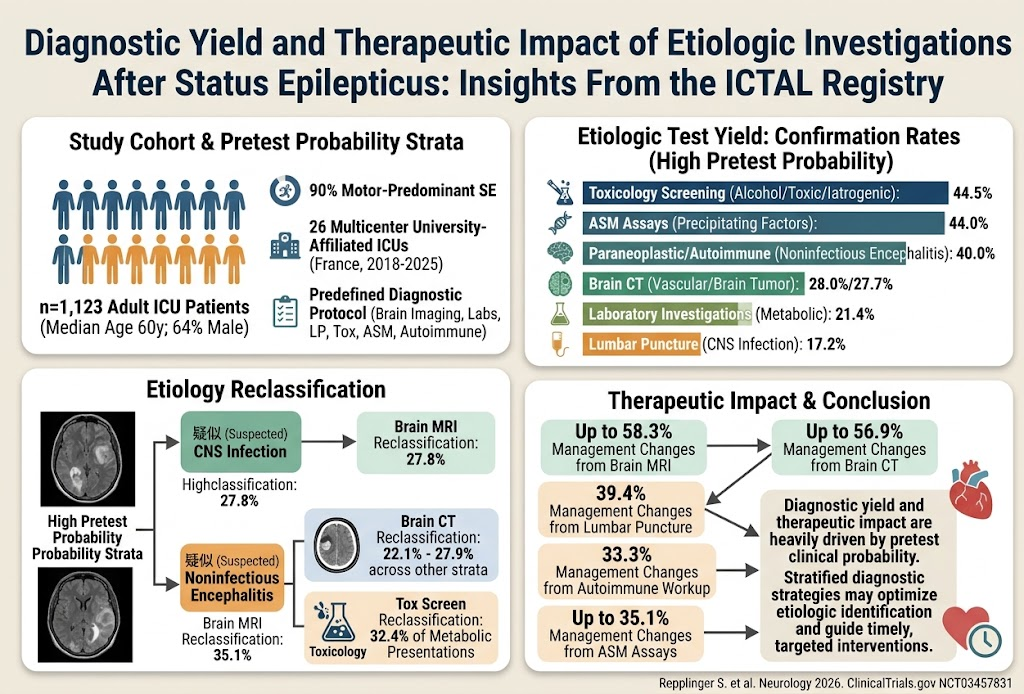
- Diagnostic yield of etiologic investigations in status epilepticus (SE) varies widely across modalities and underlying pretest probability strata.
- Toxicology screening, antiseizure medication assays, brain imaging, lumbar puncture, and autoimmune/paraneoplastic workup each play unique roles based on suspected etiology.
- Brain MRI and CT showed substantial reclassification ability, significantly impacting clinical management.
- Stratified, pretest probability-driven investigation protocols optimize etiologic identification and guide targeted therapeutic interventions.
Study Background
Status epilepticus (SE) is a neurological emergency characterized by prolonged or rapidly recurring seizures that can lead to significant morbidity and mortality. Prompt symptomatic control and identification of the underlying cause are crucial for effective treatment and improved patient outcomes. Despite established guidelines recommending various etiologic investigations, the overall diagnostic yield and consequential therapeutic impact of these investigations remain poorly understood, particularly when considering the clinical pretest probability of specific etiologies. Given the heterogeneity of SE causes—ranging from metabolic disturbances, infections, structural brain lesions, toxic and iatrogenic factors, to paraneoplastic and autoimmune encephalitides—a streamlined diagnostic approach could enhance efficiency and treatment precision.
Study Design
This prospective multicenter cohort study utilized data from the ICTAL registry, encompassing 26 university-affiliated intensive care units (ICUs) across France, collected from 2018 to 2025. The study enrolled 1,123 adult patients (≥18 years) admitted for status epilepticus, predominantly motor SE (90%).
Each participant underwent a standardized, predefined diagnostic protocol that included:
– Brain imaging (computed tomography [CT] scan and magnetic resonance imaging [MRI])
– Laboratory investigations (metabolic panels, toxicology screening)
– Lumbar puncture (CSF analysis)
– Antiseizure medication (ASM) assays
– Paraneoplastic and autoimmune disease workup
The primary endpoint was the diagnostic yield of each investigation. This was operationalized as the ability of a test to confirm the suspected etiology, establish a codiagnosis, or reclassify the etiology entirely. The secondary outcome assessed was change in clinical management directly attributable to the investigation results.
Key Findings
Diagnostic Yield Varied by Test and Clinical Context
Diagnostic yield was inversely and directly related to the pretest probability of certain etiologies. For example:
– Toxicology screening confirmed alcohol, toxic, or iatrogenic causes in 44.5% of cases with high pretest probability and reclassified 32.4% of metabolic presentations presumed high probability (e.g., unexplained metabolic disturbance possibly due to toxin exposure).
– ASM assays identified precipitating factors in 44.0% of relevant cases, facilitating targeted treatment.
– Paraneoplastic/autoimmune workup confirmed noninfectious encephalitis etiology in 40.0%, a critical group requiring immunomodulatory therapy.
– Brain CT contributed notably to diagnosis of vascular causes (28.0%) and brain tumors (27.7%), conditions where urgent management is often required.
– Laboratory metabolic panels confirmed metabolic-related SE in 21.4% of cases.
– Lumbar puncture demonstrated a 17.2% confirmation rate for central nervous system (CNS) infections.
Reclassification Capacity of Imaging and Other Modalities
Brain MRI demonstrated a powerful ability to reclassify SE etiology across multiple strata, especially noninfectious encephalitis, with reclassification rates between 27.8% and 35.1%. Brain CT also played a significant role in reclassification (22.1%–27.9%), underscoring the complementary utility of both imaging modalities.
Therapeutic Impact
Diagnostic-led management changes were most frequent after brain MRI (up to 58.3%), brain CT (up to 56.9%), and lumbar puncture (39.4%). Paraneoplastic/autoimmune workup led to management shifts in one-third of patients (33.3%), chiefly by initiating or tailoring immunotherapies. ASM assays influenced treatment adjustments in up to 35.1% of cases through detection of drug levels and identification of precipitating factors.
Expert Commentary
This study robustly quantifies the utility of etiologic investigations in a real-world, critically ill SE population. The findings emphasize that a “one-size-fits-all” diagnostic approach may be inefficient and that pretest clinical probability should drive tailored investigation strategies.
Notably, while brain CT remains indispensable for rapid assessment of structural etiologies like stroke and tumors, brain MRI offers superior sensitivity for detecting inflammatory and metabolic changes, enhancing detection of subtle causes and influencing therapy. The significant diagnostic and therapeutic contributions of toxicology and ASM assays highlight the importance of considering iatrogenic and toxic etiologies early, especially in refractory SE.
Limitations include potential variability in interpretation of investigations and generalizability limited to well-resourced neurocritical care centers. Future studies may explore rapid point-of-care modalities and integrate biomarkers to further refine etiologic ascertainment.
Conclusion
Etiologic investigations after status epilepticus yield substantial diagnostic information that directly informs treatment decisions, but their utility is highly contingent upon initial clinical suspicion and patient context. Pretest probability stratification and a stepwise approach prioritizing high-yield tests such as brain imaging, lumbar puncture, toxicology screening, and autoimmune workup can optimize resource utilization and improve patient outcomes. This study supports the development of evidence-based algorithms to guide tailored diagnostic workups in SE, an approach critically needed in neurocritical care practice.
Funding and Registration
This study was supported by multiple academic and institutional grants within the ICTAL registry framework. The trial is registered on ClinicalTrials.gov under NCT03457831.
References
1. Repplinger S et al. Diagnostic Yield and Therapeutic Impact of Etiologic Investigations After Status Epilepticus: Insights From the ICTAL Registry. Neurology. 2026;107(7):e218544. PMID: 42766827.
2. Trinka E, Cock H, Hesdorffer D, Rossetti AO, Scheffer IE, Shinnar S, Shorvon S, Lowenstein DH. A definition and classification of status epilepticus–Report of the ILAE Task Force on Classification of Status Epilepticus. Epilepsia. 2015;56(10):1515-1523.
3. Sánchez Fernández I, Goodkin HP. Etiologic investigations in status epilepticus: Are we doing enough? Neurology. 2016;87(22):2383-2384.
4. Rossetti AO, Logroscino G, Milligan TA, Michaelides C, Bromfield EB, Shutter L, Marsh E, Morabito C. Status epilepticus severity score (STESS): a tool to predict outcome of status epilepticus. Neurology. 2008;71(3):198-204.
5. Gaspard N, Hirsch LJ, Sutter R, Alvarez V, Pugin D, Kaplan PW. New-onset refractory status epilepticus (NORSE) and Febrile Infection-Related Epilepsy Syndrome (FIRES): State of the Art and Perspectives. Epilepsia. 2018;59(4):745-752.