Highlight
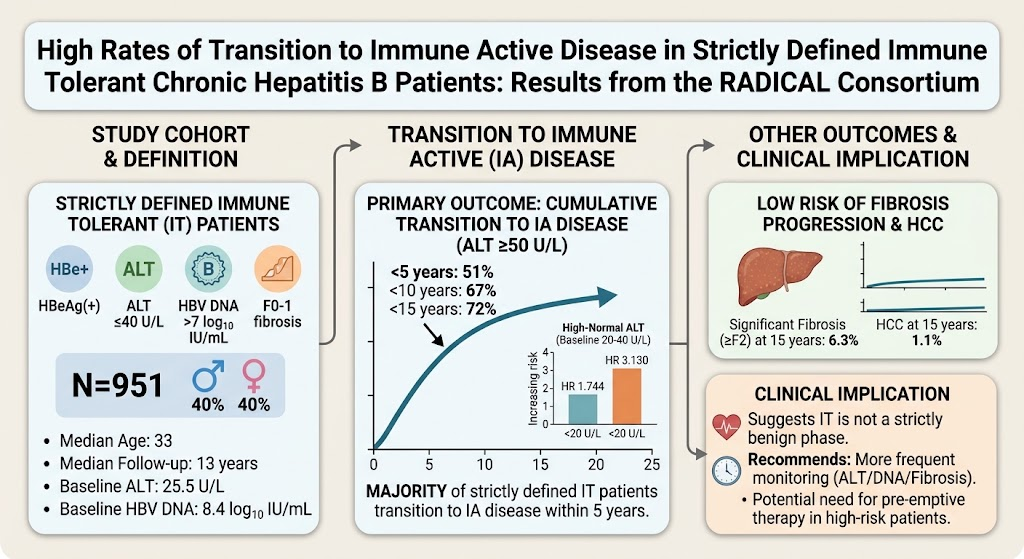
- A large international cohort strictly defining immune tolerant (IT) chronic hepatitis B (CHB) showed a 51% transition to immune active (IA) disease within 5 years.
- High-normal alanine aminotransferase (ALT) levels within the IT phase significantly increased risk of progression to IA disease, raising considerations for closer monitoring or early treatment.
- Despite the high transition rate to IA disease, the risk of significant fibrosis (≥F2) and hepatocellular carcinoma (HCC) remained low over a 15-year follow-up.
- Findings challenge the traditional perception of benign IT phase and highlight heterogeneity within IT patients, underscoring a need for tailored clinical management.
Study Background
Chronic hepatitis B virus (HBV) infection affects an estimated 296 million people worldwide and is a leading cause of cirrhosis and hepatocellular carcinoma (HCC). The natural history of chronic HBV infection encompasses distinct immunological phases – among them the immune tolerant (IT) phase characterized by persistent hepatitis B e-antigen (HBeAg) positivity, high viral replication, and minimal biochemical and histological liver damage. Traditionally, this IT phase, often seen in young, perinatally infected individuals, has been perceived as benign with limited need for antiviral therapy because of low inflammation and fibrosis. However, controversy persists regarding whether these patients should be closely monitored or treated early to prevent progression to active liver disease and complications.
Clarifying the natural history of strict IT-phase patients is pivotal for evidence-based management guidelines and optimization of patient outcomes. The RADICAL consortium conducted a comprehensive, multicenter international study to evaluate transition risks from the IT phase to immune active (IA) disease, potential fibrosis progression, and development of HCC.
Study Design
This study included 951 strictly defined IT patients with mono-infection of CHB from multiple international centers. Inclusion criteria for IT phase were stringent: (1) persistent HBeAg positivity, (2) alanine aminotransferase (ALT) ≤40 U/L, (3) HBV DNA >7 log10 IU/mL, and (4) liver fibrosis staged F0–F1 within the first year after baseline. Median age was 33 years, with 40% male participants and a median follow-up duration of 13 years.
Key study endpoints included:
– Transition to IA disease defined as ALT ≥50 U/L
– Progression to significant liver fibrosis (≥F2)
– Development of hepatocellular carcinoma (HCC)
The study assessed cumulative probabilities over 5, 10, and 15 years and subanalyses evaluated the influence of baseline ALT within the normal range on disease progression risk.
Key Findings
The RADICAL consortium’s findings challenge the traditionally benign view of the IT phase:
1. High Rate of Transition to Immune Active Disease
– The probability of transitioning from IT to IA disease was 51% within 5 years, increasing to 67% at 10 years and 72% at 15 years.
– Notably, patients with high-normal ALT values (20-30 U/L and >30 U/L) had significantly elevated risks of IA transition compared to those with lower ALT (<20 U/L), with subdistribution hazard ratios (sHR) of 1.744 and 3.130 respectively, both statistically significant (p<0.001).
2. Low Risk of Significant Fibrosis Progression
– Despite frequent IA transitions, progression to significant fibrosis (≥F2) was low over the long term, with only 6.3% risk at 15 years.
– This suggests that while biochemical activity increases, substantial fibrotic damage remains uncommon during this period.
3. Minimal Risk of Hepatocellular Carcinoma
– The 15-year cumulative incidence of HCC was minimal at 1.1%, reinforcing the relatively low oncogenic risk during well-defined IT phases.
4. Implications of High-Normal ALT
– The stratification by high-normal ALT revealed a subgroup within IT patients at heightened risk, implying that ALT within the upper normal limits may not fully reflect hepatic quiescence.
Expert Commentary
This study provides compelling evidence that the immune tolerant phase in chronic HBV infection is not universally benign. The rigorous, standardized definition of IT patients and extensive follow-up across diverse populations strengthen the reliability of findings and their global applicability.
The data suggest that reliance on traditional ALT cutoff values may underestimate inflammatory activity and risk of immune activation. Importantly, the results advocate for refined clinical surveillance strategies, incorporating ALT dynamics within the normal range as a predictive biomarker for IA progression.
Current global guidelines variably recommend monitoring versus antiviral treatment during IT phase, often deferring therapy due to perceived minimal risk. The RADICAL consortium results call for a more nuanced risk stratification; patients exhibiting high-normal ALT or early signs of IA may benefit from closer monitoring or early antiviral intervention to preempt progression and liver damage.
Limitations include potential variability in fibrosis assessment methods and incomplete control for all confounders influencing disease natural history. However, the large cohort and long follow-up partly mitigate these concerns. Further research into host and viral factors contributing to transition risk and clinical trials testing early treatment in high-risk IT patients are warranted.
Conclusion
In conclusion, strictly defined immune tolerant chronic hepatitis B patients demonstrate a substantial risk of transitioning to immune active disease over 5 to 15 years, particularly when ALT levels are at the higher end of the normal range. Although progression to significant fibrosis and HCC remains low, the high frequency of immune activation challenges the longstanding perception of the immune tolerant phase as uniformly benign.
Routine clinical management should incorporate more frequent monitoring of ALT, especially in patients with high-normal values, and consider the potential role of early antiviral therapy to improve long-term outcomes. These findings contribute critical evidence toward personalized HBV care, bridging a significant gap in current understanding and guideline recommendations.
Funding and Clinical Trials
The RADICAL consortium study was conducted by leading global hepatology research centers. Details regarding funding sources were not specified within the abstract. No clinical trial registration number was provided.
References
1. van Velsen LM, Choi WM, Kilany M, et al. High rates of transition to immune active disease in a cohort of strictly defined immune tolerant patients with chronic hepatitis B: results from the RADICAL consortium. Gut. 2026 Sep 18. PMID: 42760116.
2. European Association for the Study of the Liver. EASL 2017 Clinical Practice Guidelines on the management of hepatitis B virus infection. J Hepatol. 2017 Aug;67(2):370-398.
3. Terrault NA, Lok ASF, McMahon BJ, et al. Update on prevention, diagnosis, and treatment of chronic hepatitis B: AASLD 2018 hepatitis B guidance. Hepatology. 2018 Apr;67(4):1560-1599.
4. Kim GA, Lim YS. When and whom to treat during the immune tolerant phase of chronic hepatitis B virus infection? Gut Liver. 2020 May;14(3):350-357.
5. Cho Y, Kim JH, Jun BG, et al. High-normal ALT level as a predictor of liver disease progression in patients with chronic hepatitis B. J Viral Hepat. 2022 Jan;29(1):14-22.
These references provide additional clinical context and guideline recommendations relevant to the management of chronic HBV during the IT phase.