Introduction
Alzheimer disease (AD) pathology is characterized by the accumulation of tau protein tangles in the brain, which progressively impair cognitive functions. Tau positron emission tomography (PET) imaging allows noninvasive visualization and staging of this tau burden, aiding in diagnosis and clinical decision-making. However, the current standard regulatory-approved visual interpretation of tau PET is binary—classifying scans simply as positive or negative—primarily targeting advanced stages of disease. This approach limits the ability to detect early tau pathology and adequately stratify patients, especially during mild cognitive impairment or presymptomatic phases.
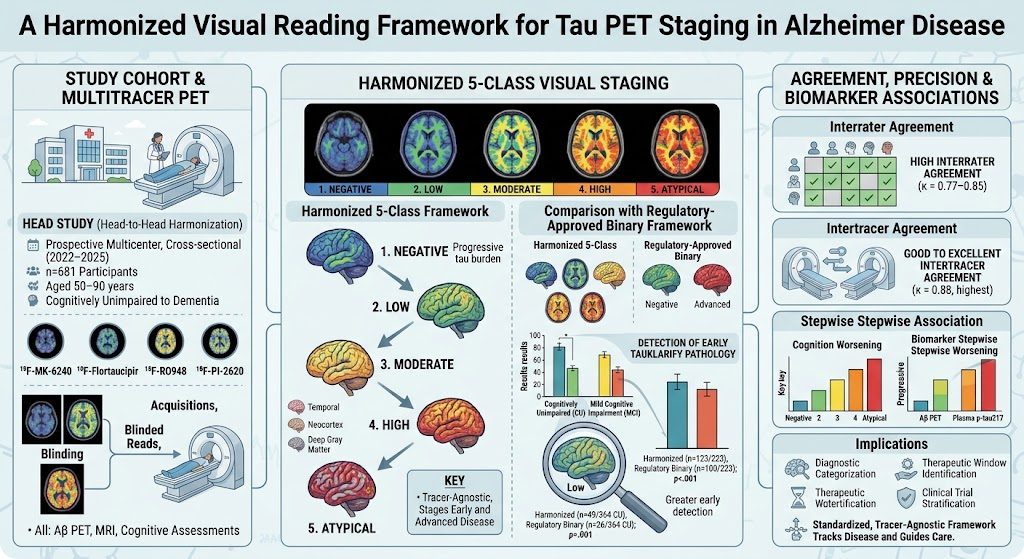
Recognizing this gap, the Head-to-Head Harmonization of Tau Tracers in Alzheimer’s Disease (HEAD) study aimed to develop and validate a harmonized, multi-class tau PET visual reading framework. This framework classifies tau burden across five categories—negative, low, moderate, high, and atypical—regardless of the radiotracer used. Such a nuanced classification is expected to enhance the sensitivity of tau PET in early diagnosis, better correlate with cognitive and biological measures of AD, and improve clinical trial stratification.
Methods
This prospective multicenter cross-sectional study was conducted from March 2022 to August 2025, with data analyzed up to June 2026. It enrolled 822 adults aged 50 to 90 years from nine sites across North America and Europe. Participants ranged from cognitively unimpaired to those with mild cognitive impairment (MCI) and dementia. Each underwent tau PET imaging using between two and four radiotracers, specifically 18F-MK-6240 (marketed as TAUKLARIFY), 18F-flortaucipir (Tauvid), 18F-RO948, and 18F-PI-2620. All participants also received amyloid-β (Aβ) PET scans and brain magnetic resonance imaging (MRI).
Clinicians blinded to clinical data performed visual reads independently across tracers, classifying tau PET scans into one of five categories: negative, low, moderate, high, or atypical tau burden. Interrater (between different clinicians) and intertracer (between different tracers) agreement were assessed to confirm reliability and harmonization. Prevalence of tau-positive scans in each cognitive category was compared between this new framework and the existing binary regulatory-approved framework.
Results
From 822 enrolled individuals, 681 completed multi-tracer tau PET and cognitive assessments, with a mean age of 69.3 years and 53.9% female. The harmonized five-class visual reading framework demonstrated excellent interrater reliability (kappa values ranged from 0.77 to 0.85) and good to excellent intertracer agreement, highest between 18F-MK-6240 and 18F-flortaucipir (kappa = 0.88).
This multi-class method identified substantially more tau-positive cognitively unimpaired individuals compared to the binary regulatory-approved approach. For example, using harmonized 18F-flortaucipir, 49 of 364 cognitively unimpaired participants were classified tau-positive versus only 26 detected by the binary classification (prevalence ratio [PR] = 1.89). The most sensitive tracer 18F-MK-6240 detected 71 tau-positive cognitively unimpaired participants (PR = 2.73). A similar pattern was observed for individuals with mild cognitive impairment, where harmonized classification yielded higher tau detection rates than the binary framework.
Regarding disease progression markers, tau burden classes correlated stepwise with worsened cognition, increasing Aβ PET burden, and elevated plasma phosphorylated tau 217 (p-tau217), a key blood biomarker. Between the low and high tau classes, cognition scores differed by 1.4-fold, Aβ PET burden by 3.2-fold, and plasma p-tau217 levels by 2.5-fold, illustrating the framework’s biological and clinical relevance.
Discussion
The harmonized five-class tau PET visual reading framework offers a refined and tracer-agnostic approach to stage tau pathology in Alzheimer disease. By enabling nuanced classification across different radiotracers, it enhances early detection of tau accumulation, which is crucial for timely diagnosis and potential interventions before severe cognitive decline.
The improved interrater and intertracer reliability suggest this framework could be widely adopted across clinical and research settings, providing consistent and comparable tau PET interpretations. Detecting more tau-positive individuals at early stages supports patient stratification for clinical trials targeting tauopathy and tailoring therapeutic windows more precisely.
Further, the observed stepwise association with cognition, amyloid pathology, and plasma tau biomarkers reinforces the biological validity and clinical utility of this framework. It also potentially benefits monitoring disease progression and treatment response.
Conclusion
This large multicenter study validates a harmonized visual reading framework with five tau burden categories in Alzheimer disease tau PET imaging. Compared to the current binary regulatory-approved system, it significantly improves early tau pathology detection in cognitively unimpaired and mildly impaired individuals, with strong concordance among different radiotracers and raters.
Such a standardized framework serves as a robust tool for diagnostic classification, enhancing patient stratification, therapeutic timing, and clinical trial design in Alzheimer disease management. Adoption of this harmonized approach paves the way for more sensitive, reliable, and clinically meaningful tau PET interpretation worldwide.
Implications for Clinical Practice and Research
Clinicians interpreting tau PET scans should consider adopting multi-class visual frameworks to improve sensitivity in early and atypical AD presentations. Researchers may leverage this methodology to unify tau PET data across studies and tracers, facilitating large-scale biomarker analyses.
Future work could integrate automated image quantification tools with this framework to further reduce subjective variability and enable precision medicine approaches in AD.
Reference
Ruppert E, Vermeiren MR, Scop Medeiros M, Povala G, Soares C, Rocha A, de Oliveira Franco A, Scarpatto Rodrigues M, Oliveira M Jr, Mroué R, Ferreira PCL, Bauer-Negrini G, Lussier FZ, Amaral L, Bellaver B, Tissot C, Masdeu J, Tudorascu DL, Karikari T, Soleimani-Meigooni DN, Fortea J, Lowe VJ, Oh H, Pascual B, Gordon BA, Rosa-Neto P, Baker S, Ossenkoppele R, van de Giessen E, Pascoal TA; HEAD study. A Harmonized Visual Reading Framework for Tau PET Staging in Alzheimer Disease. JAMA Neurol. 2026 Sep 21. doi: 10.1001/jamaneurol.2026.3253. Epub ahead of print. PMID: 42766299.