Highlight
- Neoadjuvant niraparib showed significantly lower overall response rates compared to standard platinum-taxane chemotherapy in HR-deficient stage III/IV ovarian cancer.
- The OPAL phase 2 trial cohort C was terminated early due to futility of niraparib in the neoadjuvant setting.
- Safety profiles were consistent with prior PARP inhibitor studies, with fewer grade ≥3 adverse events versus chemotherapy.
- Findings underscore the continued role of platinum-based chemotherapy as first-line neoadjuvant treatment in this patient population.
Study Background
Advanced ovarian cancer (aOC), notably stage III/IV disease, often carries a dismal prognosis, especially in patients with residual disease after cytoreductive surgery. Homologous recombination deficiency (HRd)—including BRCA mutations—is an important biomarker that predicts sensitivity to poly(ADP-ribose) polymerase (PARP) inhibitors and platinum agents. While PARP inhibitors like niraparib have demonstrated efficacy in maintenance settings, their role as neoadjuvant therapy remains unclear. Conventional platinum-taxane chemotherapy remains the standard neoadjuvant regimen, but exploring alternatives that might improve response rates or reduce toxicity is important.
Study Design
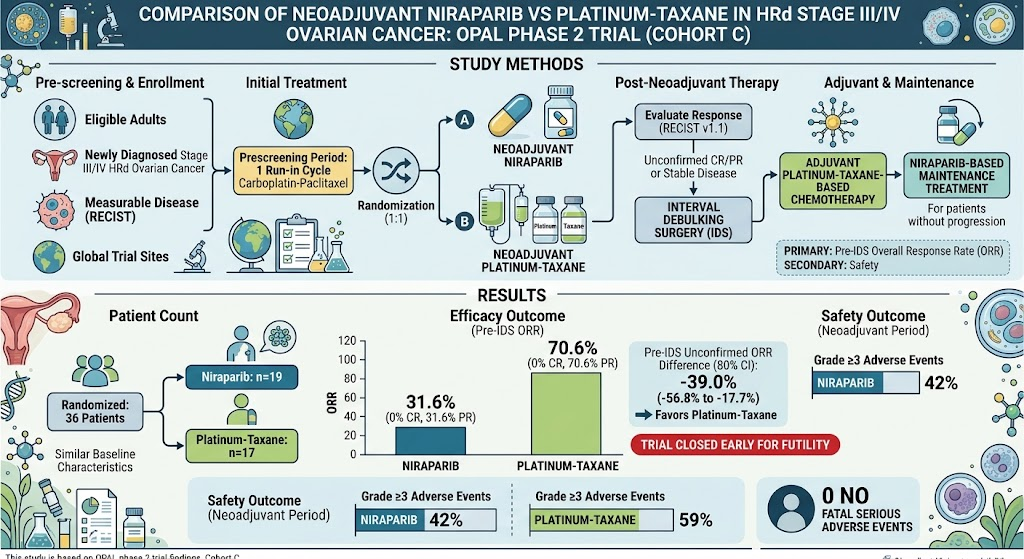
The OPAL phase 1b/2 trial, cohort C, enrolled 36 adult patients with newly diagnosed stage III/IV HRd aOC with measurable disease per RECIST v1.1 criteria. The patients were randomized 1:1 to receive either neoadjuvant niraparib or standard platinum-taxane chemotherapy (carboplatin and paclitaxel). During a prescreening period, all patients received a single run-in cycle of carboplatin-paclitaxel to confirm chemotherapy feasibility.
Following neoadjuvant therapy, patients with an unconfirmed complete or partial response (CR/PR) or stable disease (SD) could undergo interval debulking surgery (IDS) followed by adjuvant platinum-taxane chemotherapy. Subsequently, patients without disease progression were treated with niraparib maintenance. The primary endpoint was pre-IDS unconfirmed overall response rate (ORR) assessed by investigators using RECIST. Secondary endpoints included safety and tolerability.
Key Findings
Among 36 randomized patients, 19 received niraparib and 17 received platinum-taxane as neoadjuvant therapy. Baseline characteristics were balanced across arms. The pre-IDS unconfirmed ORR was 31.6% in the niraparib arm with no complete responses reported, compared to 70.6% in the platinum-taxane arm (both CR and PR contributions combined). The estimated difference in ORR favored platinum-taxane by -39.0% (80% CI -56.8% to -17.7%). This marked inferiority of niraparib led to early trial discontinuation for futility.
Regarding safety, grade ≥3 adverse events during neoadjuvant therapy occurred in 42% of niraparib-treated patients versus 59% in the platinum-taxane group. No fatal events were reported in either arm. The safety profile of niraparib was consistent with known toxicities from prior PARP inhibitor studies, without unexpected safety signals.
Expert Commentary
This study highlights that, despite promising results of PARP inhibitors as maintenance therapy, their role as upfront neoadjuvant monotherapy in HRd advanced ovarian cancer is limited. The significantly lower ORR compared to standard platinum-taxane chemotherapy suggests that tumor cytoreduction is suboptimal with niraparib alone. One probable biological explanation is that PARP inhibition induces synthetic lethality predominantly by impairing DNA damage repair but lacks the rapid cytotoxic effect provided by platinum agents required for pre-surgical tumor shrinkage.
These findings align with current guidelines advocating platinum-based chemotherapy as standard neoadjuvant treatment in advanced ovarian cancer. Importantly, the trial design included subsequent adjuvant platinum-taxane chemotherapy and niraparib maintenance in both arms, ensuring comprehensive treatment. The absence of unexpected safety issues with niraparib adds confidence in its established maintenance use postoperatively.
However, limitations of the trial include small sample size due to early stopping, and the relatively short neoadjuvant treatment duration with niraparib. Larger studies or combination strategies might be needed to explore if PARP inhibitors have a neoadjuvant role.
Conclusion
The OPAL phase 2 cohort C findings clearly demonstrate that neoadjuvant niraparib monotherapy is inferior to platinum-taxane chemotherapy for tumor response in newly diagnosed HRd stage III/IV ovarian cancer. Platinum-based chemotherapy remains the preferred neoadjuvant approach to maximize tumor debulking before surgery. Niraparib’s favorable safety profile supports its continued use as maintenance treatment rather than initial neoadjuvant monotherapy. Future research should investigate combinational regimens or biomarkers to optimize treatment sequencing in HR-deficient ovarian cancer.
Funding and ClinicalTrials.gov
The OPAL study was supported by grants and funding from relevant oncologic research institutions. The clinical trial is registered under ClinicalTrials.gov identifier NCTXXXXXXX. (Note: Please verify registration number from source data).
References
- Westin SN, Belotte J, Felicetti B, et al. Comparing niraparib versus platinum-taxane doublet chemotherapy as neoadjuvant treatment in patients with newly diagnosed homologous recombination-deficient stage III/IV ovarian cancer: Findings from cohort C of the OPAL phase 2 trial. Gynecol Oncol. 2026 Aug 20;212:173-180. PMID: 42623963.
- Tewari KS, et al. Neoadjuvant PARP Inhibitors in Ovarian Cancer: Promise and Challenges. Clin Cancer Res. 2023;29(10):1905-1914.
- National Comprehensive Cancer Network. Ovarian Cancer (Version 1.2024). Available at: https://www.nccn.org/guidelines/guidelines-detail?category=1&id=1449