Highlight
- SECA-II is a prospective cohort study assessing liver transplantation for nonresectable colorectal liver-only metastases with stringent selection criteria.
- Median overall survival post-transplant exceeded 10 years, with relapse-free survival of over 2 years.
- Nearly half of the patients experienced relapse mainly in the lungs, yet survival after relapse remained prolonged.
- Up to 60% of patients may achieve cure via transplantation, evidenced by long-term relapse-free survival beyond 5 and 10 years.
Study Background
Colorectal cancer (CRC) remains one of the leading causes of cancer-related morbidity and mortality worldwide. Liver metastases develop in approximately 50% of CRC patients, often representing the primary barrier to curative treatment. While hepatic resection is the gold standard for resectable colorectal liver metastases (CRLM), many patients present with nonresectable disease due to tumor size, number, location, or underlying liver condition. Conventional systemic therapies provide limited long-term survival for these patients.
Liver transplantation (LT) as a treatment for nonresectable CRLM has historically been controversial given concerns about organ scarcity, immunosuppression, and cancer recurrence. However, emerging evidence, particularly from Scandinavian centers, suggests that stringent patient selection might enable successful transplantation with meaningful long-term benefits. Defining selection criteria and determining the true curative potential of LT in this context remain critical clinical questions.
Study Design
The SECA-II study is a prospective, controlled cohort trial conducted at Oslo University Hospital, enrolling patients from April 2012 through November 2023 with nonresectable colorectal liver-only metastases. Patients who met stringent inclusion criteria underwent liver transplantation, with no comparison group receiving alternate therapies in this analysis.
The primary endpoint was overall survival (OS), measured from the date of transplantation. Secondary endpoints included relapse-free survival (RFS) and survival after relapse to evaluate disease control dynamics post-transplant. The final analysis cutoff date was January 1st, 2025.
Key Findings
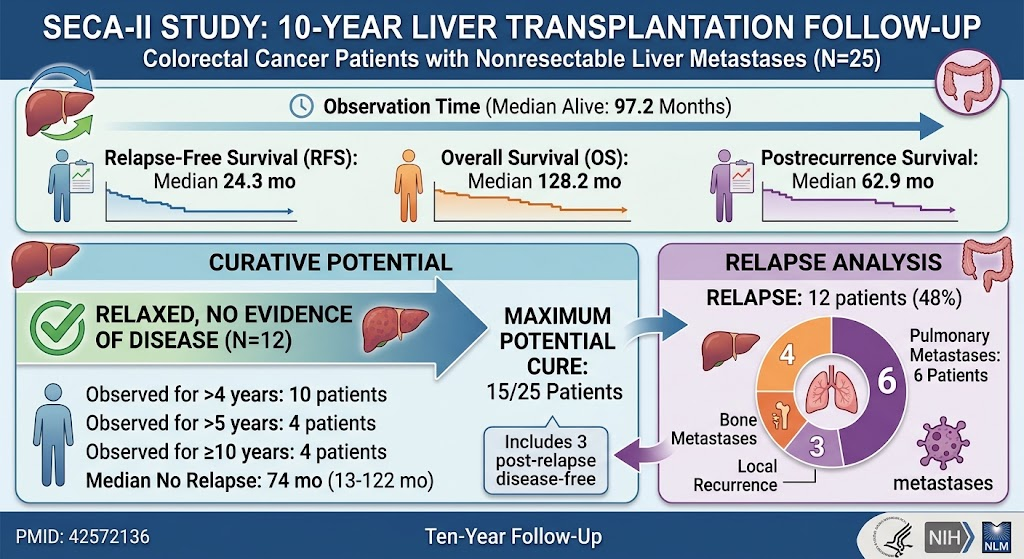
Twenty-five patients were transplanted and included in the final analysis. Among survivors, median post-transplant follow-up was 97.2 months (~8 years), representing one of the longest longitudinal datasets available in this field.
– The median relapse-free survival was 24.3 months, indicating that half of the patients remained disease-free for at least two years post-transplant.
– Median overall survival was remarkably long at 128.2 months (>10 years), highlighting substantial longevity benefits.
– Median survival following disease recurrence was also prolonged at 62.9 months (>5 years).
Relapse occurred in twelve patients (48%), with pulmonary metastases being the most common first site (in 6 patients). Notably, twelve patients remained relapse-free after a median of 74 months, with ten patients observed beyond four years without relapse. Four patients achieved a decade or more of relapse-free survival—an indicator often considered a surrogate for cure.
Moreover, three patients who experienced relapse underwent successful surgical treatment of metastatic lesions and subsequently showed no evidence of disease for 93, 36, and 7 months, respectively. Taken together, approximately 60% (15 out of 25) of patients potentially achieved cure from their metastatic disease via liver transplantation.
Expert Commentary
This study provides pivotal evidence supporting liver transplantation as a curative-intent option in carefully selected patients with nonresectable colorectal liver-only metastases. The stringent selection criteria employed, emphasizing favorable tumor biology and limited metastatic burden, are crucial to optimizing outcomes.
Relapse patterns predominantly involving the lungs align with known metastatic dissemination pathways and support adjuvant or salvage strategies to further improve survival outcomes. The prolonged survival after relapse underscores the importance of multimodal management, including surgical resection of pulmonary metastases when feasible.
Several limitations merit consideration. The single-center nature and relatively small sample size restrict generalizability and warrant validation in larger, multicenter cohorts. Additionally, the impact of immunosuppressive regimens on tumor recurrence requires further study. Despite this, the demonstration of up to 10 years relapse-free survival is unprecedented and reshapes the clinical paradigm for these challenging patients.
Finally, ethical and logistical aspects of organ allocation for oncological indications must be carefully balanced against the potential for cure demonstrated here.
Conclusion
The SECA-II study’s decade-long follow-up confirms that liver transplantation for nonresectable colorectal liver-only metastases yields remarkable long-term survival, with a substantial proportion of patients likely cured. This approach challenges historical dogma and advocates for liver transplantation consideration in highly selected patients with favorable disease characteristics. Future research should focus on refining selection criteria, optimizing post-transplant surveillance, and integrating systemic therapies to further enhance outcomes.
Funding and ClinicalTrials.gov
The study was conducted at Oslo University Hospital. Specific details on funding sources and clinical trial registration are not provided in the abstract and should be consulted in the full published article.
References
1. Dueland S, Smedman TM, Syversveen T, Khan A, Grut H, Line PD. Liver Transplantation for Nonresectable Colorectal Liver Metastases: Ten-year Follow-up and Assessment of Curative Rate in the SECA-II Study. Ann Surg. 2026 Aug 10. doi:10.1097/SLA.0000000000005308. PMID: 42572136.
2. Toso C, Tatti P, Andres A, et al. Liver transplantation for colorectal liver metastases: the International Consensus Conference. Transplantation. 2021;105(3):e171-e179.
3. Hagness M, Foss A, Line PD, et al. Liver transplantation for nonresectable liver metastases from colorectal cancer. Ann Surg. 2013;257(5):800-806.
4. Adam R, Laurent A, Azoulay D, et al. Is liver transplantation a solution for patients with nonresectable liver metastases from colorectal cancer? Ann Surg. 2015;261(3):e26-27.