Highlight
1. Inebilizumab effectively reduces the risk of exacerbations and the need for rescue therapies in patients with generalized myasthenia gravis (gMG), including subpopulations positive for acetylcholine receptor antibodies (AChR+) and muscle-specific kinase antibodies (MuSK+).
2. The benefit of inebilizumab is observed during corticosteroid tapering, indicating its potential role in improving long-term disease control while minimizing steroid exposure.
3. The phase 3 MINT trial, involving 238 participants across 18 countries, validates inebilizumab’s safety and efficacy within a rigorous, international, randomized controlled setting.
4. Risk reduction for exacerbations by inebilizumab in MuSK+ patients is especially pronounced, highlighting its therapeutic promise in this often more treatment-resistant subgroup.
Study Background
Generalized myasthenia gravis (gMG) is a chronic autoimmune neuromuscular disorder characterized by fluctuating muscle weakness and fatigability. The disease often leads to exacerbations, which can be severe enough to precipitate myasthenic crises requiring rescue therapies such as intravenous immunoglobulin (IVIG) or plasma exchange (PLEX). These exacerbations contribute significantly to morbidity and healthcare utilization. While standard treatments, including corticosteroids and immunosuppressants, are effective, steroid-related side effects and inadequate disease control highlight the unmet need for targeted, steroid-sparing therapies.
Inebilizumab is a humanized monoclonal antibody targeting CD19, a marker present on B cells from early developmental stages to plasmablasts, enabling broad B cell depletion. This mechanism is hypothesized to reduce autoantibody production, addressing the underlying pathology of gMG in AChR+ and MuSK+ patients. The Myasthenia Gravis Inebilizumab Trial (MINT) was designed to evaluate inebilizumab’s efficacy and safety, with a specific focus on its impact on exacerbations and rescue therapy use, critical parameters in disease management.
Study Design
The MINT trial was a phase 3, international, randomized, double-blind, placebo-controlled study enrolling adults with moderate to severe gMG positive for anti-acetylcholine receptor (AChR) or anti-muscle-specific kinase (MuSK) antibodies. Recruitment spanned from August 2020 to November 2023 across 81 sites in 18 countries, including both academic and nonacademic centers.
Participants had a baseline Myasthenia Gravis Activities of Daily Life (MG-ADL) score between 6 and 10, reflecting significant functional impairment. The trial included a 52-week randomized controlled period for the AChR+ cohort and 26 weeks for the MuSK+ cohort, followed by an optional three-year open-label extension.
Subjects were randomized 1:1 to inebilizumab or placebo. All participants underwent a protocol-specified corticosteroid taper aiming to reduce prednisone or equivalent to 5 mg per day or less, to assess inebilizumab’s efficacy under conditions minimizing steroid confounding.
The primary endpoint for this prespecified analysis was the frequency of exacerbations, defined as myasthenic crisis, clinically significant worsening of MG-ADL scores, or the need for rescue therapies such as IVIG or plasma exchange.
Key Findings
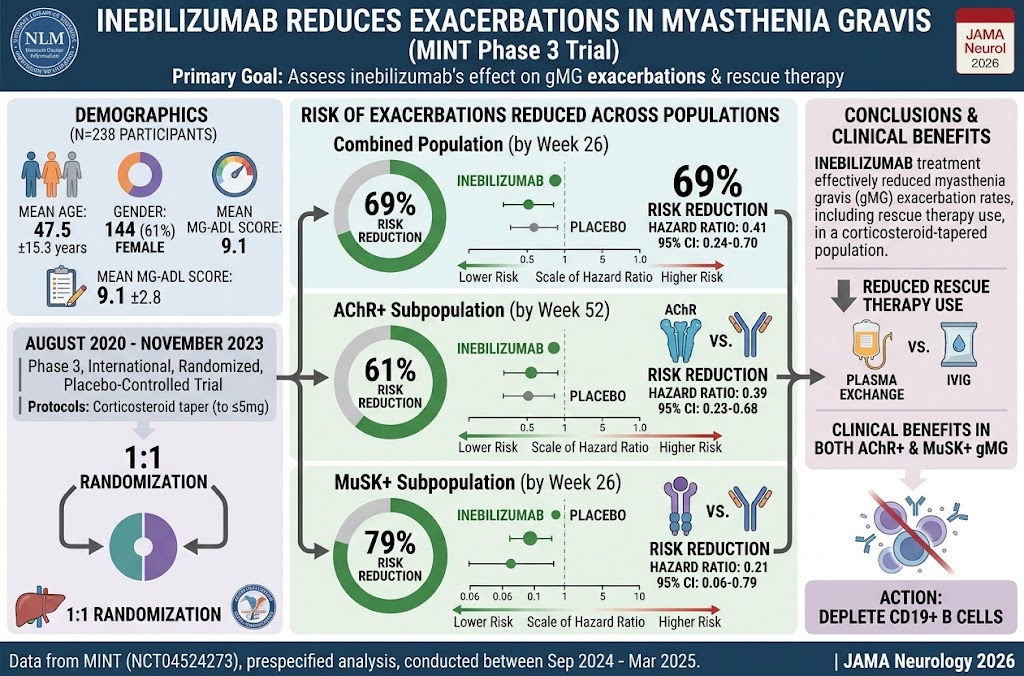
The study enrolled 238 participants with a mean age of 47.5 years; 61% were female. The mean baseline MG-ADL score was 9.1, indicating moderate to severe disease burden.
By week 26, inebilizumab significantly reduced the risk of exacerbations in the combined gMG population compared to placebo (hazard ratio [HR], 0.41; 95% confidence interval [CI], 0.24–0.70), indicating a 59% relative risk reduction.
In the AChR+ subpopulation followed for 52 weeks, the HR for exacerbations with inebilizumab was 0.39 (95% CI, 0.23–0.68), demonstrating 61% risk reduction sustained over a full year.
Remarkably, in the MuSK+ subpopulation at 26 weeks, the HR was 0.21 (95% CI, 0.06–0.79), corresponding to a substantial 79% risk reduction, which is clinically significant given the typically refractory nature of MuSK+ gMG.
The reduction in exacerbations was reflected in lower rescue therapy utilization, underscoring inebilizumab’s ability to provide more stable disease control and reduce acute interventions.
Safety analyses reaffirmed the tolerability of inebilizumab, consistent with previous reports of B cell–targeted therapies. No unexpected adverse events were noted, and corticosteroid tapering was generally manageable in both treatment arms.
Expert Commentary
These results provide compelling evidence that inebilizumab is a valuable addition to the therapeutic armamentarium for generalized myasthenia gravis. By targeting CD19+ B cells, inebilizumab depletes the cellular precursors responsible for autoantibody production, thereby directly addressing disease pathophysiology. The robust reduction of exacerbations, especially in MuSK+ patients, who often respond poorly to conventional therapies, marks a critical advancement.
While maintaining a steroid taper, inebilizumab’s efficacy suggests potential steroid-sparing benefits, which could translate into reduced long-term corticosteroid toxicity—an important consideration in chronic autoimmune diseases.
Limitations include the shorter randomized period for the MuSK+ subgroup, although the observed effect size is compelling. Future long-term data from the open-label extension will be essential to confirm sustained benefits and safety. Additionally, real-world studies will be needed to define optimal positioning of inebilizumab within the treatment algorithm, including head-to-head comparisons with existing B cell–targeted agents.
Conclusion
The MINT trial prespecified analysis establishes that inebilizumab significantly lowers exacerbation rates and reduces rescue therapy needs in patients with generalized myasthenia gravis undergoing corticosteroid tapering. Its efficacy in both AChR+ and MuSK+ subpopulations highlights its broad clinical utility. These findings support the integration of inebilizumab into clinical practice as a targeted therapy to improve disease stability and patient quality of life.
Funding and Clinical Trial Registration
The MINT trial was an investigator-initiated, industry-supported study registered on ClinicalTrials.gov (NCT04524273). Funding sources and detailed trial methodology are described in the original publication.
References
- Nowak RJ, Utsugisawa K, Benatar M, et al. Management of Exacerbations and Rescue Therapy: A Prespecified Analysis of the Phase 3 Myasthenia Gravis Inebilizumab Randomized Clinical Trial. JAMA Neurol. 2026 Aug 10; PMID: 42573995.
- Benatar M, et al. Overview of Myasthenia Gravis and Current Treatment Paradigms. Neurol Clin. 2023;41(2):217-230.
- Herbst R, et al. B Cell–Directed Therapies in Autoimmune Diseases. Nat Rev Drug Discov. 2023;22(4):281-300.