Highlight
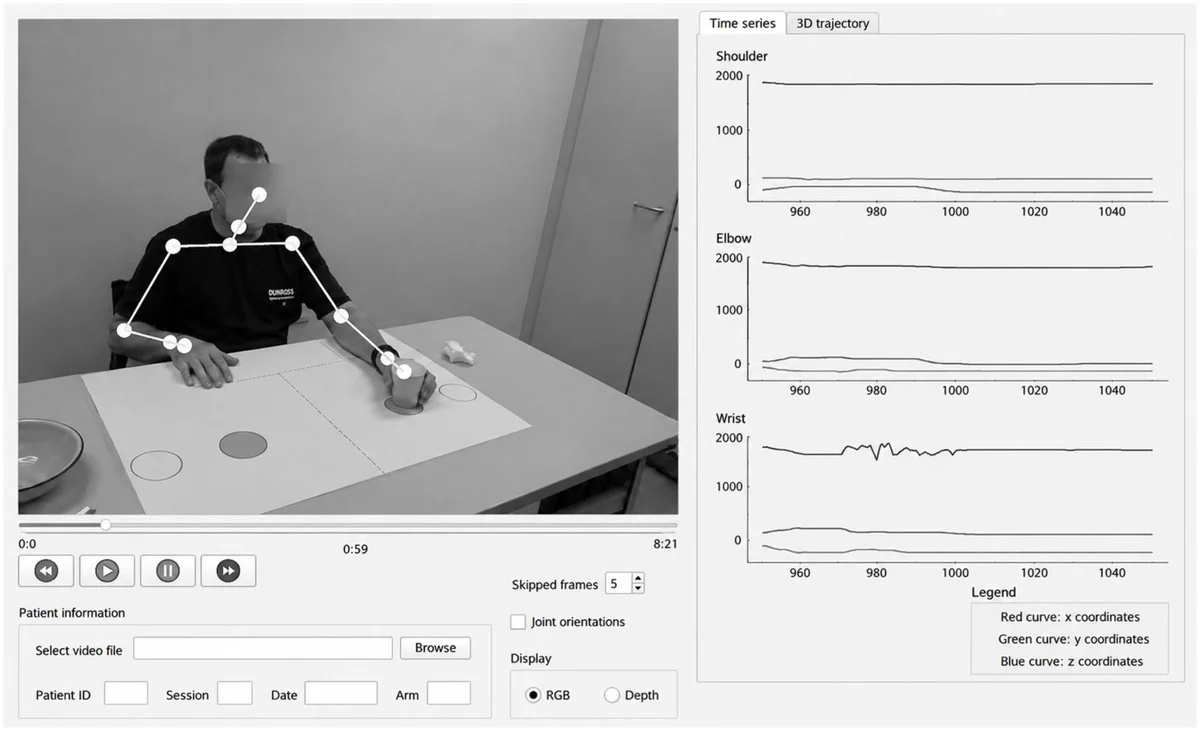
The Functional Upper Limb Movement Assessment (FULMA) system is a newly developed single-camera, markerless motion capture tool designed to objectively evaluate upper limb function in stroke survivors. Using a LiDAR depth camera and machine learning algorithms, it predicts clinical task performance scores aligned with established assessments like the Action Research Arm Test (ARAT). The system achieved a mean accuracy of 83.3% with kappa values indicating substantial agreement with occupational therapist ratings. Its automated kinematic commentary highlights movement deficits relevant for rehabilitation but requires further validation before clinical deployment.
Study Background
Upper limb impairment following stroke is prevalent and substantially impacts functional independence and quality of life. Clinical assessments such as the Fugl Meyer Assessment and the Action Research Arm Test (ARAT) are gold standards for evaluating motor recovery and guiding rehabilitation. However, these assessments are subject to inter-rater variability and may lack sensitivity in detecting subtle yet clinically important changes in motor performance. This underscores a critical need for objective, reproducible, and sensitive measurement tools to support precise monitoring and tailored interventions in stroke rehabilitation.
Study Design
This prospective observational study enrolled 39 participants with stroke and 19 healthy control subjects. Participants performed nine predefined functional upper limb tasks, including activities such as bringing a cup to the mouth and hair brushing. Motion was captured using a single LiDAR depth camera that allowed markerless tracking of upper limb kinematics without requiring wearable sensors or markers. Extracted kinematic features were processed with machine learning models, including a multilayer perceptron and a support vector machine, to predict ordinal task performance scores based on ARAT scoring descriptors. Automated kinematic commentary reflecting movement characteristics was also generated. Independent occupational therapists provided blinded ratings for validation of the predictive models.
Key Findings
The multilayer perceptron model demonstrated a mean accuracy of 83.3% in predicting ordinal scores, with individual task accuracies ranging from 75.0% to 91.7%. Weighted kappa values indicated substantial to almost perfect agreement (0.67 to 0.88) with occupational therapist ratings, underscoring strong concordance in task performance classification. The support vector machine model showed slightly lower accuracy at 78.5%, with kappa values ranging from 0.59 to 0.83 across tasks.
Performance varied by task, with the highest accuracy noted for the cup to mouth and hair brushing tasks. These tasks likely involve distinct and consistent movement patterns that the models could effectively recognize. Automated kinematic commentary interpreted functional impairments such as prolonged movement time, diminished movement smoothness, and compensatory trunk displacement commonly observed in post-stroke upper limb dysfunction.
These results suggest the potential of the FULMA system to objectively capture clinically relevant upper limb motor impairments and provide meaningful metrics aligned with conventional clinical scales. However, as this was a developmental study using a controlled dataset, performance outside this context remains to be established.
Expert Commentary
The development of markerless motion capture systems for stroke rehabilitation represents an important advancement in leveraging technology for personalized medicine. By reducing dependence on wearable sensors and simplifying setup, such approaches can enhance feasibility in clinical environments. The use of machine learning to translate kinematic data into validated clinical scores is promising, addressing inter-rater variability and granularity limitations.
Nevertheless, challenges remain, including the need for external validation in larger, more heterogeneous stroke populations and assessment in real-world clinical settings. The reliability, sensitivity to longitudinal change, and responsiveness to therapeutic interventions warrant investigation. Although the automated kinematic commentary provides intuitive insights into movement strategies, clinicians should regard these interpretations as exploratory pending rigorous validation.
Integrating these tools into clinical workflows will require user-friendly interfaces and alignment with rehabilitation goals. Consideration of confounding factors such as spasticity, cognitive impairments, and compensatory behaviors will be essential for meaningful interpretation. Collaboration between engineers, clinicians, and patients is vital to optimize functionality and clinical impact.
Conclusion
The FULMA single-camera markerless motion capture system offers a novel, objective method for assessing upper limb motor function after stroke, leveraging advances in depth imaging and machine learning. It achieves promising agreement with occupational therapist ratings for task performance and provides automated kinematic commentary highlighting key motor deficits.
Further studies are required to externally validate the FULMA system, characterize its measurement properties including sensitivity and reliability, and confirm its clinical utility across diverse stroke populations and settings. The integration of such technology could enhance precision rehabilitation by delivering consistent, real-time movement assessments that facilitate data-driven decision making.
Funding and Clinical Trial Registration
The original study was supported by institutions and did not specify a clinical trial registration number in the provided abstract. Further details may be available in the full publication.
References
1. Fisher J, Bunn C, Li W, et al. Development of a Single-Camera Markerless Motion Capture System for Assessing Upper Limb Function Post-Stroke (FULMA). Neurorehabil Neural Repair. 2026 Nov 2;15459683261493918. doi:10.1177/15459683261493918. PMID: 42973162.
2. Lyle RC. A performance test for assessment of upper limb function in physical rehabilitation treatment and research. Int J Rehabil Res. 1981;4(4):483-492.
3. Platz T, Pinkowski C, van Wijck F, Kim IH, Di Bella P, Johnson G. Reliability and validity of arm function assessment with standardized measures after stroke. J Neurol Neurosurg Psychiatry. 2005 Feb;76(2):317-20.
4. Kwakkel G, Kollen BJ, Wagenaar RC. Therapy impact on functional recovery in stroke rehabilitation: a critical review of the literature. Physiotherapy. 1999 Jun;85(7):377-91.
Specialty calculators
For clinical reference; use professional judgment.