Highlight
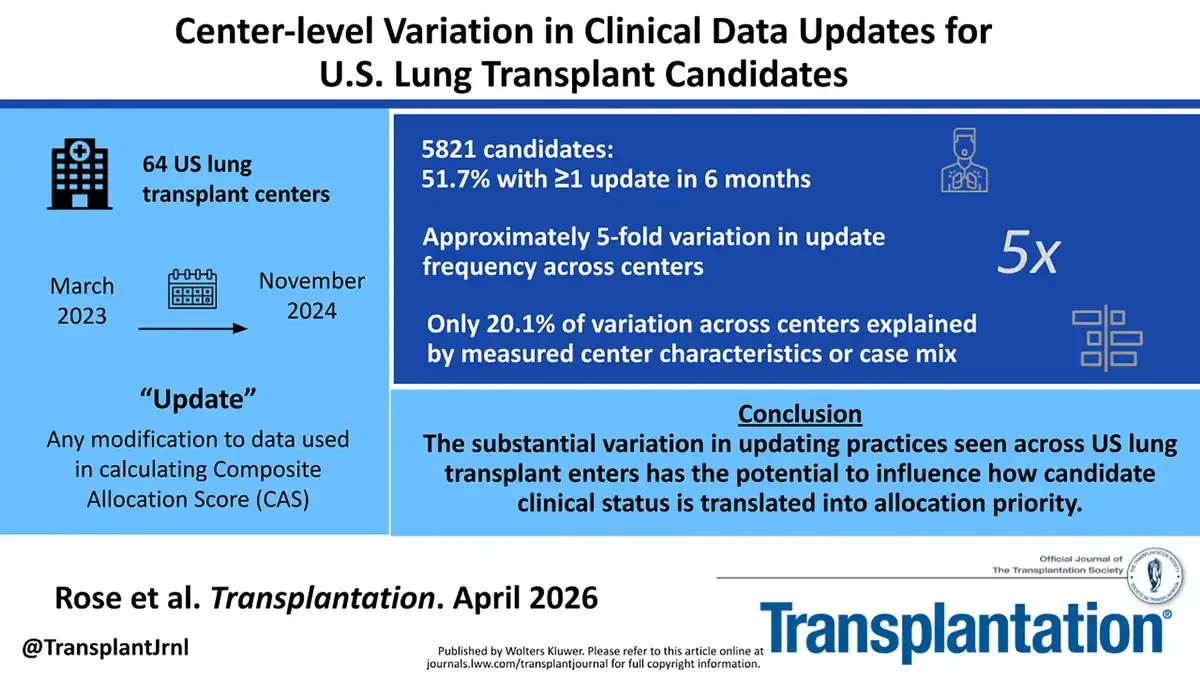
- Significant fivefold variation exists across US lung transplant centers in the frequency of clinical data updates among candidates.
- Over half of lung transplant candidates have at least one clinical data update within six months, but many receive fewer updates, particularly those with highest urgency due to shorter wait times.
- Center characteristics and candidate medical profiles explained less than 30% of the observed variability in update frequency, indicating center-specific practices largely drive differences.
- Unexplained heterogeneity in data updating could influence lung allocation priority, potentially affecting equity and outcomes in lung transplantation.
Background
Lung transplantation is a life-saving procedure for patients with end-stage lung diseases such as idiopathic pulmonary fibrosis, chronic obstructive pulmonary disease, and cystic fibrosis. Because donor lungs are a highly scarce resource, allocation systems prioritize candidates based on urgency and likelihood of benefit to optimize outcomes and equity. In the United States, allocation priorities are determined using the Composite Allocation Score (CAS), which incorporates clinical data submitted by transplant centers to the Organ Procurement and Transplantation Network (OPTN). The CAS integrates variables reflecting medical urgency and post-transplant survival prospects. Accurate and timely updating of these clinical variables is crucial to ensure candidates are prioritized appropriately. Despite policy specifying minimum frequency for updating clinical data, transplant centers have considerable discretion regarding how often they revise candidate information. This variation could impact how promptly patients are prioritized, influencing waitlist outcomes and fairness of organ allocation.Study Design
This investigation analyzed data from the Scientific Registry of Transplant Recipients (SRTR) focusing on adult lung transplant candidates listed from March 9, 2023, through November 1, 2024. The study examined the frequency of updates to CAS-related clinical variables within six months after listing across 64 US transplant centers encompassing 5,821 candidates. The primary endpoint was the rate of candidate clinical data updates, with median and interquartile range (IQR) of updates quantified. Statistical modeling utilized mixed-effects Poisson regression incorporating random effects at the center level, adjusting for candidate medical urgency and demographic factors. This approach assessed how much variation in update frequency could be explained by center attributes (e.g., volume, geographic region) and candidate characteristics (e.g., disease severity, urgency status).Key Findings
Among the 5,821 lung transplant candidates, 51.7% had at least one clinical data update within six months of listing. The median number of updates per candidate was 2 (IQR 1–3), but update frequency varied substantially across transplant centers, with an approximately fivefold difference between the least and most frequent updating centers. Candidates classified with the highest medical urgency received fewer updates. This finding reflects their shorter waitlist duration, leaving less time for repeated clinical reassessment. However, when controlling for candidacy and center-level factors, a large proportion of the variability in update frequency—approximately 70.9%—remained unexplained, underscoring the influence of center-specific practices rather than patient or center demographics. This unexplained variation suggests inconsistent approaches to candidate monitoring and data reporting across centers. Centers with less frequent updates may underrepresent changes in candidate condition, potentially altering CAS calculation and thus affecting organ allocation priority. Conversely, centers with more frequent updates may identify clinical deterioration sooner, possibly increasing candidates’ access to transplantation.Expert Commentary
The findings raise important questions about the transparency and consistency of clinical data reporting practices in lung transplantation. While regulatory frameworks mandate minimum data update intervals, the observed substantial heterogeneity highlights gaps in policy enforcement or interpretation. Experts in transplant ethics and policy might express concern that such variability could lead to systemic inequities whereby patients’ urgency is underestimated or overestimated depending on center practices rather than clinical reality. Standardizing update frequency or implementing automated triggers for data reassessment could minimize such disparities. Future research could investigate how update variability translates to differences in waitlist outcomes and post-transplant survival. Notably, the study benefits from robust registry data and advanced modeling, but limitations include reliance on reported updates rather than continuous clinical monitoring, and the inability to capture qualitative differences in data accuracy or comprehensiveness.Conclusion
This study reveals considerable center-level variation in the updating frequency of clinical data for US lung transplant candidates, with most of the variation unexplained by measured center or candidate factors. These findings suggest that nonclinical factors, such as center protocols or resource availability, influence how candidate status is reported and thus how allocation priority is determined. Ensuring equitable lung transplantation may require harmonized practices for clinical data updates, enhanced oversight, and potentially policy revisions to minimize variability and optimize allocation fairness.References
1. Rose J, Baker SL, Gunsalus PR, Lehr CJ, Dalton JE, Valapour M. Center-level Variation in Clinical Data Updates for US Lung Transplant Candidates. Transplantation. 2026 Jul 8;110(11):e2308-e2316. PMID: 42418258. 2. Organ Procurement and Transplantation Network (OPTN). Lung Allocation System Policy. Available at: https://optn.transplant.hrsa.gov/media/bi5k3t3t/lung_allocation_system.pdf 3. Valapour M, Lehr CJ, Skeans MA, et al. OPTN/SRTR 2021 Annual Data Report: Lung. Am J Transplant. 2023;23(S3):321-413. 4. Egan TM, Edwards LB. The new lung allocation system: moving toward evidence-based organ allocation. Am J Transplant. 2006;6(5 Pt 2):1099-101.Funding and Trial Registration
The study data were derived from the Scientific Registry of Transplant Recipients, funded by the Health Resources and Services Administration (HRSA). No clinical trial registration applies as this analysis used observational registry data.Specialty calculators
For clinical reference; use professional judgment.