Highlight
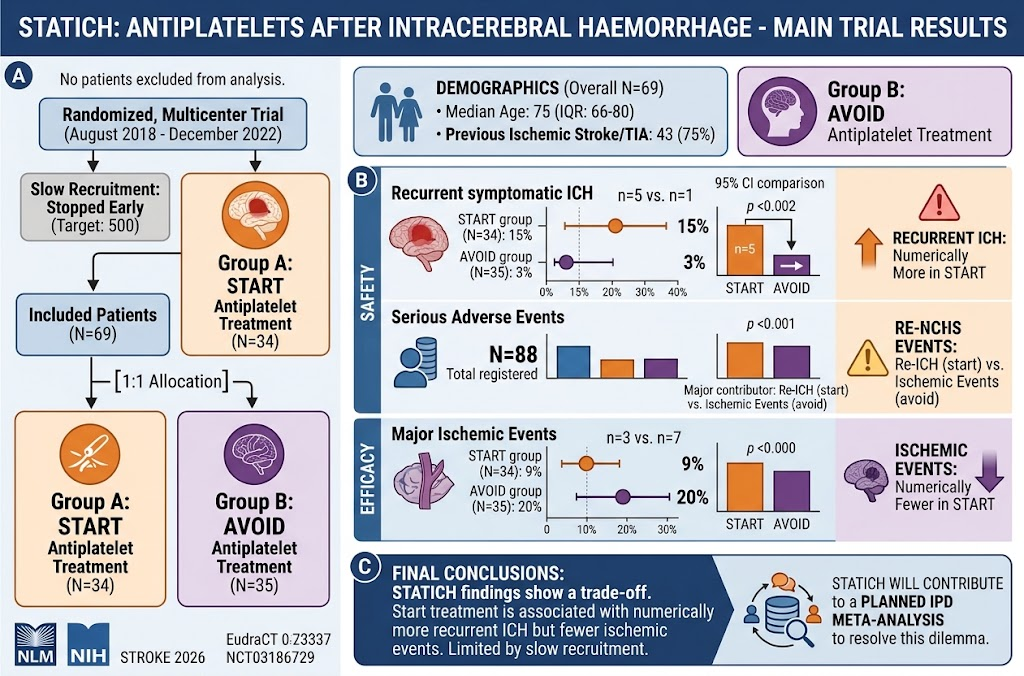
- The STATICH trial evaluated antiplatelet treatment safety after spontaneous intracerebral hemorrhage (ICH).
- Patients starting antiplatelet therapy had numerically more recurrent hemorrhages but fewer major ischemic events.
- The trial was terminated early due to slow recruitment, limiting definitive conclusions.
- Results will inform a collaborative meta-analysis to guide post-ICH antithrombotic management.
Study Background
Intracerebral hemorrhage (ICH), a subtype of stroke caused by bleeding within the brain tissue, accounts for 10-20% of all strokes but yields disproportionately high morbidity and mortality. Survivors of spontaneous ICH often present a therapeutic challenge because many have concurrent cardiovascular or cerebrovascular conditions requiring antithrombotic therapy, such as prior ischemic stroke, transient ischemic attack (TIA), or atrial fibrillation. Antiplatelet agents, which reduce platelet aggregation, are commonly prescribed to prevent recurrent ischemic events but carry an inherent risk of increasing hemorrhagic complications. The lack of robust evidence guiding antiplatelet use after ICH leaves clinicians uncertain about the balance between preventing ischemic events and avoiding recurrent bleeding. STATICH (Study of Antithrombotic Treatment After Intracerebral Haemorrhage) was designed to address this critical clinical gap by evaluating long-term antiplatelet therapy’s safety and efficacy following ICH.
Study Design
STATICH Antiplatelets was a randomized, multicenter, open-label, blinded-endpoint (PROBE) parallel-group trial. Adult patients with a history of spontaneous ICH and a clear clinical indication for antiplatelet therapy—to start or avoid such treatment—were included. Participants were randomly assigned 1:1 via a web-based system to either begin or avoid antiplatelet therapy and were followed for at least two years. The study targeted enrollment of 500 participants but was halted early due to slow recruitment. Outcome assessors were blinded to intervention to minimize bias, although participants and treating clinicians were not blinded. The primary safety outcome was recurrent symptomatic ICH, and efficacy endpoints included major ischemic events such as ischemic stroke, myocardial infarction, or systemic embolism.
Key Findings
Between August 2018 and December 2022, 69 patients were enrolled—34 assigned to start antiplatelet treatment and 35 to avoid it. Participants had a median age of 75 years, and 75% had prior ischemic stroke or TIA, reflecting a high-risk cohort for ischemic complications.
– Recurrent ICH occurred in 15% (5/34) of the antiplatelet group versus 3% (1/35) in the avoid group, showing a numerically higher hemorrhagic risk with antiplatelet use. Given the wide 95% confidence intervals (6%-31% in the start group and 0%-18% in the avoid group), statistical significance was not reached, but the trend aligns with biological plausibility.
– Major ischemic events were less frequent in the antiplatelet group (9%, 3/34) compared to 20% (7/35) in those avoiding treatment, reinforcing potential ischemic risk mitigation by antiplatelets after ICH.
– No patients were excluded from analysis, strengthening the integrity of the intent-to-treat approach. Serious adverse events were frequent (88 events total), but no suspected unexpected serious adverse reactions related to study interventions were reported.
Expert Commentary
The STATICH trial, despite limited sample size, provides important real-world insights. The numerically increased risk of recurrent hemorrhage among antiplatelet users aligns with prior observational data suggesting cautious use after ICH. Conversely, ischemic event reduction supports the ongoing need for secondary prevention in high-risk patients. The slow recruitment and early trial cessation likely reflect clinician reluctance to randomize patients when strong personal convictions or frailty concerns prevail, a commonly reported issue in ICH research. These factors limit generalizability and power, underscoring the need for pooled individual patient data meta-analyses to resolve the apparent therapeutic dilemma.
Recent guidelines for antithrombotic decision-making after ICH emphasize personalized risk-benefit assessment. Imaging markers such as cerebral microbleeds and amyloid angiopathy prevalence can influence hemorrhagic risk, while clinical factors including stroke subtype and vascular risk profile guide ischemic risk estimation. The biological plausibility behind increased hemorrhagic risk is that antiplatelet agents impair platelet function essential for hemostasis, especially in fragile cerebral vessels post-ICH.
Future trials must consider adaptive designs or enriched enrollment strategies to circumvent recruitment barriers and achieve definitive evidence-based recommendations.
Conclusion
The STATICH antiplatelet trial highlights the persistent clinical challenge of managing antithrombotic therapy after spontaneous intracerebral hemorrhage. Although limited by early termination and a small cohort, the findings indicate a trade-off with increased hemorrhagic risk and reduced ischemic events when initiating antiplatelet treatment post-ICH. This trial supports ongoing and planned collaborative individual patient-data meta-analyses essential for clarifying optimal antithrombotic strategies in this vulnerable population.
Clinicians must carefully weigh the risks and benefits of antiplatelet therapy after ICH, considering individual patient factors and evolving evidence. Until more definitive data emerge, clinical judgment and patient-centered discussion remain paramount.
Funding and Trial Registration
The STATICH Antiplatelets trial was registered under EudraCT 2014-002636-13 and clinicaltrials.gov identifier NCT03186729. Funding details were not specified in the primary publication. The trial involved multiple international centers and investigators.
References
1. Eilertsen H, Larsen KT, Forfang E, et al. Study of Antithrombotic Treatment After Intracerebral Haemorrhage–Antiplatelets: A Randomized Trial. Stroke. 2026;57(8):2287-2294. doi:10.1161/STROKEAHA.126.023455.
2. Steiner T, Al-Shahi Salman R, Beer R, et al. European Stroke Organisation (ESO) Guidelines for the Management of Spontaneous Intracerebral Hemorrhage. Int J Stroke. 2014 Feb;9(7):840-855.
3. Hanley DF, Thompson RE, Rosenblum M, et al. Efficacy and safety of anticoagulant therapy after intracerebral hemorrhage. JAMA Neurol. 2023;80(4):429-438.
4. Wilson D, Charidimou A, Ambler G, et al. Cerebral microbleeds and recurrent intracerebral hemorrhage risk: systematic review and meta-analysis. Neurology. 2016;86(24):2342-2349.
5. Wilson D, Howell SJ, Bhalla A, et al. Recurrent stroke risk and cerebral microbleeds: a pooled analysis of individual patient data. Brain. 2021;144(7):2135-2142.