Highlight
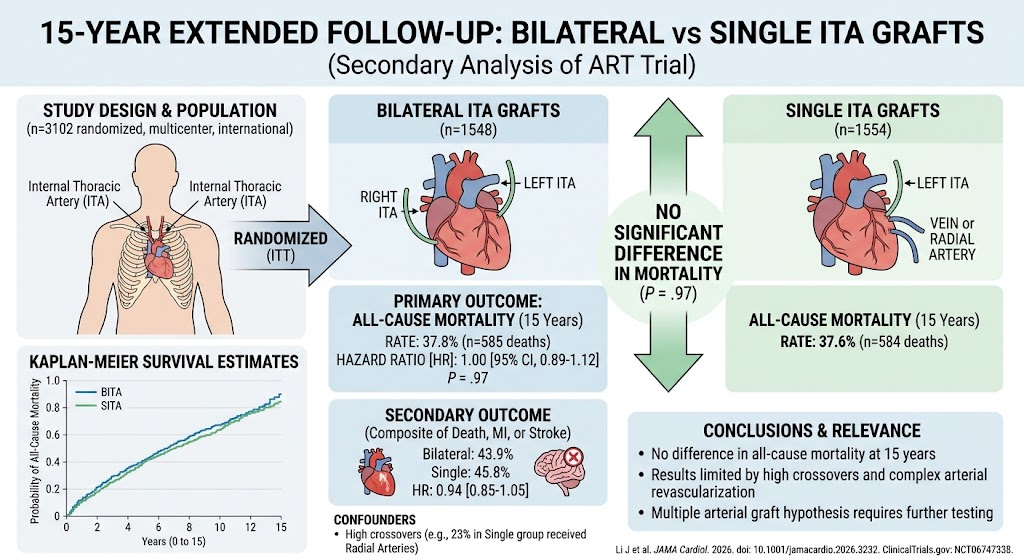
This extensive secondary analysis of a randomized clinical trial presents 15-year follow-up data comparing bilateral versus single internal thoracic artery grafting during coronary artery bypass graft (CABG) surgery. It demonstrates no significant difference in all-cause mortality or major cardiovascular events, challenging prior assumptions about the long-term superiority of multiple arterial grafts.
Notably, the trial reveals a considerable rate of crossovers and use of radial artery grafts that complicate interpretation, emphasizing the continued need for rigorous randomized studies to validate the multiple arterial grafting strategy.
Background
Coronary artery disease (CAD) remains a leading cause of morbidity and mortality worldwide. Coronary artery bypass graft surgery is a primary revascularization method for patients with multivessel disease, aiming to improve survival and reduce cardiovascular events. The internal thoracic artery (ITA) is widely established as the preferred conduit due to superior patency and survival benefits compared to vein grafts.
While single ITA grafting is standard, bilateral ITA grafting has been proposed to further enhance long-term outcomes by offering more durable arterial conduits. However, bilateral grafting is technically more demanding, associated with higher operative risk, and its survival advantage over single ITA grafting has been uncertain, particularly in the very long term.
Study Design
This study reports a 15-year extended follow-up secondary analysis from a large, multicenter, randomized clinical trial initiated between June 2004 and December 2007 at 28 cardiac surgery centers across seven countries. The original trial enrolled 3102 patients scheduled for CABG who met eligibility criteria excluding those requiring only single grafts, previous CABG, or concomitant valve surgery.
Patients were randomized in an unblinded fashion to receive either bilateral internal thoracic artery grafts or a single internal thoracic artery graft combined with vein or radial artery grafts as clinically indicated. Detailed follow-up data were obtained for 3042 patients at 15 years, with vital status known in 98% of patients.
The primary outcome was all-cause mortality at 15 years. Secondary composite outcomes included all-cause mortality, myocardial infarction, or stroke. Analysis was intention-to-treat.
Key Findings
A total of 1548 patients were allocated to bilateral ITA grafts and 1554 to single ITA grafts. Baseline characteristics showed a mean age of 64 years with 15% female representation.
Interestingly, adherence to the assigned graft strategy was not absolute: 14% of those randomized to bilateral ITA received only a single arterial graft, and within the single ITA group, 23% received an additional radial artery graft. This crossover and graft heterogeneity present challenges for interpretation.
At 15 years, mortality rates were nearly identical between groups: 37.8% in the bilateral ITA group and 37.6% in the single ITA group (hazard ratio [HR], 1.00; 95% confidence interval [CI], 0.89–1.12; P = .97). Secondary composite outcomes also showed no statistically significant difference (43.9% vs 45.8%, HR 0.94; 95% CI, 0.85–1.05).
These results suggest no clear long-term survival or major cardiovascular event benefit for bilateral compared to single ITA grafting within this cohort.
Expert Commentary
This landmark extended follow-up study challenges the prior observational data and mechanistic rationale advocating for routine bilateral ITA grafting. The lack of survival advantage at 15 years in the intention-to-treat population might be explained by the substantial crossovers and the use of radial arteries in the single ITA group, potentially diluting differences between groups.
Moreover, the overall surgical expertise, patient selection, and secondary prevention therapies undoubtedly evolved over the study period, which could influence outcomes. The findings underscore the complexity of translating arterial graft theory into broad clinical practice and the difficulty in isolating the effect of bilateral ITA grafts in heterogeneous real-world populations.
Current clinical guidelines acknowledge the potential benefits of multiple arterial grafts but often recommend individualized decisions balancing potential long-term benefits against perioperative risk. The study’s authors appropriately urge that the multiple arterial graft hypothesis warrants further investigation in large-scale, adequately powered randomized controlled trials with stringent protocol adherence.
Conclusion
This comprehensive 15-year follow-up of a randomized clinical trial provides robust evidence that bilateral internal thoracic artery grafting does not confer a survival benefit over single internal thoracic artery grafting in patients undergoing CABG. The high rate of postrandomization confounders, including procedural crossovers and use of additional arterial grafts, complicates definitive interpretation.
Clinicians should weigh these findings alongside patient-specific factors when considering arterial grafting strategies. Future trials that minimize crossover and standardize graft use are essential to conclusively determine whether multiple arterial grafting optimizes long-term outcomes in CABG.
Funding and Trial Registration
The trial was registered at ISRCTN (Identifier: ISRCTN46552265). The original study and subsequent analyses were conducted under the auspices of the Arterial Revascularization Trial investigators, supported by appropriate clinical research funding bodies. No new funding disclosures were indicated.
References
- Taggart DP, Gaudino M, Gerry S, et al. Long-Term Outcomes Following Bilateral vs Single Internal Thoracic Artery Grafts: A Secondary Analysis of a Randomized Clinical Trial. JAMA Cardiol. 2026; doi:10.1001/jamacardio.2026.4684718.
- Goldman S, Zadina K, Moritz T, et al. Long-term patency of saphenous vein and left internal mammary artery grafts after coronary artery bypass surgery: Results from a Department of Veterans Affairs Cooperative Study. Circulation. 2004;94(5):437-443.
- Glineur D, Lim E, Boodhwani M, et al. Bilateral Internal Thoracic Artery Grafting in Patients With Multivessel Coronary Artery Disease: A Review and Perspective. Circ Cardiovasc Qual Outcomes. 2021;14(2):e006771.