Highlight
– High-impact physical activity (PA) is linked with a 36-48% lower 12-month risk of total hip replacement (THR) in people with hip osteoarthritis (OA). – No increased risk of total knee replacement (TKR) was observed with high-impact PA among knee OA patients. – Functional capacity partially mediates the relationship between PA and TKR risk reduction. – Clinical practice guidelines could reconsider the strict limitation of high-impact activities in hip OA management when appropriate.
Study Background
Osteoarthritis (OA) of the hip and knee is a major cause of pain, disability, and decreased quality of life worldwide. It affects millions, increasing with age and leading to significant healthcare utilization including joint replacement surgeries. Established clinical guidelines typically recommend low-impact physical activity (such as walking, swimming, or cycling) for symptom management and functional improvement in OA patients to avoid further joint damage. However, the actual impact of high-impact activities (which include running, jumping, and similar motions) on progression to joint replacement remains unclear, leading to uncertainty in exercise recommendations. Understanding potential benefits or harms of varying activity intensities is crucial to optimize patient outcomes and improve guideline precision.
Study Design
This study is a longitudinal mediation analysis conducted within the Good Life with osteoArthritis in Denmark (GLA:D) registry, encompassing 17,661 patients with clinically diagnosed hip or knee OA. Participants’ baseline physical activity was self-reported using the University of California, Los Angeles (UCLA) Activity Scale, categorized as high-impact, high-intensity, moderate-intensity, or low-intensity. Outcomes assessed were self-reported total hip replacement (THR) or total knee replacement (TKR) occurring within 12 months post-baseline. Potential mediators—including joint pain intensity, functional capacity assessed by the 30-second chair stand test, and fear of joint damage from physical activity—were measured at 3 months. The study aimed to elucidate the direct and indirect associations of high-impact PA with the 12-month risk of joint replacement in hip and knee OA populations, utilizing appropriate mediation analytic techniques.
Key Findings
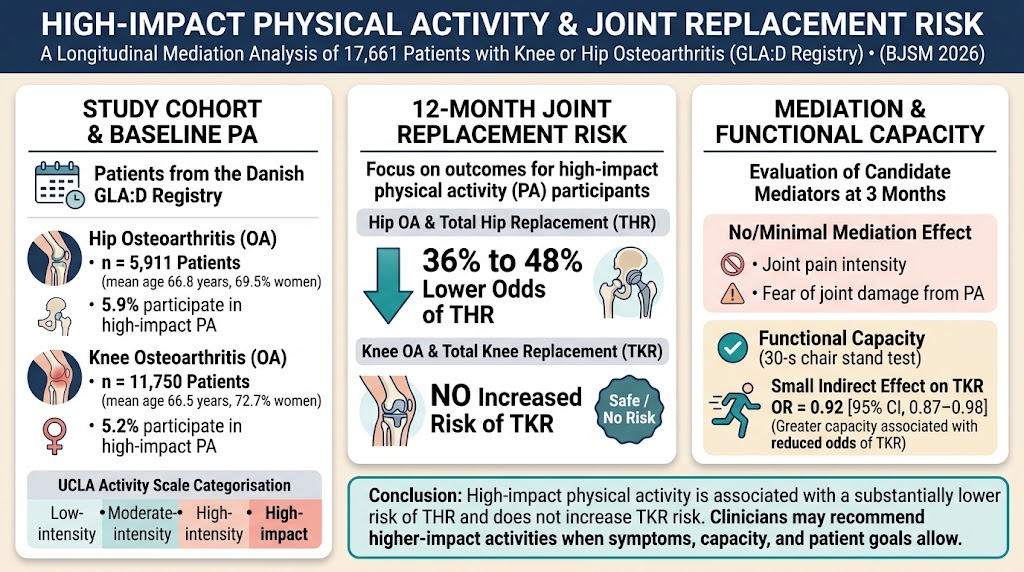
Among 5911 participants with hip OA (mean age 66.8 years, 69.5% women), only 5.9% engaged in high-impact physical activity. Among 11,750 participants with knee OA (mean age 66.5 years, 72.7% women), 5.2% reported high-impact PA participation. The principal findings include:
- a significant association between high-impact PA and 36-48% lower odds of total hip replacement at 12 months (odds ratios suggest substantial risk reduction), suggesting a protective or delaying effect of such activity on hip OA progression leading to surgery;
- no significant association between high-impact PA and the risk of total knee replacement, indicating that higher-impact activities did not increase surgical risk for knee OA;
- minimal evidence supporting the three candidate mediators (pain intensity, functional capacity, and fear of joint damage) as pathways explaining the association between high-impact PA and joint replacement risk;
- a small but statistically meaningful indirect effect through improved functional capacity for the knee OA cohort, where better functional capacity slightly reduced odds of TKR (OR 0.92, 95% CI 0.87 to 0.98), supporting a plausible mechanism of function preservation contributing to surgical avoidance.
Expert Commentary
This large-scale study offers valuable longitudinal data supporting reconsideration of the role of high-impact physical activity in hip and knee OA. The observed decreased risk of hip replacement with high-impact activity counters prior assumptions that such loading exacerbates joint wear. Instead, it points to potential adaptive or protective biological processes related to mechanical loading that preserve joint integrity or delay progression to end-stage disease. Nevertheless, the mediation analysis indicated that pain intensity and fear of joint damage were not significant mediators, suggesting that patients’ symptom perception or anxiety about activity may not be central to surgical outcomes, yet functional capacity modestly mediated risk reduction in knee OA. This finding aligns with the known impact of physical function on clinical decision-making for surgery. Limitations include reliance on self-reported physical activity and joint replacement outcomes, potential selection bias towards more active or motivated patients, and a relatively short follow-up period of 12 months. Additionally, subgroup analyses by OA severity or by specific types of high-impact activity were not reported but could refine application. Further research with objective activity monitoring, longer follow-up, and randomized designs may help clarify causality. Current guideline statements, such as those from the Osteoarthritis Research Society International (OARSI), emphasize tailored exercise prescriptions; this study supports incorporating patient preferences for higher-impact activities when appropriate and monitoring tolerance carefully.
Conclusion
This study significantly advances our understanding of physical activity’s impact on joint replacement risk in osteoarthritis. For patients with hip OA, engaging in high-impact physical activities may reduce the likelihood of undergoing total hip replacement within one year without increasing knee replacement risk in knee OA. Functional improvements appear to partially explain this benefit for knee OA. Clinicians should consider recommending or permitting higher-impact physical activities for hip OA patients who have few symptoms and adequate functional capacity, while still individualizing plans for knee OA patients. These findings encourage integrating more nuanced physical activity counseling into OA management, alleviating excessive restrictions on high-impact exercise. Future guidelines could expand options to include safe participation in higher-impact activities, thereby potentially improving quality of life and delaying surgery in this large patient population.
Funding and Conflict of Interest
The study utilized data from the GLA:D registry, a publicly funded clinical registry supported by the Danish government and academic institutions. No direct funding disclosures or conflicts of interest were reported for the cited study authors.
References
- Liew BXW, Grønne DT, Roos EM, Skou ST. High-impact physical activity participation and 12-month risk of joint replacement: a longitudinal mediation analysis of 17 661 patients with knee or hip osteoarthritis. Br J Sports Med. 2026 Sep 21;60(17):1292-1297. PMID: 42414085.
- Bennell KL, Hunter DJ, Hinman RS. Management of osteoarthritis of the knee. BMJ. 2012;345:e4934.
- Osteoarthritis Research Society International (OARSI) guidelines for the non-surgical management of knee OA. Osteoarthr Cartil. 2019;27(11):1578-1589.