Integrated Respiratory and Functional Training Enhances Weaning and Recovery After Emergency Abdominal Surgery: Insights from a Randomized Controlled Trial
Integrated respiratory and multidimensional functional training significantly improves weaning success from mechanical ventilation after emergency abdominal surgery.
Multidimensional functional training leads to greater peripheral muscle strength, improved functional independence, reduced pain, and shortened ICU length of stay compared to high-intensity inspiratory muscle training (IMT) plus conventional chest physiotherapy (CPT) alone.
Both training regimens improve maximal inspiratory pressure (MIP) similarly, highlighting the added value of functional training on overall recovery metrics beyond respiratory muscle performance.
Study Background
Emergency abdominal surgery is frequently complicated by respiratory muscle weakness and difficulty in weaning from mechanical ventilation—a critical determinant of morbidity, prolonged ICU stay, and increased healthcare costs. Respiratory muscle dysfunction and peripheral muscle weakness can delay ventilatory liberation, impair functional recovery, and increase pain postoperatively. While high-intensity inspiratory muscle training combined with conventional chest physiotherapy has been a standard approach to facilitate ventilator weaning, emerging evidence suggests that a multidimensional functional training program targeting both respiratory and peripheral muscles along with functional ability may enhance clinical outcomes. This study was conducted to evaluate whether integrated respiratory and functional training provides superior benefits compared to conventional IMT plus CPT for patients with difficult weaning after emergency abdominal surgery.
Study Design
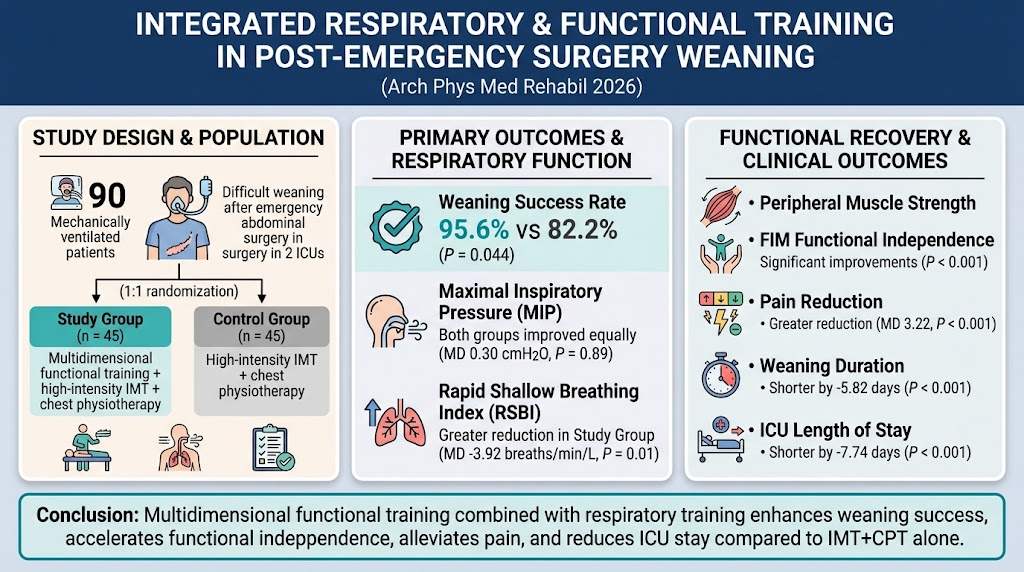
This prospective, multicenter, parallel-group, randomized controlled trial enrolled 90 mechanically ventilated adult patients experiencing difficult weaning following emergency abdominal surgery across two intensive care units. Participants were randomized 1:1 into two groups:
1. Study group: received multidimensional functional training incorporating high-intensity inspiratory muscle training plus conventional chest physiotherapy.
2. Control group: received high-intensity inspiratory muscle training combined with conventional chest physiotherapy alone.
Primary outcomes assessed were weaning success (liberation from mechanical ventilation) and maximal inspiratory pressure (MIP), an objective measure of respiratory muscle strength. Secondary outcomes included rapid shallow breathing index (RSBI), peripheral muscle strength (including key muscle groups), functional independence measured by the Functional Independence Measure (FIM), subjective pain scores, duration of weaning, and intensive care unit (ICU) length of stay.
Key Findings
The trial reported several important results:
Weaning Success: The study group showed significantly higher rate of successful weaning at 95.6% compared to 82.2% in the control group (P = 0.044), demonstrating clinical superiority of the integrated training approach.
Respiratory Muscle Strength: Both groups achieved significant improvements in maximal inspiratory pressure (MIP) from baseline; however, no statistically significant difference existed between groups post-intervention (mean difference 0.30 cmH₂O; 95% CI: -4.11 to 4.72; P=0.89), indicating that IMT efficacy was maintained irrespective of additional functional training.
Peripheral Muscle Strength and Functional Independence: The study group exhibited significantly greater improvements across all measured peripheral muscle strength domains and in functional independence as assessed by FIM (all P<0.001). This implies that multidimensional functional training enhances global muscular and functional recovery beyond respiratory-specific effects.
Rapid Shallow Breathing Index (RSBI): There was a greater reduction in RSBI in the study group compared with controls (MD=-3.92 breaths/min/L; 95% CI: -6.85 to -1.00; P=0.01), suggestive of better respiratory efficiency and reduced work of breathing.
Pain Reduction: Patients undergoing integrated training reported significantly lower pain scores (MD=3.22; 95% CI: 3 to 3.44; P<0.001), highlighting the potential analgesic or rehabilitative benefits of enhanced mobility and respiratory function.
Weaning Duration and ICU Length of Stay: The study group required fewer days to complete weaning (mean difference -5.82 days; 95% CI: -7.98 to -3.67; P<0.001) and had shorter ICU stays (MD=-7.74 days; 95% CI: -11.37 to -4.11; P<0.001), signifying faster recovery and reduced resource utilization.
Expert Commentary
The findings of Mehani et al. add robust evidence supporting the implementation of multidimensional functional rehabilitation programs in critically ill post-surgical patients requiring prolonged mechanical ventilation. The integration of respiratory muscle training with peripheral strengthening and functional mobility exercises addresses the multifactorial nature of muscle deconditioning and respiratory insufficiency seen in this population.
While inspiratory muscle training effectively targets diaphragm and accessory respiratory muscles, peripheral muscle weakness is equally salient in delaying ventilator liberation and functional independence. The improvement in FIM scores and reduction in pain likely facilitate earlier mobilization and physical autonomy, which are critical for long-term recovery. Furthermore, the significant decrease in ICU length of stay underscores both clinical and economic value.
Limitations of this study include the relatively small sample size and setting limited to two ICUs, which may affect generalizability. Additionally, long-term follow-up assessing sustained functional outcomes and quality of life would help elucidate the broader impact of this integrated intervention. Future studies may explore dose-response relationships and feasibility in diverse critical care contexts.
Conclusion
In mechanically ventilated patients undergoing emergency abdominal surgery with difficult weaning, integrated respiratory and multidimensional functional training significantly improves weaning success, peripheral muscle strength, functional independence, pain management, and shortens weaning duration and ICU stay compared with high-intensity IMT plus conventional chest physiotherapy alone. These findings advocate for a holistic rehabilitative approach targeting both respiratory and peripheral musculature to optimize recovery trajectories in critically ill surgical patients.
Funding and Clinical Trials Registry
The original study publication did not specify funding sources or clinical trial registration details in the abstract. Accessing the full article may provide additional transparency regarding support and ethical approvals.
References
1. Mehani SHM, Mohamed AA, Mohamed MS, Mahmoud MIM. Effect of Integrated Respiratory and Functional Training on Weaning from Mechanical Ventilation, Respiratory and Peripheral Muscle Strength, Functional Ability, and Pain After Emergency Abdominal Surgery: A Randomized Controlled Trial. Arch Phys Med Rehabil. 2026 Oct 09. PMID: 42854888.
2. Boles JM, Bion J, Connors A, et al. Weaning from mechanical ventilation. Eur Respir J. 2007 May;29(5):1033-56.
3. Ziganshina LE, Arbatova AG, Kiselev AR, et al. Inspiratory muscle training for patients undergoing mechanical ventilation: a systematic review and meta-analysis. Crit Care. 2019 Apr 25;23(1):163.
4. Needham DM, Truong AD, Fan E. Technology to enhance physical rehabilitation of critically ill patients. Crit Care Med. 2009;37(10 Suppl):S436-41.
These references contextualize the evidence base and complement the study’s findings within the current critical care rehabilitation landscape.