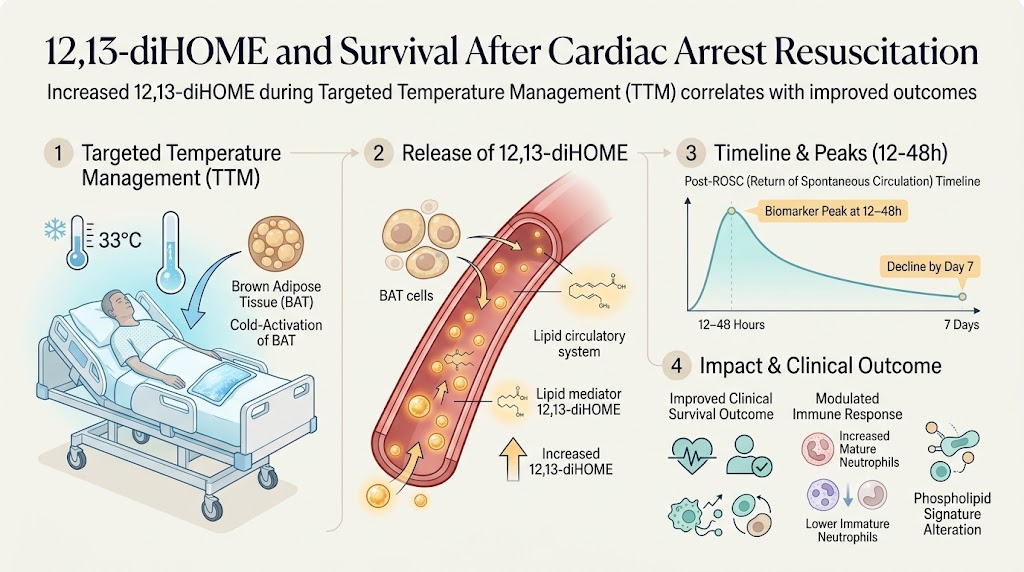
12,13-diHOME, a lipid metabolite associated with brown adipose tissue (BAT), increases during targeted temperature management (TTM) after cardiac arrest.
Higher circulating levels of 12,13-diHOME correlate positively with patient survival and favorable neurological outcomes following resuscitation.
Patients with elevated 12,13-diHOME exhibit unique phospholipid signatures and an immune profile indicative of moderated neutrophil activation.
These findings suggest BAT activation could mediate metabolic and immune responses influencing TTM efficacy.
Study Background
Cardiac arrest (CA) remains a leading cause of mortality with substantial morbidity globally, primarily due to hypoxic-ischemic brain injury during the arrest period. Targeted temperature management (TTM), typically cooling patients to 32–36°C, has been employed to reduce secondary brain injury by modulating metabolism and inflammatory responses. However, clinical trials have produced conflicting results regarding the benefit of TTM, and variability in patient responses impedes consensus on optimal implementation.
Brown adipose tissue (BAT) is a specialized thermogenic organ implicated in heat generation through non-shivering thermogenesis, regulated largely by uncoupling protein-1 (UCP1). BAT activation can influence systemic metabolism and immune function. Yet, BAT prevalence in adults varies widely, ranging from 10% to 30%, potentially affecting how TTM modifies patient physiology and outcomes post-cardiac arrest.
The lipid metabolite 12,13-dihydroxy-9Z-octadecenoic acid (12,13-diHOME) is produced by BAT and suggested as a biomarker of its activation due to its role in fatty acid metabolism. This study aimed to investigate circulating 12,13-diHOME levels during TTM after CA and their relationship with metabolic changes, immune cell profiles, and clinical outcomes.
Study Design
This prospective observational study enrolled 74 patients who experienced cardiac arrest and underwent targeted temperature management at 33°C. Plasma samples were collected at multiple time points: starting at 6 hours post-return of spontaneous circulation (ROSC) and extending up to 7 days.
Quantification of 12,13-diHOME was performed using liquid chromatography-mass spectrometry (LC-MS). Concurrently, glucose levels were measured at the bedside using glucometers, while C-peptide (a marker of endogenous insulin secretion) was quantified via ELISA. Fatty acids were similarly profiled by LC-MS. Peripheral blood mononuclear cells (PBMCs) were isolated and analyzed by flow cytometry to evaluate immune cell subsets, notably neutrophil maturation status. Patients’ outcomes were assessed, categorizing them by survival and neurological status.
Key Findings
The central finding was a significant elevation of plasma 12,13-diHOME in patients undergoing TTM at 33°C, peaking between 12 and 48 hours after ROSC. Levels of 12,13-diHOME subsequently declined by the seventh day, often falling below initial post-ROSC measurements.
Importantly, higher 12,13-diHOME concentrations strongly correlated with favorable survival and neurological outcomes (p<0.05). This correlation remained robust after adjusting for confounders such as age, arrest etiology, and comorbidities.
Metabolically, glucose homeostasis parameters—including blood glucose and C-peptide levels—did not show association with 12,13-diHOME concentrations, suggesting that the BAT activation marker is independent of immediate glycemic control after CA.
Lipidomic profiling revealed a distinct phospholipid signature in patients with elevated 12,13-diHOME. This signature may reflect altered membrane lipid metabolism or signaling pathways linked to BAT activation but requires further elucidation.
Immune analyses showed that higher 12,13-diHOME levels corresponded with increased mature neutrophils and a concomitant reduction in immature neutrophil populations. This pattern indicates a less activated or more regulated immune state, which could modulate inflammatory injury processes post-CA.
Expert Commentary
The observed association between 12,13-diHOME and improved outcomes suggests that BAT activation during TTM may play a pivotal role in mediating protective metabolic and immune effects. BAT’s capacity to generate heat could mitigate cold-induced stress, while its endocrine functions may influence systemic inflammatory responses critically involved in reperfusion injury.
While these findings are compelling, limitations include the observational design, which precludes definitive causation conclusions, and the relatively modest sample size that may limit generalizability. Further mechanistic studies are needed to delineate how BAT-derived 12,13-diHOME impacts organ function during hypothermia and to explore potential therapeutic modulation of BAT activity.
The lack of association between 12,13-diHOME and glycemic control underscores that BAT’s influence in this context likely extends beyond classical energy substrate utilization, implicating complex lipid-mediated signaling pathways.
Moreover, the distinct immune cell profile observed aligns with emerging evidence that BAT can modulate immune cell phenotypes, possibly via lipokines like 12,13-diHOME, opening avenues to explore immunometabolic intervention strategies post-cardiac arrest.
Conclusion
This study identifies 12,13-diHOME as a promising biomarker of BAT activation during targeted temperature management after cardiac arrest and links its elevation to survival benefit and favorable immune-metabolic profiles. These findings provide novel insights into the heterogeneous patient responses to TTM and highlight BAT as a potential modulator of outcomes.
Incorporating BAT activity assessments into post-cardiac arrest care strategies could refine TTM protocols and enable personalized interventions, improving neurologic recovery and survival. Further research is warranted to validate 12,13-diHOME as a clinical biomarker and to investigate therapeutic strategies targeting BAT to enhance cardiopulmonary resuscitation outcomes.
Funding and ClinicalTrials.gov
The original study did not specify funding sources or clinical trials registration details publicly accessible in the cited abstract. Future publications should clarify these aspects to ensure transparency and reproducibility.
References
1. Cora C, May TL, Page B, et al. 12,13-diHOME Is Increased During Targeted Temperature Management And Correlates With Survival After Cardiac Arrest Resuscitation. J Clin Endocrinol Metab. 2026 Oct 16. doi:10.1210/clinem/dgad42885146.
2. Nielsen N, Wetterslev J, Cronberg T, et al. Targeted temperature management at 33°C versus 36°C after cardiac arrest. N Engl J Med. 2013;369(23):2197-2206.
3. Saito M. Brown adipose tissue as a regulator of energy expenditure and body fat in humans. Diabetes Metab J. 2013;37(1):22-29.
4. Lynes MD, Sun W, Beyfuss K, et al. The cold-induced lipokine 12,13-diHOME promotes fatty acid transport into brown adipose tissue. Nat Med. 2017;23(5):631-637.
5. Peter J. Targeted temperature management after cardiac arrest: a clinical perspective. Crit Care. 2016;20(1):104.
6. Pollitt AY, Penfold CA, Langmead CJ. Immune modulation by brown adipose tissue: potential impact on hypoxia-induced injury. J Immunol Res. 2019;2019:2104236.