Highlights
- The REVISE trial demonstrated high overall consent rates (85%) in a critically ill, mechanically ventilated population, with significant variability across centers.
- Deferred consent (‘consent to continue’) was as frequently employed as a priori consent and was strongly associated with higher consent rates, mitigating early refusal in vulnerable ICU patients.
- Consent encounters directly involving patients yielded higher provision rates compared to those involving substitute decision-makers (SDMs), illuminating ethical and pragmatic considerations in critical illness research consent processes.
- The COVID-19 pandemic introduced protocol adaptations including increased telephone consent and shifted consent models that maintained or improved consent rates despite challenging research conditions.
Background
Critical care research often involves highly vulnerable, incapacitated patients, posing unique challenges to obtaining informed consent ethically and feasibly. Stress ulcer prophylaxis (SUP) in intensive care units (ICUs) is a common intervention intended to prevent gastrointestinal bleeding in mechanically ventilated patients; however, its efficacy and safety remain debated. The REVISE trial, an international randomized controlled study comparing intravenous pantoprazole to placebo for SUP among invasively ventilated adults, provides valuable data not only on clinical outcomes but also on the processes and predictors of informed consent in this complex setting. Understanding consent behaviors and factors influencing consent provision is essential for optimizing ethical conduct, protocol adherence, and patient autonomy in ICU research.
Key Content
Chronological Development and Context of REVISE Trial
The REVISE trial’s pilot phase, initiated before 2016, set out to explore the feasibility of withholding proton pump inhibitors for SUP, challenging prevailing clinical practices weakened by concerns over low GI bleeding incidence and potential adverse infections. Gradually expanding to multiple centers internationally, the study incorporated rigorous randomized methods with blinded allocation, including adult mechanically ventilated ICU patients anticipated to require >48 hours of ventilation.
The COVID-19 pandemic presented an unprecedented disruption to clinical research globally. According to Mehta et al. (2024), during the pandemic’s onset, ICU research activities were paused or adapted. The REVISE trial reports from March 2020 to August 2022 revealed an increase in participating centers (from 18 to 59) and enrollment during this period, demonstrating resilience and adaptability in trial conduct.
Patterns of Informed Consent in the REVISE Trial
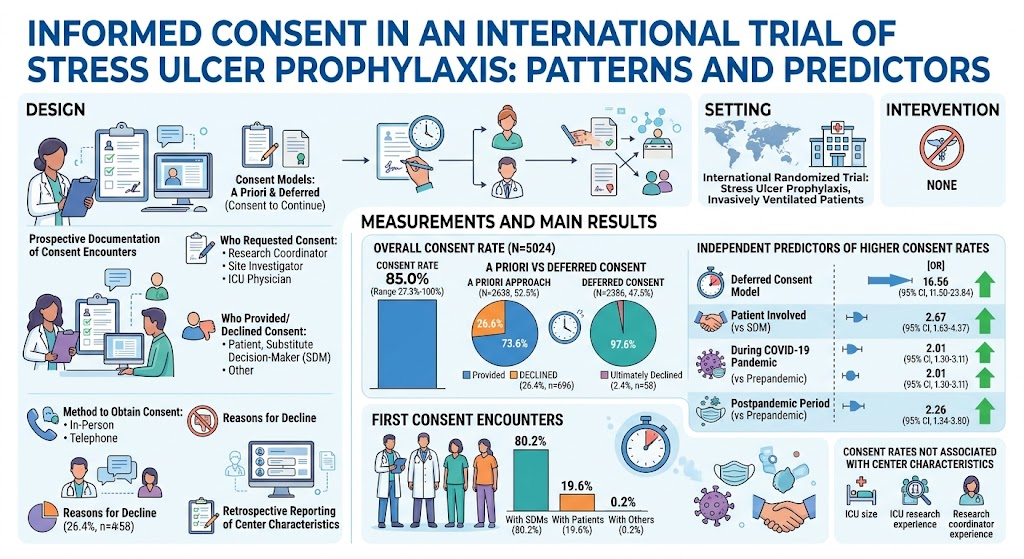
Prospective documentation by research coordinators captured granular details on consent encounters. Two key consent models emerged:
- A priori consent: Obtained before enrollment, requiring explicit agreement prior to any intervention.
- Deferred consent (Consent to Continue): Enrollment proceeds with later consent obtained from patients or SDMs. Deferral addresses the immediacy of intervention needs when patients are incapacitated.
Among 5024 approached patients/SDMs, consent was secured in 85.0% overall, with wide variation (27.3% to 100%) across centers. Half the patients underwent a priori consent, with a sizeable refusal rate of 26.4%. Conversely, the deferred consent group, constituting 47.5%, had a much lower refusal rate (2.4%), underscoring deferred consent’s effectiveness in reducing early refusals.
Most consent requests (80.2%) involved SDMs rather than patients (19.6%). Logistic regression analysis revealed that consent provision was independently higher with:
- Deferred consent (Odds Ratio [OR] 16.56, 95% CI 11.50–23.84)
- Encounters with the patient themselves (OR 2.67, 95% CI 1.63–4.37)
- Encounters during or after the COVID-19 pandemic, compared to pre-pandemic (OR 2.01 and 2.26 respectively)
No significant association was found with center-level characteristics, such as ICU size, research experience, or coordinator expertise, suggesting that consent dynamics were more closely linked to consent approach and interaction modality than to institutional factors.
Adaptations During the COVID-19 Pandemic
Aligned with findings from the 2024 BMCMed Research Methodology study, the pandemic necessitated procedural flexibility:
- Shift from predominantly a priori consent to consent to continue models allowed critical timely enrollment.
- Telephone-based consent interactions surged from 16.6% to 68.2%, facilitating consent while minimizing exposure risks.
- Opt-out consent models were piloted in select centers under specific regulatory approvals.
- Data monitoring and patient transfers were optimized for continued trial integrity.
These adaptations appear to have positively influenced consent rates and supported sustained research during global healthcare crises.
Expert Commentary
The REVISE trial’s detailed investigation into informed consent reveals key insights into ethical and operational challenges in ICU research. The high refusal rate with a priori consent highlights difficulties engaging incapacitated or surrogate decision-makers under acute stress. Deferred consent mitigates these barriers by allowing prompt enrollment with subsequent consent, respecting autonomy without jeopardizing urgent care or research integrity.
That encounters directly involving patients had higher consent rates suggests that whenever possible, patient engagement is preferable. Yet, critical illness frequently precludes this, emphasizing the need for robust surrogate decision-making frameworks. The elevated consent rates during and after the pandemic likely reflect the methodological shifts and the heightened research momentum despite logistical challenges.
The lack of correlation with center characteristics underscores that effective consent processes rely more on consent model choice and interaction quality than on institutional scale or staff experience, emphasizing standardization and training focused on consent communications.
From an ethical perspective, deferred consent remains controversial but is increasingly validated in emergency and critical care research. The REVISE trial data add empirical support for its pragmatic utility and acceptability, especially when timely enrollment is critical. Researchers and ethics committees should consider its inclusion in protocol designs while balancing regulatory requirements and participant protections.
Conclusion
The REVISE international trial of stress ulcer prophylaxis provides comprehensive evidence on informed consent dynamics in critical care research:
- Consent rates are significantly influenced by the consent model, with deferred consent markedly improving participation.
- Direct patient involvement raised consent likelihood, although SDMs predominated as decision-makers.
- COVID-19 pandemic-related adaptations, including remote and deferred consent, maintained high consent rates amid unprecedented clinical challenges.
- Institutional factors appear less predictive of consent provision than consent approach and encounter characteristics.
These findings have vital implications for designing and conducting ethical, pragmatic ICU trials. Adopting flexible, patient-centered consent strategies tailored to critical illness contexts—such as deferred consent and remote engagement—may optimize enrollment and respect participant autonomy. Further research exploring reasons for consent refusal and long-term outcomes relating to consent models can augment ethical frameworks governing critical care research.
Reference
Mehta S, Burns KEA, Zytaruk N, Heels-Ansdell D, Hand L, Clarke F, Hardie M, Lad V, Geagea A, Binnie A, Lauzier F, Tsang JLY, Finfer S, Hanlon G, Gresham R, Marshall JC, English SW, Rochwerg B, Adhikari NKJ, Al-Fares A, Jichici D, Engels P, Sharma S, Bhadange N, Stevens W, Reis G, Archambault PM, Charbonney E, Zarychanski R, Vazquez-Grande G, Ovakim D, Karachi T, Dionne JC, Niven DJ, St-Arnaud C, Waheed M, Cook D; Reevaluating the Inhibition of Stress Erosions (REVISE) Research Coordinators, REVISE Investigators, Canadian Critical Care Trials Group, and the Australian and New Zealand Intensive Care Society Clinical Trials Group. Informed Consent in an International Trial of Stress Ulcer Prophylaxis: Patterns and Predictors. Crit Care Med. 2026 Aug 21. doi: 10.1097/CCM.0000000000007314. Epub ahead of print. PMID: 42627200.