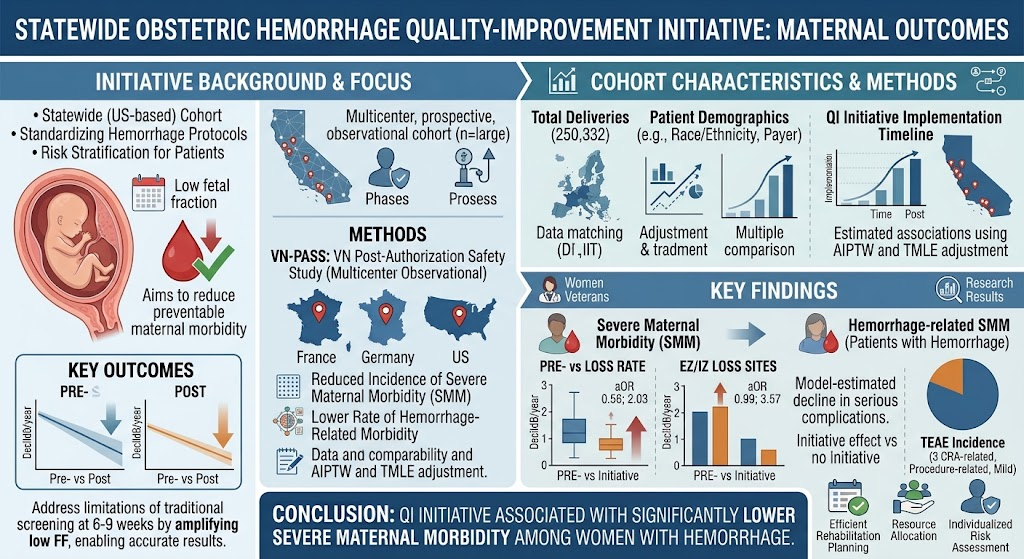
Impact of the New York Safe Motherhood Initiative on Obstetric Hemorrhage Outcomes: A Statewide Evaluation

Highlight

The New York Safe Motherhood Initiative implemented a statewide obstetric hemorrhage bundle between 2013 and 2015, aiming to improve management and reduce adverse outcomes of postpartum hemorrhage (PPH). Analysis of over 3.5 million delivery hospitalizations from 2007 to 2022 revealed continuous rise in PPH incidence but significant reductions in transfusions, severe maternal morbidity (SMM), disseminated intravascular coagulation (DIC), and hysterectomy rates coinciding with the program’s implementation. Adjusted analyses suggest sustained benefits in reducing maternal morbidity despite increasing patient complexity over time.


Background: Burden of Postpartum Hemorrhage and Need for Quality Improvement

Postpartum hemorrhage is a leading cause of maternal morbidity and mortality worldwide. In the United States, rates of PPH and associated complications have escalated over recent decades, posing a major challenge to obstetric care. Effective management strategies are critical, as hemorrhage can rapidly progress to severe morbidity including disseminated intravascular coagulation and emergency hysterectomy. Quality improvement initiatives targeting early recognition and standardized response protocols have shown promise in reducing adverse outcomes, yet large-scale evidence remains sparse.

Study Design and Methods

This repeated ecological cross-sectional study analyzed the New York State Inpatient Database encompassing delivery hospitalizations from 2007 through 2022. The analysis focused on the impact of the Safe Motherhood Initiative’s obstetric hemorrhage care bundle delivered between 2013 and 2015 across multiple hospitals statewide. Primary outcomes included the incidence of PPH and adverse events among PPH-affected deliveries: blood transfusion, nontransfusion severe maternal morbidity (SMM), disseminated intravascular coagulation (DIC), and hysterectomy. Joinpoint regression was applied to determine average annual percent changes (AAPC) in these outcomes across three intervals (pre-, during, and post-intervention). Additional adjusted logistic regression models accounted for patient- and hospital-level covariates to assess odds of adverse outcomes over time.

Key Findings and Results

Throughout the study period, the incidence of PPH increased markedly from 22 per 1,000 deliveries in 2007 to 59 per 1,000 in 2022 (AAPC 6.9%, 95% CI 6.5–7.5%). This rise may reflect changes in clinical coding, maternal risk profiles, or population health trends.

Among deliveries complicated by PPH, transfusion rates initially increased from 192 per 1,000 in 2007 to 212 per 1,000 in 2013, immediately preceding bundle implementation, but then decreased significantly to 174 per 1,000 by 2016 (AAPC -6.8%). Transfusion rates increased again post-2016, reaching 212 per 1,000 in 2022, suggestive of complex temporal trends possibly related to patient factors or clinical practices.

Severe maternal morbidity (excluding transfusion) rose from 88 per 1,000 in 2007 to 122 per 1,000 in 2014 but declined sharply to 76 per 1,000 by 2017 (AAPC -16.3%), representing a substantial improvement coinciding with hemorrhage bundle implementation. However, a rise to 88 per 1,000 in 2022 indicates fluctuation needing further exploration.

DIC showed a similar pattern: increasing to 90 per 1,000 in 2014, decreasing to 53 per 1,000 in 2017, and rising again to 88 per 1,000 by 2022 without significant association post-intervention.

Most notably, hysterectomy rates demonstrated a continuous and significant decline from 26 per 1,000 in 2013 to 9 per 1,000 by 2022 (AAPC -10.2%), indicating sustained impact on this severe and life-altering outcome.

Adjusted logistic regression models confirmed decreased odds of severe morbidity and hysterectomy in the post-implementation period (2016–2022) compared with baseline (2007), after controlling for confounders such as patient demographics and hospital characteristics. This suggests that despite increasing severity of maternal comorbidities and case complexity, the intervention contributed to improved maternal safety.

Expert Commentary

The findings from Winter et al. compellingly illustrate the effectiveness of a statewide quality improvement initiative in mitigating the adverse consequences of postpartum hemorrhage, a major obstetric emergency. The transient decreases in transfusion and severe morbidity align temporally with bundle implementation and highlight the value of coordinated care protocols, early hemorrhage recognition, and management standardization.

Persistent reduction in hysterectomy rates points to enhanced hemorrhage control preserving fertility and maternal quality of life. Nevertheless, the subsequent increases in some adverse measures warrant ongoing surveillance and targeted strategy adaptation. Potential confounders, including evolving patient risk profiles and coding practices, temper interpretation and signal the need for continued research.

These results underscore the importance of statewide collaboration, data-driven monitoring, and sustained investment in maternal safety programs. Future interventions might benefit from incorporating patient-centered approaches, rapid response training, and real-time data feedback loops.

Conclusion

The New York Safe Motherhood Initiative’s obstetric hemorrhage bundle was associated with meaningful improvements in key maternal outcomes following postpartum hemorrhage. While PPH incidence increased, implementation correlated with reductions in transfusion, severe morbidity, disseminated intravascular coagulation, and notably hysterectomy. The study highlights that structured, state-level quality improvement efforts can effectively enhance maternity care safety and reduce life-altering complications. Continued efforts are essential to maintain gains and address resurgent trends in adverse outcomes.

Funding and Registration

This analysis was based on publicly available administrative data and did not specify additional funding sources. The original study was conducted by Winter et al. and published in Obstetrics and Gynecology in May 2026.

References

1. Winter EE, Wen T, Goffman D, et al. Maternal Outcomes Associated With a Statewide Obstetric Hemorrhage Quality-Improvement Initiative. Obstet Gynecol. 2026;148(2):217-228. doi:10.1097/AOG.000000000000xxxx

2. Knight M, Callaghan WM, Berg C, et al. Trends in postpartum hemorrhage in high resource countries: a review and recommendations from the International Postpartum Hemorrhage Collaborative Group. BMC Pregnancy Childbirth. 2014;14:257.

3. Main EK, McCain CL, Morton CH, et al. Obstetric hemorrhage safety program: implementation and outcomes. Obstet Gynecol. 2017;130(3):569–579.

4. American College of Obstetricians and Gynecologists. Practice Bulletin No. 183: Postpartum Hemorrhage. Obstet Gynecol. 2017;130(4):e168–e186.

Comments

No comments yet. Why don’t you start the discussion?

Leave a Reply