Highlight
This large national study assesses 30-day mortality following perioperative cardiac arrest (POCA) in children undergoing inpatient noncardiac surgery and finds no significant racial or ethnic disparities. Mortality is notably associated with clinical predictors such as emergent surgery and preoperative inotropic support rather than racial or ethnic background.
Study Background
Perioperative cardiac arrest (POCA) in pediatric patients, while fortunately rare, remains a significant clinical event due to high associated morbidity and mortality. Understanding factors contributing to outcomes after POCA is crucial for improving pediatric surgical safety and survival. Racial and ethnic disparities in healthcare outcomes have been documented across numerous medical conditions and surgical settings. However, whether such disparities exist in pediatric POCA survival has remained unclear. Identifying whether racial or ethnic groups have different outcomes after such critical events may guide targeted improvements to promote equity in pediatric surgical care.
Study Design
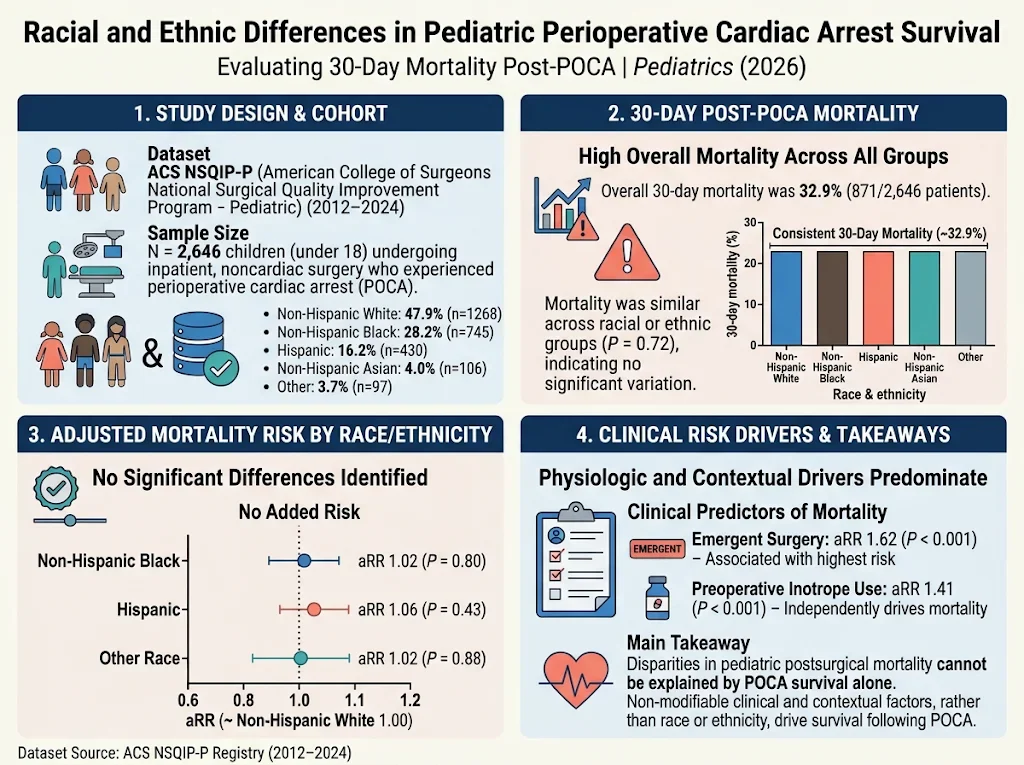
The study utilized data from the American College of Surgeons National Surgical Quality Improvement Program for Pediatrics (NSQIP-P) registry between 2012 and 2024. It included 2646 children under 18 years old who underwent inpatient, noncardiac surgery and experienced a perioperative cardiac arrest. Patients were categorized by self-reported race and ethnicity into Hispanic, non-Hispanic Asian, non-Hispanic Black or African American, non-Hispanic white, and other. The primary endpoint evaluated was 30-day postoperative mortality. Both crude mortality rates and adjusted relative risks using multivariable regression controlling for potential confounders were analyzed.
Key Findings
The overall 30-day mortality rate after POCA in this pediatric cohort was 32.9%, a substantial figure reflecting the severity of this complication. The racial and ethnic distribution was: non-Hispanic white (47.9%), non-Hispanic Black (28.2%), Hispanic (16.2%), non-Hispanic Asian (4.0%), and other (3.7%). Unadjusted analysis revealed similar mortality rates across all racial and ethnic groups (P = 0.72), indicating no statistically significant differences. Adjusted analyses, accounting for clinical variables, confirmed these findings. Compared to non-Hispanic white children, adjusted relative risks (aRR) for 30-day mortality were 1.02 (P = 0.80) for non-Hispanic Black children, 1.06 (P = 0.43) for Hispanic children, and 1.02 (P = 0.88) for other races, demonstrating no significant disparities in mortality risk by race or ethnicity.
Notably, clinical factors such as undergoing emergent surgery (aRR 1.62, P < 0.001) and use of preoperative inotropes (aRR 1.41, P < 0.001) were independently associated with increased mortality risk. These findings suggest that physiological vulnerability and urgency of surgery strongly influence survival post-POCA.
Expert Commentary
This study provides valuable evidence that, within the context of perioperative cardiac arrest in children, racial and ethnic disparities in mortality are not evident, contrasting with disparities often reported in other surgical or medical conditions. The large, multicenter registry dataset and rigorous adjustment for clinical variables lend robustness to these conclusions. However, limitations inherent to registry analyses such as potential unmeasured confounding and inability to capture long-term outcomes should be acknowledged.
These results highlight that perioperative mortality in pediatric cardiac arrest is predominantly influenced by medical acuity and perioperative management factors rather than racial or ethnic factors. This finding implies that efforts to reduce pediatric surgical mortality and bridge disparities should target modifiable clinical factors, optimize preoperative stabilization, and improve emergency surgical protocols.
Conclusion
The study conclusively demonstrates no significant racial or ethnic differences in 30-day mortality following pediatric perioperative cardiac arrest among inpatient noncardiac surgery cases. Instead, mortality correlates with clinical urgency and preoperative cardiovascular support requirements. Future research and quality improvement initiatives should focus on these clinical drivers to improve pediatric perioperative survival universally. Additionally, efforts to address broader pediatric surgical disparities must extend beyond perioperative cardiac arrest outcomes alone, considering other perioperative complications and access factors.
Funding and ClinicalTrials.gov
The study was conducted utilizing the NSQIP-P registry data and did not report specific funding sources or clinical trial registration numbers.
References
1. Kitio SAY, Jung S, Gbadegesin S, Yeh J, Nafiu OO. Racial and Ethnic Differences in Pediatric Perioperative Cardiac Arrest Survival. Pediatrics. 2026 Nov 3; doi:10.1542/peds.2026-xxxxxx. PMID: 42971259.
2. Glance LG, Osler TM, Mukamel DB, et al. Impact of race and ethnicity on surgical outcomes: a review. J Surg Res. 2019;243:243-250.
3. Nafiu OO, et al. Predictors of Pediatric Perioperative Cardiac Arrest: A National Cohort Study. Anesthesiology. 2020;132(1): 87-96.
4. American College of Surgeons National Surgical Quality Improvement Program-Pediatrics (NSQIP-P) public database documentation, 2024.
Specialty calculators
For clinical reference; use professional judgment.