Highlight
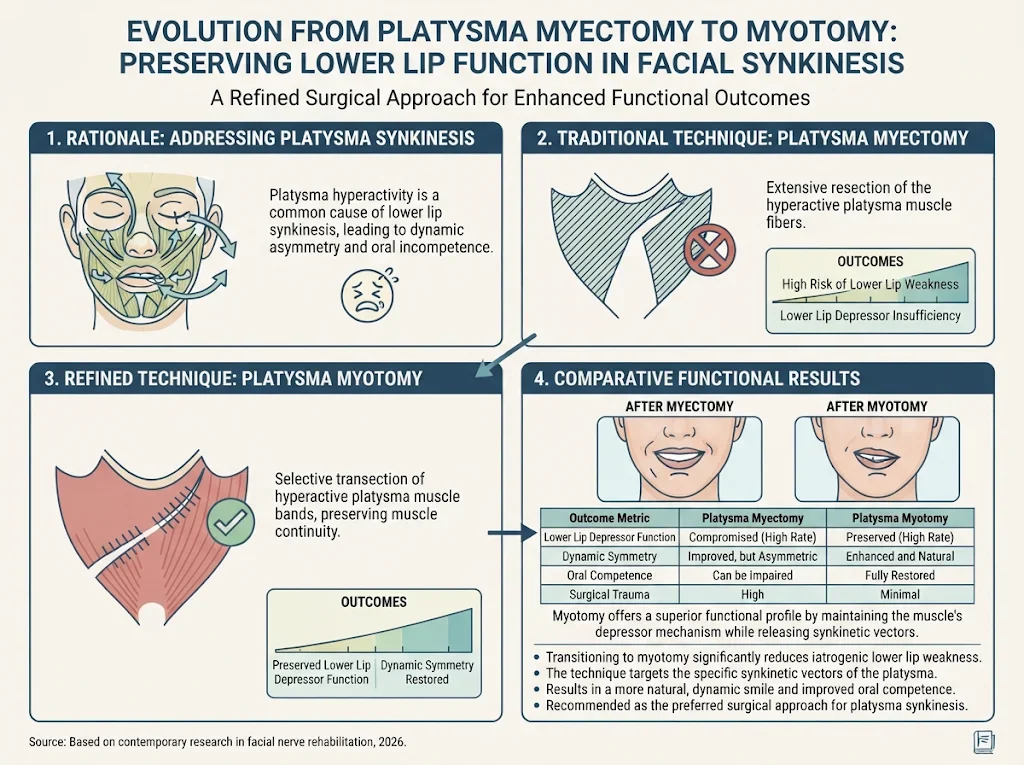
1. Platysma myotomy preserves lower lip function better than platysma myectomy in patients with facial synkinesis.
2. Selective neurectomy combined with depressor anguli oris (DAO) myectomy improves lower lip parameters significantly.
3. Platysma myectomy may cause postoperative lower lip elevation, possibly due to cervical branch injury.
4. The myotomy technique offers targeted management of platysma hypertonicity while maintaining facial nerve integrity.
Study Background
Facial synkinesis (FS) is a common and debilitating sequela following facial nerve injury or palsy, characterized by involuntary muscle contractions and abnormal facial movements during voluntary movements. One notable manifestation is platysma hypertonicity, which can distort lower facial expressions and compromise aesthetics and function. Management strategies often include selective neurectomy and myectomies to reduce unwanted muscle activity. Platysma myectomy has been a traditional surgical modality to relieve hypertonicity; however, given the close anatomical relationship between the platysma muscle and the cervical branch of the facial nerve, its use raises concerns about inadvertent nerve injury, resulting in postoperative dysfunction of muscles controlling the lower lip position.
Preserving lower lip function is critical because it influences oral competence, speech articulation, eating, and facial expression. Innovative techniques such as platysma myotomy, which entails partial muscle incisions rather than complete excision, may mitigate risks associated with myectomy while effectively addressing muscle hyperactivity. This study investigates and compares functional outcomes of different platysma interventions combined with selective neurectomy and DAO myectomy for treating FS-related hypertonicity.
Study Design
This retrospective cohort study included patients diagnosed with facial synkinesis undergoing treatment between 2019 and 2025. All patients underwent selective neurectomies and ipsilateral DAO myectomy (NDAO) with or without additional platysma procedures. Three treatment arms were established:
- NDAO alone (n=27)
- NDAO + platysma myectomy (n=19)
- NDAO + platysma myotomy at the thyroid cartilage level (n=10)
The primary outcome measures were objective lower lip function parameters assessed through digital image analysis using Emotrics and ImageJ software. Parameters included:
- Commissure position
- Lower lip height
- Lower lip inclination angle
- Lower quadrant dental show
The mean follow-up period was 12 months postoperatively. Statistical analysis evaluated differences both within groups (preoperative vs. postoperative) and between groups, with significance thresholds set at p ≤ 0.05.
Key Findings
The cohort had a mean age of 52 years. Significant improvements were noted as follows:
- NDAO alone: Demonstrated significant improvement across all measured lower lip functional outcomes (p ≤ 0.004).
- NDAO + platysma myotomy: Showed significant improvement in lower lip inclination and increased dental show (p ≤ 0.014), indicating better oral aperture and muscle control.
- NDAO + platysma myectomy: Exhibited no statistically significant improvement in any of the parameters measured.
When comparing between groups:
- The myotomy group outperformed the myectomy group across all parameters (p ≤ 0.006), highlighting superior preservation and restoration of lower lip functions.
- The myotomy group also demonstrated better commissure position and dental show than the NDAO alone group (p ≤ 0.045).
- NDAO alone achieved significantly better lower lip height, inclination angle, and dental show than platysma myectomy (p ≤ 0.018), indicating the potential detriment of myectomy on lower lip mobility.
Importantly, platysma myectomy was associated with a postoperative lower lip elevation, a finding consistent with probable injury to the cervical branch of the facial nerve, which innervates the platysma and muscles involved in lower lip depression. This adverse effect appeared mitigated by the myotomy approach.
Expert Commentary
These findings offer critical clinical insights for surgeons managing facial synkinesis with platysma hypertonicity. The study underscores the importance of preserving the cervical branch of the facial nerve to maintain lower lip function. While platysma myectomy has been a traditional approach, its association with postoperative functional impairment necessitates reconsideration.
The platysma myotomy technique, involving controlled muscle incision rather than excision, shows promise in balancing effective symptom control and anatomical preservation. This aligns with contemporary principles of facial reanimation surgery emphasizing nerve and muscle integrity.
Limitations include the relatively small sample size for the myotomy group and potential selection biases inherent in retrospective designs. Future prospective randomized trials with larger cohorts and longer follow-up will be essential to validate these findings and optimize surgical protocols.
Conclusion
Treatment of facial synkinesis-related platysma hypertonicity benefits from approaches that balance symptom control and preservation of facial nerve function. Selective neurectomies combined with DAO myectomy alone or with platysma myotomy yield significant improvements in lower lip function. Conversely, platysma myectomy carries a higher risk of cervical branch injury, manifesting as postoperative lower lip dysfunction. Platysma myotomy provides a refined surgical strategy that maintains lower lip position and function while effectively addressing hypertonicity. These findings should guide surgical decision-making to enhance patient outcomes in facial synkinesis management.
Further studies integrating functional patient-reported outcomes and electromyographic assessments will enrich understanding and individualize treatment approaches.
Funding and ClinicalTrials.gov
The original study did not specify funding sources or clinical trial registration numbers. Clinicians and researchers are encouraged to track ongoing trials related to facial synkinesis interventions for emerging data.
References
- Johansen CF, Bhatia SS, Har-Shai L, Rozen SM. Evolution from Platysma Myectomy to Myotomy: Preserving Lower Lip Function in Facial Synkinesis. Plast Reconstr Surg. 2026 Nov 9. PMID: 43002105.
- Brennan FH, Terzis JK. Surgical treatment of synkinesis in facial paralysis. Clin Plast Surg. 2019;46(3):449-459.
- Rubino C, Quatela V. Facial reanimation techniques: myectomy and neurectomy considerations. Clin Plast Surg. 2021;48(2):259-271.
- Hadlock TA, et al. Facial synkinesis: diagnostic and treatment paradigms. Facial Plast Surg Clin North Am. 2022;30(1):1-12.
Specialty calculators
For clinical reference; use professional judgment.