Highlight
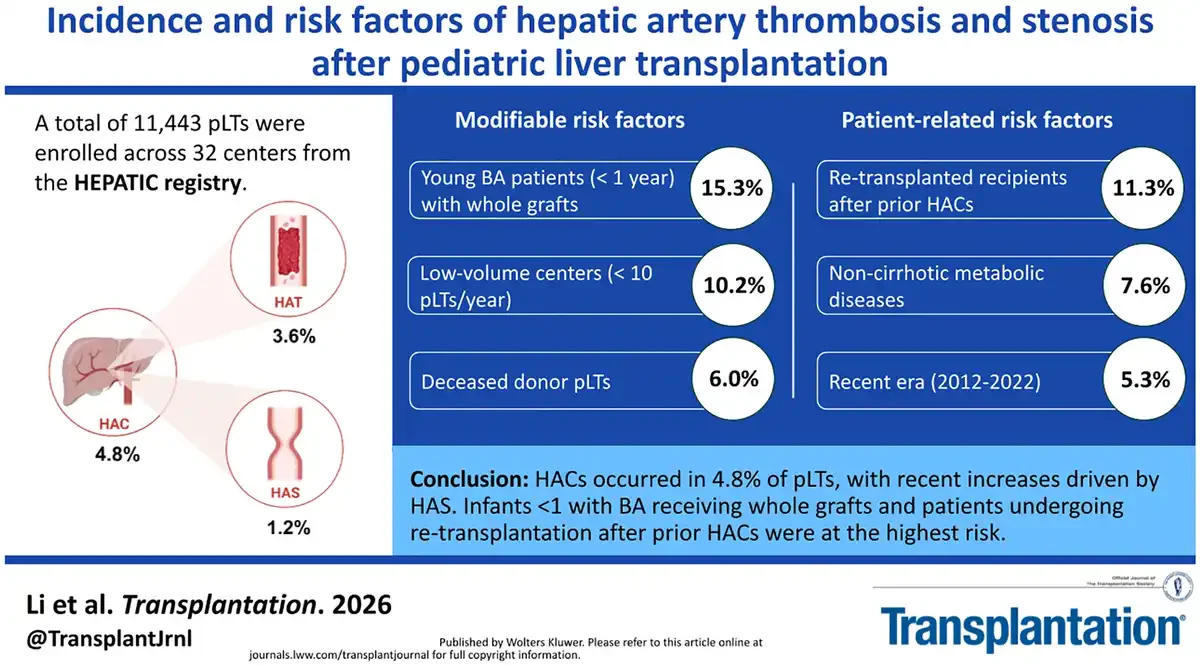
1. Hepatic artery complications (HACs) occur in approximately 4.8% of pediatric liver transplants, with thrombosis (HAT) dominating early post-transplantation and stenosis (HAS) increasingly recognized over recent years.
2. Highest risk groups include infants under one year with biliary atresia receiving whole grafts and patients undergoing retransplantation after prior HAC.
3. Living donor transplantation and high-volume centers are associated with significantly lower rates of HACs, suggesting modifiable institutional and procedural factors.
4. Screening strategies must be tailored with attention to the number needed to screen, which varies widely but is notably lower in high-risk subgroups.
Background
Pediatric liver transplantation (pLT) offers a life-saving option for children with complex liver diseases such as biliary atresia and metabolic disorders. However, post-transplant vascular complications, particularly those involving the hepatic artery, remain a critical challenge. Hepatic artery thrombosis (HAT) and hepatic artery stenosis (HAS) are associated with graft failure and increased morbidity and mortality. Despite advancements in surgical techniques and postoperative care, comprehensive data on the incidence, timing, and determinants of these complications across diverse pediatric populations and transplant centers remain sparse. This paucity creates an unmet need to better understand their epidemiology to inform surveillance and intervention.
Study Design and Methods
This retrospective cohort study utilized data from the HEPATIC registry, encompassing 11,443 pediatric liver transplants performed at 32 international centers over two decades. The study systematically evaluated the incidence of hepatic artery complications, including both thrombosis and stenosis, across subgroups defined by recipient age, transplant indication, donor type (living vs. deceased), transplant era, and center volume categorized by annual transplant numbers.
Primary endpoints included the incidence rates of HAT and HAS, timing of complication onset post-transplant, and identification of clinical and procedural risk factors. The study also calculated the number needed to screen (NNS) to detect a single HAC event, intending to optimize resource allocation for post-transplant surveillance.
Key Findings
The overall incidence of hepatic artery complications was 4.8%, with HAT accounting for 3.6% and HAS for 1.2% of cases. Most HACs presented early, with 82.4% occurring within the first post-transplant month. The incidence of HAT peaked within the first two weeks post-transplant, whereas HAS events were more evenly distributed over time.
A temporal increase in overall HAC incidence was observed from 2012 to 2021 (5.3%), driven primarily by a rise in HAS, while HAT rates remained largely stable. This trend may reflect improved detection methods or evolving clinical practices.
Subgroup analysis revealed that infants younger than one year with biliary atresia and whole graft transplants had a significantly higher HAC incidence (15.3%). Such patients represent a notably vulnerable population requiring intensified monitoring. Conversely, living donor liver transplantation was associated with a lower HAC rate (3.4%), potentially due to better graft quality and perioperative management. Similarly, higher volume centers demonstrated a reduced HAC incidence (3.8%), underscoring the importance of surgical expertise and institutional experience.
Patient factors including retransplantation following previous HAC episodes (11.3%) and noncirrhotic metabolic diseases (7.6%) also conferred increased risk.
The NNS to detect one HAC varied markedly, ranging from 173 in high-risk groups to as high as 1907 in lower-risk patients. These data highlight the importance of targeted surveillance strategies to optimize clinical resource utilization and early intervention.
Expert Commentary
Hepatic artery complications remain a pressing issue in pediatric liver transplantation due to their impact on graft survival and patient outcomes. This landmark registry-based study provides robust multicenter evidence underscoring the dynamic epidemiology of HACs and delineates key patient- and center-related risk factors.
Data suggesting a protective effect of living donor grafts and higher institutional volumes align with previously published findings advocating for the centralization of complex pediatric liver transplants in experienced centers. Additionally, the pronounced risk in infants with biliary atresia and whole grafts points to a critical need for enhanced surveillance protocols and possibly adjunctive perioperative strategies in this subgroup.
However, limitations inherent to registry analyses, such as potential heterogeneity in diagnostic criteria for HACs across centers and missing granularity on perioperative variables, should be acknowledged. Future prospective studies incorporating detailed surgical and hemodynamic data could help elucidate mechanistic pathways and refine risk stratification models.
Conclusion
Hepatic artery thrombosis and stenosis represent significant early complications following pediatric liver transplantation, occurring in nearly 5% of patients with varying risk across subpopulations. The recent rise in HAS incidence demands heightened clinical awareness and optimized monitoring protocols, especially for high-risk infants with biliary atresia, recipients of whole grafts, and patients undergoing retransplantation after prior HACs.
Strategies promoting living donor transplantation and consolidating expertise in high-volume centers appear beneficial in minimizing HAC incidence. The wide variation in screening efficiency emphasizes the need for individualized surveillance algorithms to balance early detection with resource allocation.
Overall, these findings provide crucial epidemiological insights to inform clinical practice, improve graft outcomes, and guide future research directions in pediatric liver transplantation.
Funding and ClinicalTrials.gov
The original study did not specify funding sources or registered trial details. Future dissemination of registry-based studies would benefit from clarity on funding and protocol registration to enhance transparency.
References
Li W, Hartog H, Minetto J, et al. Incidence and Risk Factors of Hepatic Artery Thrombosis and Stenosis After Pediatric Liver Transplantation: Results From the HEPATIC Registry. Transplantation. 2026 Oct 28. PMID: 42950133. Available at: https://pubmed.ncbi.nlm.nih.gov/42950133/
Specialty calculators
For clinical reference; use professional judgment.