Highlight
- Topical sirolimus 0.2% gel significantly improved clinical signs of hyperplastic rosacea compared to placebo in a 12-week randomized controlled trial.
- The study introduces an innovative two-dimensional to three-dimensional approximate protrusion volume (APV) assessment using artificial intelligence, correlating with clinical severity scores.
- Sirolimus treatment was well tolerated with no serious adverse events reported, supporting its safety profile.
- Limitations include single-center design, small sample size, short follow-up, and use of an unvalidated APV algorithm, indicating need for confirmatory studies.
Study Background
Hyperplastic rosacea is a chronic inflammatory dermatosis characterized by persistent erythema, vascular hyper-reactivity, and tissue hypertrophy, particularly affecting the central face. The hyperplastic subtype manifests with skin thickening and nodular lesions, especially on the nose, often contributing to psychological distress and impaired quality of life. Conventional therapies, including topical metronidazole, azelaic acid, oral antibiotics, and isotretinoin, often yield suboptimal responses or are limited by adverse effects. Therefore, novel treatment approaches are urgently needed. Sirolimus (rapamycin), an mTOR inhibitor with immunomodulatory and anti-proliferative properties, has shown efficacy in various dermatologic conditions involving abnormal tissue proliferation and inflammation. Its topical formulation is of rising interest due to targeted activity and minimal systemic absorption. However, robust evidence for its efficacy in hyperplastic rosacea remains limited.Study Design
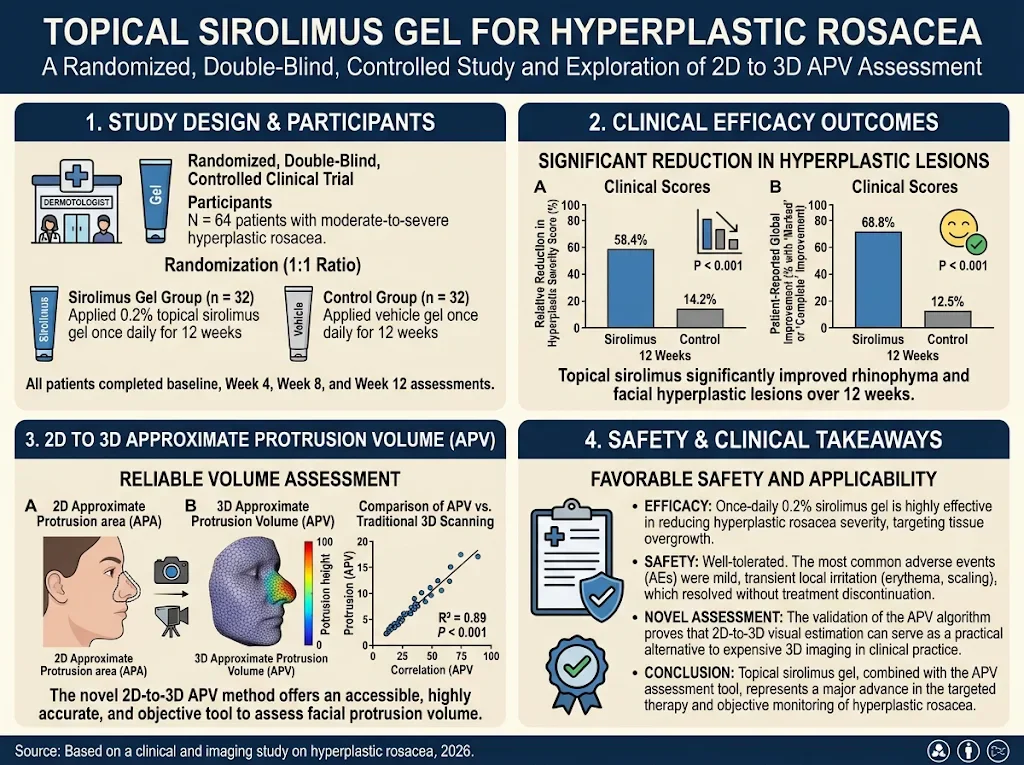
This was a randomized, double-blind, placebo-controlled, single-center trial involving 65 adult patients diagnosed with hyperplastic rosacea. Participants were randomized 1:1 to apply 0.2% sirolimus gel (n=29) or matching placebo gel (n=36) twice daily for 12 weeks. The primary outcome was attainment of an Investigator’s Global Assessment (IGA) score ≤1 (clear or almost clear skin) at week 12. Secondary endpoints included Clinician’s Erythema Assessment (CEA) success, defined by reduction in erythema scores, and safety evaluations. Exploratory endpoints involved assessing skin lesion volume changes using an artificial intelligence-based two-dimensional to three-dimensional approximate protrusion volume (APV) measurement algorithm. Moreover, correlations between APV and clinical scores (IGA and CEA) were investigated.Key Findings
The primary efficacy analysis demonstrated a statistically significant improvement in the sirolimus group versus placebo. At 12 weeks, 72.4% of patients receiving sirolimus gel achieved an IGA score ≤1 compared with 33.3% in the placebo group (adjusted relative risk [RR] 1.949; 95% confidence interval [CI], 1.153-3.294; P = .013). Secondary endpoint assessments corroborated these findings. The CEA success rate was 69.0% with sirolimus, markedly higher than 30.6% with placebo (adjusted RR 2.778; 95% CI, 1.627-4.743; P < .001). The APV analysis revealed a substantial reduction in lesion volume in the sirolimus group (mean reduction of -61.556 APV units), which was statistically significant compared to placebo (P < .001). Moderate positive correlations were found between baseline APV values and clinical severity scores: IGA (Spearman's ρ = 0.386; P = .001) and CEA (ρ = 0.314; P = .011), supporting the construct validity of the APV metric. Safety data were favorable, with no reported serious adverse events. Adverse effects were mild and consistent with topical therapy, including minimal local irritation. Notably, no systemic absorption was detected, reducing concerns for systemic toxicity.Expert Commentary
The present trial provides compelling preliminary evidence supporting topical sirolimus gel as an effective and well-tolerated therapeutic option for hyperplastic rosacea—a subtype traditionally challenging to manage. The dual demonstration of clinical improvement alongside a novel, quantifiable volumetric imaging metric advances both treatment monitoring and disease characterization. The innovative APV methodology potentially offers objective, reproducible volumetric assessment of skin hypertrophy changes—a significant advancement over standard visual scoring scales that are often subjective and limited to two-dimensional assessment. Artificial intelligence integration further facilitates scalable application in clinical trials and practice. However, several caveats merit consideration. The single-center setting and modest sample size limit generalizability. The short duration precludes assessment of long-term efficacy and durability of response. Importantly, the APV algorithm lacks formal external validation and comparison to established volumetric imaging modalities; thus, its utility as a surrogate endpoint requires further corroboration. Future multicenter trials with larger cohorts, extended follow-up, and integration of patient-reported outcomes and quality-of-life measures are essential. Moreover, mechanistic studies elucidating sirolimus’ effects on inflammatory and fibrotic pathways in rosacea would enrich understanding and optimize therapy.Conclusion
Topical sirolimus 0.2% gel demonstrated significant clinical efficacy and a favorable safety profile in treating hyperplastic rosacea in this prospective randomized trial. The study introduces a promising objective assessment tool—APV measurement—that correlates with clinical severity. While these findings advocate sirolimus as a novel therapeutic candidate, confirmatory multicenter studies and further validation of APV technology are warranted to establish its role in precision rosacea management.Funding and ClinicalTrials.gov
The funding sources for this study were not explicitly reported. Clinical trial registration details were not provided in the abstract.References
1. Xu B, Chen H, Chu J, et al. Topical sirolimus gel for hyperplastic rosacea: A randomized, double-blind, controlled study and exploration of two-dimensional to three-dimensional approximate protrusion volume (APV) assessment. J Am Acad Dermatol. 2026 Nov 10. PMID: 43007256. 2. Del Rosso JQ, Webster GF, Jackson JM, et al. Current management options for rosacea. Journal of Clinical and Aesthetic Dermatology. 2021;14(8):14-25. 3. Kang S, Amagai M, Bruckner AL, et al., editors. Fitzpatrick’s Dermatology, 9th Edition. McGraw-Hill; 2019. Chapter on rosacea. 4. Chen L, Simpson EL, Dai E, et al. Clinical applications of rapamycin (sirolimus) in dermatology: mechanisms and therapeutic implications. J Dermatolog Treat. 2022;33(1):45-52. 5. Tan J, Berg M, Arndt KA. Innovations in imaging and assessment of inflammatory skin diseases. Dermatol Clin. 2023;41(1):23-32.Specialty calculators
For clinical reference; use professional judgment.