Highlight
- High-throughput plasma proteomics identified distinct biomarkers linked to systemic sclerosis-associated interstitial lung disease (SSc-ILD) and progressive pulmonary fibrosis (SSc-PPF).
- Surfactant protein D (SP-D) serves as a diagnostic biomarker for SSc-associated ILD, exhibiting significantly higher plasma levels compared to patients without ILD.
- Matrix metalloproteinase 8 (MMP-8) independently predicts progression of pulmonary fibrosis within SSc patients, validated in two independent cohorts.
- Integrating MMP-8 measurement with clinical parameters improves prognostic accuracy for progressive lung fibrosis in systemic sclerosis, enabling better patient stratification.
Study Background
Systemic sclerosis (SSc) is a complex multisystem autoimmune disease characterized by widespread vascular abnormalities and tissue fibrosis. Pulmonary complications, particularly interstitial lung disease (ILD) and progressive pulmonary fibrosis (PPF), are leading causes of morbidity and mortality in SSc. Identifying reliable, minimally invasive biomarkers that can diagnose ILD early and predict progression to fibrosis remains a critical unmet clinical need, as existing clinical and radiological assessments have limitations in sensitivity and prognostic accuracy. High-throughput plasma proteomics offers an unbiased platform to discover circulating proteins relevant to disease pathophysiology, potentially facilitating early diagnosis and tailored risk stratification in SSc-ILD.Study Design
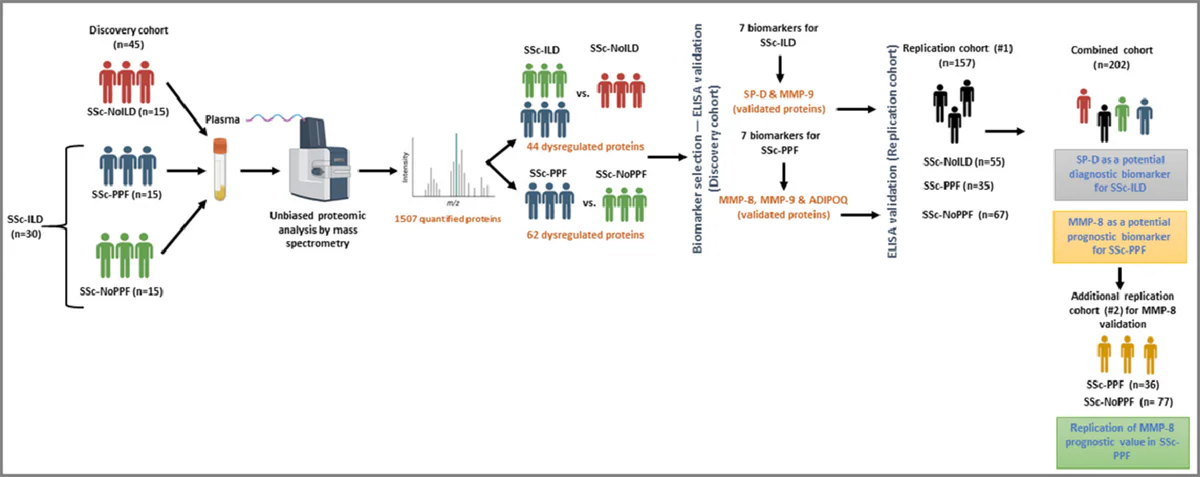
This multicentric study analyzed plasma samples from 202 patients with systemic sclerosis recruited across three European centers: Paris, Bordeaux, and Leeds. The design incorporated a discovery cohort (n=45) and a larger replication cohort (n=157). Patients were clinically stratified by ILD presence and pulmonary fibrosis progression, with progressive pulmonary fibrosis (SSc-PPF) defined according to INBUILD criteria (which include serial pulmonary function decline and radiographic worsening). Proteomic profiling employed mass spectrometry to quantify over 1500 proteins in plasma samples from the discovery cohort, followed by pathway enrichment and differential expression analyses to shortlist candidate biomarkers. Top candidates underwent validation through enzyme-linked immunosorbent assay (ELISA) in the replication cohort, and MMP-8’s prognostic utility was further confirmed in an independent cohort of 113 patients from Tokyo and Milan. Statistical modeling assessed the added predictive value of biomarkers when combined with clinical variables.Key Findings
Proteomic Discovery and Biomarker Identification
The proteomic analysis quantified 1507 unique proteins in plasma samples. Among these, 44 proteins were differentially expressed between SSc patients with ILD (SSc-ILD) and those without (SSc-NoILD). Separately, 51 proteins showed differential expression between patients with nonprogressive pulmonary fibrosis (SSc-NoPPF) and those experiencing progression (SSc-PPF). Five candidate biomarkers were selected based on statistical significance and biological relevance for ELISA validation. Surfactant protein D (SP-D) and matrix metalloproteinase 8 (MMP-8) emerged as the strongest validated markers.SP-D as a Diagnostic Biomarker for SSc-ILD
SP-D plasma levels were significantly elevated in patients with SSc-ILD versus those without ILD (mean 17.36 ± 11.99 versus 9.49 ± 7.92 ng/mL, P < .0001). This finding highlights SP-D as a promising circulating biomarker for the presence of ILD in SSc, consistent with its known role in surfactant homeostasis and innate immune defense in lung tissue.MMP-8 as a Prognostic Biomarker for Progressive Pulmonary Fibrosis
MMP-8 levels were higher in patients with SSc-PPF compared to those with stable or nonprogressive disease (mean 17.67 ± 12.45 versus 10.77 ± 10.92 ng/mL, P < .001). Importantly, the prognostic value for disease progression was replicated in an independent cohort from Tokyo and Milan, confirming the biomarker's utility across diverse populations. Multivariate analyses demonstrated that MMP-8 independently predicted progression risk and significantly enhanced prognostic models that included established clinical predictors such as baseline lung function and imaging findings. This suggests MMP-8 may reflect ongoing matrix remodeling and neutrophil-driven inflammation contributing to fibrotic progression.Pathway Enrichment and Biological Correlates
Pathway analysis implicated processes related to extracellular matrix organization, immune activation, and neutrophil degranulation in the biomarker signature. These insights align with SSc pathophysiology where aberrant fibroblast activation and immune dysregulation drive fibrosis.Expert Commentary
This study exemplifies the power of unbiased proteomic approaches in uncovering biologically and clinically relevant biomarkers in complex connective tissue diseases. SP-D’s elevation in SSc-ILD is in keeping with prior studies highlighting its role in lung injury and repair, reinforcing its potential as a noninvasive diagnostic tool. MMP-8, a collagenase released predominantly by neutrophils, serves as a marker of active tissue remodeling. Its independent association with progressive fibrosis suggests a mechanistic link between neutrophil-mediated inflammation and fibrotic evolution in SSc. Such biomarkers could guide early intervention strategies and monitoring of therapeutic response. Limitations include the observational design and potential variability in cohort clinical management. Nevertheless, validation across multiple centers enhances generalizability. Future longitudinal studies are warranted to assess biomarker dynamics over time and in response to therapies.Conclusion
High-throughput plasma proteomics identified SP-D and MMP-8 as robust circulating biomarkers associated with the diagnosis of interstitial lung disease and prediction of progressive pulmonary fibrosis in patients with systemic sclerosis. Their validation in independent multicenter cohorts underscores their potential utility for enhancing clinical risk stratification, facilitating early therapeutic intervention, and improving outcomes in this high-risk population. Integration of these biomarkers into clinical practice, alongside conventional assessments, could refine management strategies and personalize patient care in SSc-ILD.Funding and Clinical Trials
This work was conducted with support from participating academic centers in Paris, Bordeaux, Leeds, Tokyo, and Milan. Specific funding details were not disclosed in the original publication. No clinical trial registration was noted.References
1. Gerges E, Cauvet A, Guedot M, et al. High-throughput plasma proteomics reveals circulating biomarkers of interstitial lung disease and progressive pulmonary fibrosis in systemic sclerosis. Ann Rheum Dis. 2026 Jul 23;85(11):2208-2218. doi:10.1136/annrheumdis-2025-235600. PMID: 42493308. 2. Distler O, Highland KB, Gahlemann M, et al. Nintedanib for Systemic Sclerosis–Associated Interstitial Lung Disease. N Engl J Med. 2019;380(26):2518-2528. 3. Brown KK. Pulmonary fibrosis in systemic sclerosis. Rheum Dis Clin North Am. 2015;41(3):391-403. 4. Wells AU, Brown KK, Flaherty KR, et al. What’s in a name? That which we call IPF, by any other name would act the same. Eur Respir J. 2018;51(6):1800692. 5. INBUILD Trial Investigators. Efficacy and Safety of Nintedanib in Progressive Fibrosing Interstitial Lung Diseases. N Engl J Med. 2019;381(18):1718-1727. 6. Kuwana M, Shirai Y, Iannone C, et al. Biomarkers in systemic sclerosis-associated interstitial lung disease: Current status and future prospects. J Pers Med. 2022;12(11):1801.Specialty calculators
For clinical reference; use professional judgment.