Highlight
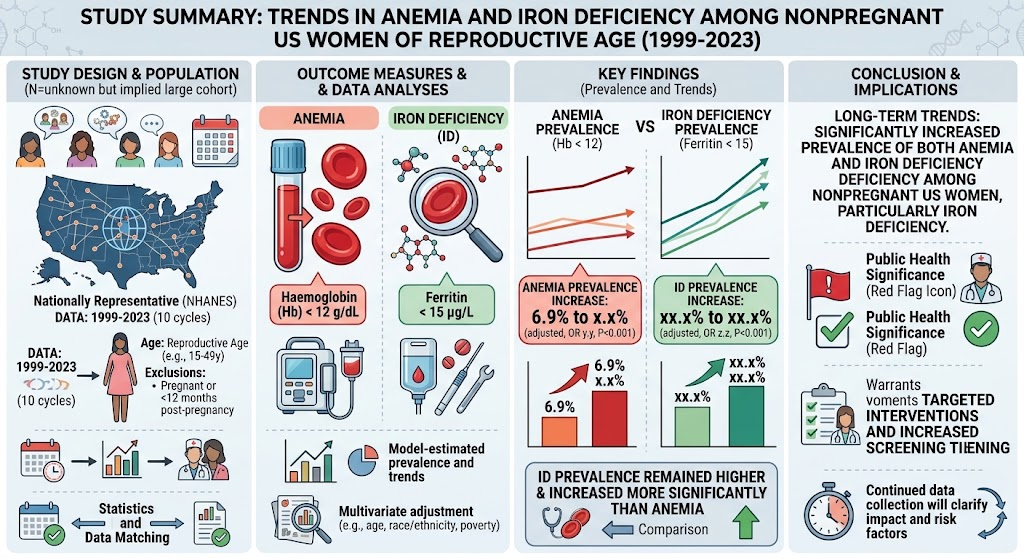
- From 1999 to 2023, the prevalence of anemia among nonpregnant U.S. women aged 20–45 increased markedly from 8.0% to 14.2%, corresponding to over 3 million affected individuals.
- Iron deficiency anemia (IDA) prevalence more than doubled in the same period, rising from 4.3% to 9.1%, indicating a growing public health concern.
- Despite the rise in anemia and IDA, the prevalence of iron deficiency alone remained high yet relatively stable around 17–19%.
- Adjusted analysis shows an 8% increase per NHANES cycle in the odds of anemia and IDA, underscoring a persistent worsening trend over the last two decades.
Study Background
Anemia and iron deficiency constitute significant global health challenges, particularly for reproductive-aged women, who are vulnerable due to menstrual blood loss and potential nutritional gaps. In the United States, these conditions contribute to fatigue, impaired cognitive function, reduced work capacity, and adverse pregnancy outcomes. Despite considerable attention to anemia in pregnancy, less focus has been given to the nonpregnant reproductive-aged cohort, who comprise a large population with potential impacts on overall women’s health and productivity. The recent national data from the National Health and Nutrition Examination Survey (NHANES) provide an opportunity to evaluate long-term trends in anemia and iron deficiency in this group, crucial for informing screening guidelines, nutritional policies, and public health interventions.
Study Design
This serial cross-sectional analysis utilized data from eight NHANES survey cycles spanning 1999-2000 through 2021-2023. The study population included nonpregnant women aged 20 to 45 years, representative of the U.S. civilian, noninstitutionalized population. Key biomarkers analyzed were hemoglobin concentration and serum ferritin levels, measured according to standardized protocols.
Definitions used were:
- Anemia: hemoglobin less than 12.0 g/dL.
- Iron deficiency: serum ferritin less than 15.0 micrograms/L.
- Iron deficiency anemia (IDA): combined anemia and iron deficiency criteria.
Prevalence estimates were weighted to reflect the overall U.S. population of nonpregnant reproductive-aged women. Logistic regression models adjusted for potential confounders examined temporal trends, treating each NHANES cycle as a continuous variable over time.
Key Findings
A total of 8,200 participants contributed data across survey years. Weighted prevalence for the entire period was 9.8% for anemia, 17.3% for iron deficiency, and 6.2% for IDA.
Trends Over Time
– Anemia: Increased from 8.0% (95% CI, 5.8–10.9%) in 1999-2000 to 14.2% (95% CI, 11.8–17.1%) in 2021-2023.
– Iron Deficiency: Rose modestly from 17.9% (95% CI, 16.4–19.5%) to 18.8% (95% CI, 16.1–21.9%), a change not statistically significant over time.
– Iron Deficiency Anemia: More than doubled from 4.3% (95% CI, 3.2–6.0%) to 9.1% (95% CI, 7.3–11.4%).
Statistical Modeling
– Adjusted odds ratios per NHANES cycle (approximately 2 years per cycle) indicated an 8% increase in odds of anemia (aOR 1.08, 95% CI, 1.05–1.11) and IDA (aOR 1.08, 95% CI, 1.04–1.12).
Interpretation
While iron deficiency alone was highly prevalent but stable, anemia and IDA showed significant upward trends, suggesting either compounding factors contributing to anemia beyond iron deficiency or worsening iron utilization/utilization disorders. The large absolute number of affected women (millions) highlights a substantial public health impact.
Expert Commentary
The findings raise concern regarding the persistent and increasing burden of anemia and iron deficiency anemia among nonpregnant women of reproductive age. This run counter to expectations considering improved nutritional awareness and supplementation strategies over the past two decades. Factors such as dietary patterns, socioeconomic disparities, chronic inflammation, or unrecognized bleeding disorders might contribute to these trends. Importantly, the stalled prevalence of iron deficiency suggests that iron intake and stores remain a critical issue, but additional pathophysiological pathways deserve investigation.
Current guidelines from the U.S. Preventive Services Task Force do not recommend routine anemia screening for nonpregnant women absent symptoms or risk factors. These data could prompt reconsideration, especially for targeted high-risk groups. Furthermore, improved public health efforts addressing nutrition, health equity, and screening may be indicated.
Limitations include the cross-sectional design of NHANES limiting causal inference, potential unmeasured confounders, and reliance on ferritin, which can be influenced by inflammation. Nonetheless, the large, nationally representative sample strengthens the generalizability of results.
Conclusion
Between 1999 and 2023, the prevalence of anemia and iron deficiency anemia among nonpregnant U.S. women aged 20-45 substantially increased, while iron deficiency remained prevalent but stable. These trends underscore an unmet need for enhanced screening, prevention, and management strategies targeting this key demographic. Future research should explore underlying causes, integrate inflammation markers, and evaluate interventions to mitigate anemia-related health burdens. Policymakers and clinicians should consider these findings when revising clinical guidelines and public health recommendations.
Funding and Clinical Trials Registration
No specific funding source or clinical trial registration was reported for the original NHANES survey data used in this secondary analysis.
References
1. Xiao MZX, Bentley J, Leavitt AD, Butwick AJ. Trends in Anemia and Iron Deficiency Among Nonpregnant U.S. Women of Reproductive Age, 1999-2023. Obstet Gynecol. 2026 Apr 2;148(2):269-277. PMID: 41926767.
2. World Health Organization. Nutritional Anaemias: Tools for Effective Prevention and Control. WHO, Geneva; 2017.
3. Centers for Disease Control and Prevention (CDC). Anemia and Iron Deficiency: Continuing Public Health Challenges. MMWR, 2020.
4. Milman N. Anemia—still a major health problem in many parts of the world! Ann Hematol. 2011;90(4):369-377.