Highlight
- Modern IOL power calculation formulas outperform traditional early-generation formulas in post-myopic laser vision correction eyes, improving refractive prediction accuracy significantly.
- Formulas incorporating posterior corneal curvature (PCC) demonstrate lower mean absolute errors and higher proportions of eyes within ±0.50 D of target refraction.
- The Cooke K6 and EVO 2.0 formulas show the best overall performance, particularly in eyes with extreme axial lengths and steep corneas.
- When full biometric data are unavailable, the Shammas-Cooke formula remains a reasonable alternative.
Study Background
Accurate intraocular lens (IOL) power calculation is critical for optimal visual outcomes after cataract surgery. This challenge is compounded in eyes with prior myopic laser vision correction (M-LVC), where corneal refractive values are altered, complicating the use of standard formulas. Traditional methods often overestimate corneal power and thus miscalculate IOL power, frequently leading to postoperative refractive surprises. There is a significant clinical need to identify formula strategies that improve refractive predictability in this growing patient population without requiring historical clinical data, which are often unavailable. Incorporating posterior corneal curvature (PCC) data theoretically refines the effective lens position estimation and total corneal power, potentially enhancing formula accuracy.
Study Design
This retrospective, multicenter database analysis utilized data from the Veracity database (Carl Zeiss) encompassing 3,738 eyes from unique patients across 145 U.S. centers between October 2017 and August 2025. All subjects underwent routine cataract surgery with biometry captured via the IOLMaster 700. Surgeon-reported M-LVC history identified eyes but lacked independent verification. Postoperative subjective refraction was collected 21-90 days after surgery. Fourteen IOL power calculation formulas were evaluated, including early-generation formulas (Haigis-L, Shammas-PL), modern formulas with and without PCC input (Barrett True K, Cooke K6, EVO 2.0, Hoffer QST, PEARL-DGS), along with Shammas-Cooke (not using PCC) and Haigis-TK (using PCC). The primary outcomes were mean absolute error (MAE) and the proportions of eyes achieving refractive outcomes within ±0.50 D and ±1.00 D of the targets. Statistical rank ordering and pairwise comparisons with Holm’s correction were employed for comparative evaluation.
Key Findings
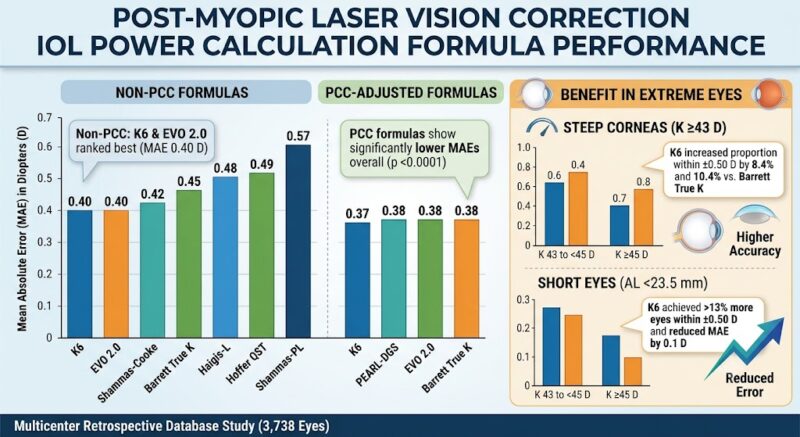
The analysis revealed that modern formulas substantially outperform early-generation formulas in the post-M-LVC eye population, with statistically significant reductions in MAE (p < 0.0001). Among formulas without PCC, Cooke K6 and EVO 2.0 led with MAE values of 0.40 D each, outperforming Shammas-Cooke (0.42 D), Barrett True K (0.45 D), Haigis-L (0.48 D), Hoffer QST (0.49 D), and Shammas-PL (0.57 D).
When PCC was included in formula input, MAE further improved with K6 achieving 0.37 D, PEARL-DGS and EVO 2.0 each at 0.38 D, and Barrett True K also at 0.38 D. This indicates meaningful accuracy gains attributable to accounting for posterior corneal power. Furthermore, subgroup analysis demonstrated that these benefits were most pronounced in eyes with extreme biometric parameters—a subset representing roughly 22% of cases. Specifically, in steep corneas (43 D to <45 D and ≥45 D), the K6 formula increased the percentage of eyes within ±0.50 D of target by 8.4% and 10.4% respectively compared with Barrett True K. In short axial length eyes (13% more eyes within ±0.50 D and reduced MAE by 0.1 D.
For typical post-M-LVC eyes without extreme parameters, the overall incremental benefit of advanced formulas over Barrett True K was small and likely clinically negligible. In scenarios lacking complete biometry—where PCC measurements are unavailable—the Shammas-Cooke formula provided a reasonable alternative with acceptable accuracy.
Expert Commentary
This extensive multicenter study provides strong real-world evidence supporting the adoption of modern, comprehensive IOL power calculation formulas that incorporate posterior corneal curvature, underscoring their utility especially in complex corneal anatomy following myopic laser vision correction. The large sample size and broad data source enhance generalizability of findings. The consistent superiority of Cooke K6 and EVO 2.0 aligns with prior smaller studies suggesting these formulas’ robustness in atypical eyes.
Limitations include reliance on surgeon-reported M-LVC history without external verification, which may introduce classification bias. A retrospective design limits direct control over confounding factors. Future prospective studies with standardized pre- and postoperative imaging might consolidate these findings further. Additionally, the incremental benefit in average cases remains modest, suggesting cost and complexity considerations must be balanced when implementing new formula platforms in routine practice.
Conclusion
For cataract surgery patients with prior myopic laser vision correction, modern IOL power calculation formulas that incorporate posterior corneal curvature provide superior refractive predictability compared to early-generation methods. The top-performing formulas—Cooke K6 and EVO 2.0—offer measurable accuracy advantages particularly for eyes with short axial length or steep corneas, although typical cases show smaller, clinically minor improvements. Where PCC data is unavailable, Shammas-Cooke remains a viable option. Integration of refined formulas into clinical practice can enhance postoperative refractive outcomes for this challenging patient subset, advancing personalized cataract care.
Funding and ClinicalTrials.gov
No specific funding sources or registered clinical trials were reported in this retrospective database study.