Highlight
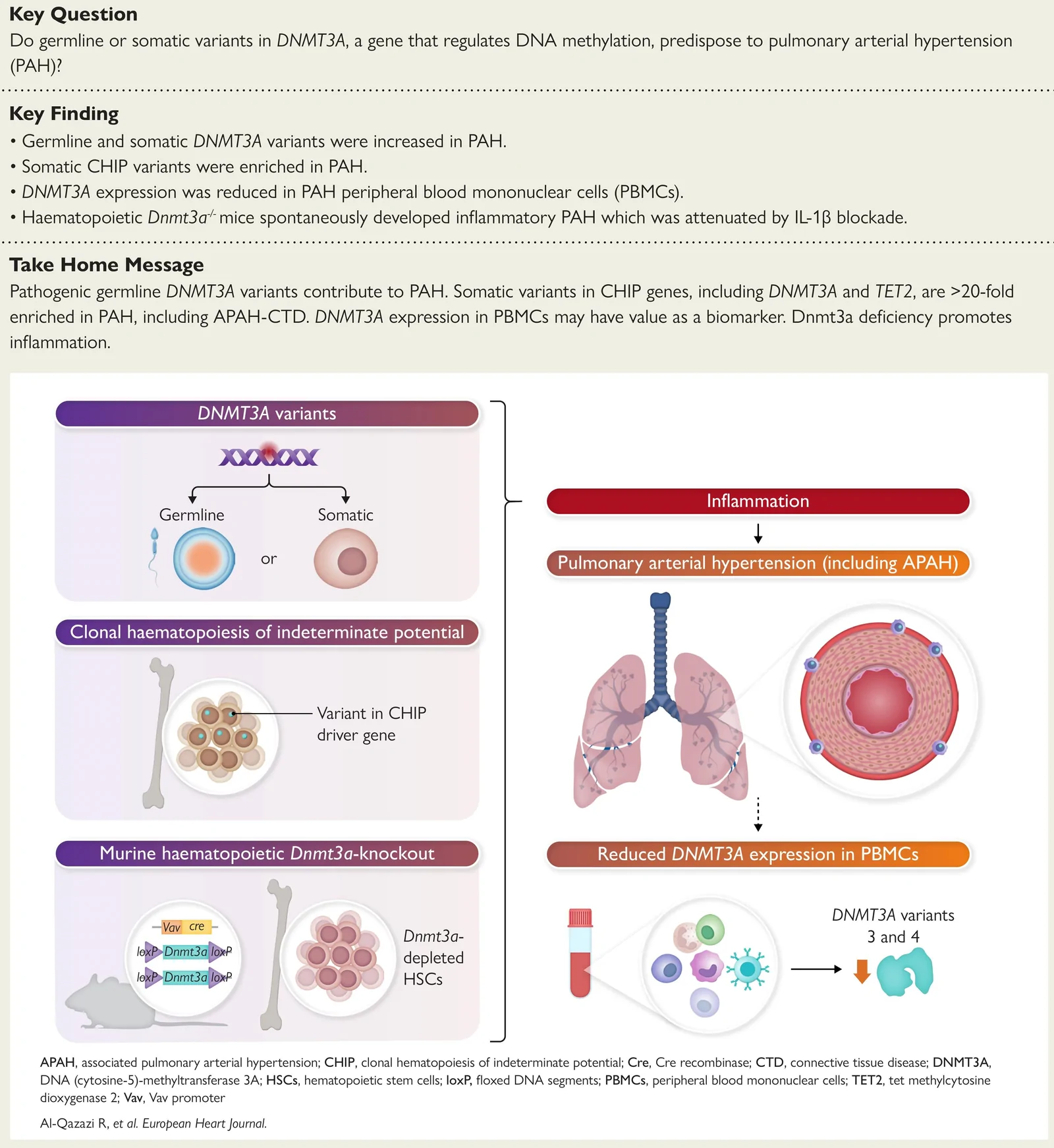
This study reveals a significant enrichment of both germline and somatic DNMT3A variants, as well as variants in other clonal haematopoiesis of indeterminate potential (CHIP) genes, in patients with pulmonary arterial hypertension (PAH), including APAH-CTD (associated PAH with connective tissue disease). It establishes a link between these genetic alterations and inflammatory mechanisms driving PAH pathology. Furthermore, haploinsufficiency of DNMT3A in hematopoietic cells experimentally recapitulates PAH in mouse models, which is reversible by targeting IL-1β, suggesting new biomarker and therapeutic avenues.
Study Background
Pulmonary arterial hypertension is a progressive, ultimately fatal disorder characterized by elevated pulmonary vascular resistance leading to right ventricular failure. While multiple germline gene variants have been implicated in familial and idiopathic PAH, the genetic underpinnings of PAH associated with connective tissue diseases (APAH-CTD) remain poorly defined. Moreover, the potential role of somatic mutations, especially those associated with clonal haematopoiesis of indeterminate potential (CHIP), in PAH pathogenesis has not been elucidated. CHIP, marked by somatic variants in genes like DNMT3A, TET2, and ASXL1 in hematopoietic cells, is increasingly recognized as a contributor to systemic inflammation and cardiovascular disease but has not been studied extensively in PAH.
Study Design and Methods
This comprehensive genetic study analyzed exome sequencing (ES) data from a large international PAH Biobank cohort (n=2572, predominantly European ancestry) and compared it against gnomAD controls and UK Biobank datasets. Two main approaches were employed: First, ES was used to identify predicted deleterious germline and somatic variants in DNMT3A and other CHIP genes. Second, targeted panel sequencing (TPS) assessed 22 CHIP genes within the PAH cohort and controls. Gene expression analyses measured DNMT3A mRNA levels in peripheral blood mononuclear cells (PBMCs) from patients with idiopathic PAH, scleroderma-associated APAH-CTD, scleroderma without PAH, and healthy controls. Finally, functional validation was performed in hematopoietic Dnmt3a knockout mice to examine hemodynamic consequences and inflammatory changes, with therapeutic targeting of interleukin-1 beta (IL-1β) explored.
Key Findings
Genetic association of DNMT3A variants with PAH: Predicted deleterious germline DNMT3A variants were significantly more prevalent in European ancestry PAH patients (6/1832) compared with controls (6/7509), yielding a relative risk of 4.1 (P = .018). This enrichment was more pronounced when considering both germline and somatic DNMT3A variants across the entire PAH Biobank cohort (1.28% vs. 0.43% in controls, P = 1.65 × 10⁻¹⁰).
Somatic mutations and CHIP gene variants: Eight DNMT3A mutations (0.39%) were classified as likely germline, while 25 mutations (0.82%) were likely somatic. Somatic variants showed a female predominance (21 females vs. 4 males). Among the APAH-CTD subgroup, 13 of 33 participants harbored DNMT3A or CHIP mutations. Targeted panel sequencing identified CHIP variants in 242 of 1659 PAH patients, with nearly half involving DNMT3A.
Statistical significance after adjustment: After correcting for age, sex, and age-CHIP interactions, DNMT3A variants conferred an odds ratio of 25.44 (P = 4.50 × 10⁻⁵), and all CHIP gene variants combined showed odds ratio of 23.35 (P = 2.87 × 10⁻⁸) for association with PAH.
Validation in the UK Biobank: Consistent with these findings, somatic CHIP mutations were more common in individuals with PAH versus controls (5.35% vs. 3.45%, P ≤ .0001).
Functional expression analyses: DNMT3A mRNA levels were significantly reduced in PBMCs from patients with PAH and APAH-CTD compared to scleroderma patients without PAH and healthy controls (AUC=0.82, P < .0001), suggesting potential as a biomarker.
In vivo mechanistic studies: Hematopoietic-specific knockout of Dnmt3a in mice induced inflammatory PAH phenotypes, including increased right ventricular systolic pressure, pulmonary vascular remodeling, and inflammatory cell infiltration. Administration of an IL-1β neutralizing antibody attenuated these pathological features, implicating IL-1β–mediated inflammation in this model.
Expert Commentary
The study provides compelling evidence that germline and somatic variants in DNMT3A and CHIP genes contribute to PAH susceptibility, expanding the genetic paradigm beyond traditional pulmonary vascular genes. The identification of CHIP mutations in a substantial proportion of APAH-CTD patients is especially notable, as this phenotype has lacked consistent genetic biomarkers. The female predominance of somatic mutations parallels the known epidemiology of PAH, raising intriguing questions about sex-specific mechanisms.
Mechanistically, DNMT3A loss in hematopoietic cells appears to promote systemic inflammation, likely via altered DNA methylation and epigenetic dysregulation, leading to IL-1β driven pulmonary vascular injury. This aligns with prior observations linking clonal haematopoiesis to cardiovascular pathology and inflammation, and translates now into pulmonary vascular disease.
Limitations include the relatively low variant frequencies and the challenge of distinguishing germline from somatic mutations definitively, despite rigorous analytic methods. Also, while murine models reinforce causality, further work is needed to clarify pathways linking CHIP mutations with endothelial and right ventricular dysfunction. Clinically, it remains to be determined whether screening for CHIP variants could inform prognosis or guide personalized therapy in PAH.
Conclusion
This landmark study uncovers the significant contribution of germline and somatic DNMT3A and CHIP gene variants to PAH, including connective tissue disease-associated forms. The findings implicate an inflammatory axis driven by mutated hematopoietic clones as a novel pathogenic mechanism. Reduced DNMT3A expression in blood cells emerges as a promising biomarker. Therapeutically, targeting IL-1β signaling holds potential to mitigate CHIP-associated PAH. Future clinical trials should evaluate the utility of CHIP variant screening for risk stratification and consider inflammation-targeted therapies to improve outcomes in this challenging disorder.
Funding and Clinical Trial Registration
The research was supported by major biomedical grants, including the NIH and European cardiovascular research consortia. Specific clinical trial registration numbers were not provided in the primary publication. Further details may be accessed through the European Heart Journal publication and associated datasets.
References
1. Al-Qazazi R et al. Germline and somatic variants in DNMT3A and other clonal haematopoiesis of indeterminate potential genes contribute to pulmonary arterial hypertension. Eur Heart J. 2026;47(33):4658-4675. PMID: 40878867.
2. Jaiswal S et al. Clonal Hematopoiesis and Risk of Atherosclerotic Cardiovascular Disease. N Engl J Med. 2017;377(2):111-121.
3. Hemnes AR et al. Recognizing and managing pulmonary arterial hypertension associated with connective tissue disease. Eur Respir Rev. 2019; 28(153):190056.
4. MacLean MR, Dempsie Y. The epigenetic future of pulmonary arterial hypertension. Pulm Circ. 2019;9(2):2045894019828359.
5. Fuster JJ et al. Clonal hematopoiesis associated with TET2 deficiency accelerates atherosclerosis development in mice. Science. 2017;355(6327):842-847.