Highlight
- The paired-sample feasibility study demonstrated high participation and low adverse events for cervical screening at 6 and 12 weeks postnatal.
- Cervical screening at 6 weeks postnatal showed comparable pain scores and patient acceptance to 12 weeks.
- High agreement rates (94.8%) were observed between clinician-taken high-risk HPV tests at 6 and 12 weeks.
- Urine self-sampling for HPV detection appeared less sensitive than clinician-taken samples in the postnatal period.
Study Background
The postnatal period offers a crucial window for cervical cancer screening, yet timing of screening and modalities that optimize uptake and diagnostic accuracy remain areas of active investigation. Human papillomavirus (HPV) testing is pivotal in cervical cancer screening programs. Traditionally, screening is scheduled at 12 weeks or later postpartum. However, earlier screening might improve coverage and early detection of cervical pathology. Urine HPV testing has emerged as a less invasive alternative but its sensitivity in the postnatal population is uncertain. This study addresses the feasibility and diagnostic performance of cervical screening at 6 versus 12 weeks postnatal using paired samples, with an emphasis on clinician-taken cervical samples and urine self-sampling for HPV detection.
Study Design
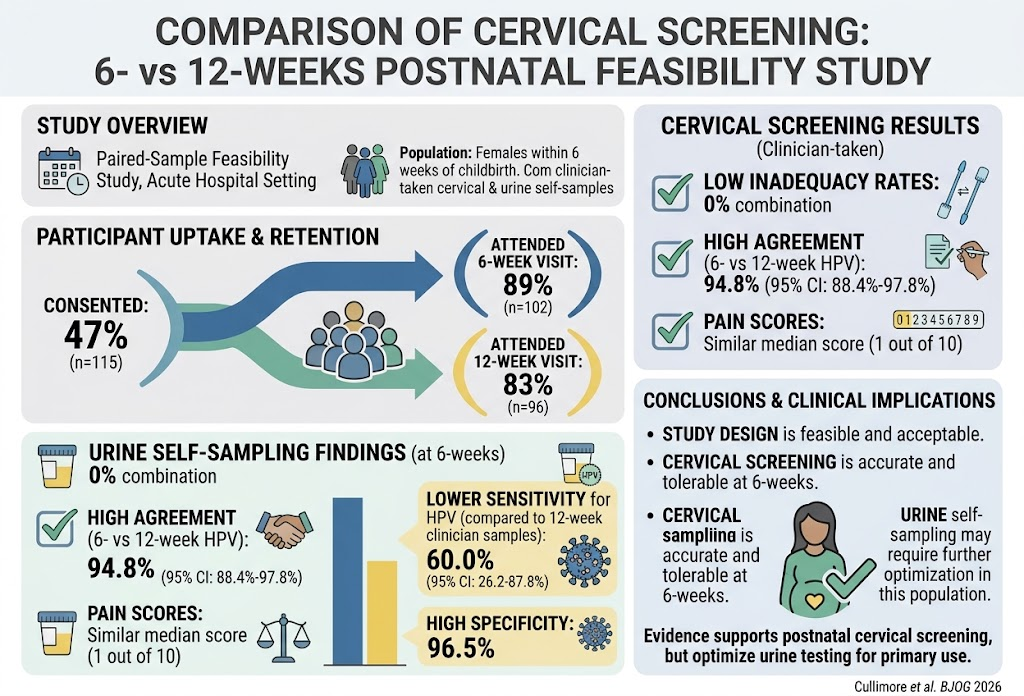
This was a paired-sample feasibility study conducted at an acute hospital setting involving females within 6 weeks of childbirth. A total of 245 females were approached, with 115 (47%) consenting to participation. Participants underwent clinician-taken cervical screening and HPV testing at both 6- and 12-weeks postnatal visits, alongside urine self-sampling for HPV at these times. The study assessed uptake rates, patient-reported pain, acceptability, adverse events, HPV detection rates, and relative test sensitivity and specificity.
Key Findings
Participation rates were high, with 102 (89%) attending the 6-week visit and 96 (83%) the 12-week visit. Pain scores reported during cervical screening were low and statistically similar at both time points (median score of 1 on a pain scale; p=0.76), indicating that earlier screening is well tolerated. Patient acceptance was strong; 95% and 89% of participants reported willingness for future screening at 6 weeks when surveyed during 6- and 12-week visits respectively.
HPV testing showed a high agreement rate between clinician-taken samples at 6 and 12 weeks postpartum (94.8%, 95% CI 88.4%-97.8%). The combination of HPV and cytology tests demonstrated high specificity (96.5%, 95% CI 90.1%-99.3%) at 12 weeks with a sensitivity of 80% (95% CI 44.4%-97.5%) when compared to 6 weeks.
Conversely, urine self-sampling, while highly specific (96.5%), showed comparatively lower sensitivity for HPV detection at 6 weeks (60%, 95% CI 26.2%-87.8%) relative to the clinician-taken samples at 12 weeks, with a robust negative predictive value (95.4%, 95% CI 88.6%-98.7%). These data suggest urine self-sampling may not yet be a suitable standalone modality for postnatal HPV screening but could complement clinician sampling.
No inadequate HPV or cytology test samples were reported, underscoring the technical feasibility of early postnatal screening.
Expert Commentary
This paired-sample feasibility study provides important insights into optimizing cervical cancer screening post childbirth. The low inadequacy rates and high concordance in clinician-taken HPV testing between 6 and 12 weeks support the safety and practicality of earlier screening. Reducing delays in postnatal screening might help capture women lost to follow-up, improving early detection of cervical intraepithelial neoplasia.
The decreased sensitivity of urine-based self-sampling highlights challenges in adopting this less invasive technique in the postnatal context, possibly due to biological or sampling differences postpartum. Further research may elucidate methods to refine urine collection or molecular assays to overcome these limitations.
Study limitations include moderate sample size and single-center setting, which may affect generalizability. Larger, multicenter studies are warranted to validate findings and inform guidelines.
Conclusion
This study confirms the feasibility of cervical screening at 6 weeks postnatal with high patient acceptance and a favorable safety profile. Clinician-taken HPV testing at 6 weeks demonstrates substantial agreement with standard 12-week testing, offering a potential opportunity to accelerate screening timelines without compromising diagnostic performance. While urine self-sampling remains appealing for postpartum populations, current data suggest caution given lower sensitivity. This research lays groundwork toward flexible, patient-centered approaches in postnatal cervical cancer screening.
Funding and Trial Registration
Details regarding funding sources or clinical trial registration were not specified in the source publication.
References
Cullimore VA, Dean T, Chu K, et al. Comparison of Cervical Screening at 6- and 12-Weeks Postnatal: A Paired-Sample Feasibility Study. BJOG. 2026;133(10):1857-1865. PMID: 41918401.
Additional relevant literature:
1. Arbyn, M., et al. (2020). Detecting cervical precancer and reaching underscreened women by using HPV testing on self samples: updated meta-analyses. BMJ, 370, m4927.
2. Wentzensen, N., et al. (2019). Postpartum cervical screening and HPV persistence: A systematic review. Journal of Lower Genital Tract Disease, 23(4), 266-273.
3. Ronco, G., et al. (2014). Efficacy of HPV-based screening for prevention of invasive cervical cancer: follow-up of four European randomised controlled trials. The Lancet, 383(9916), 524-532.