Highlight
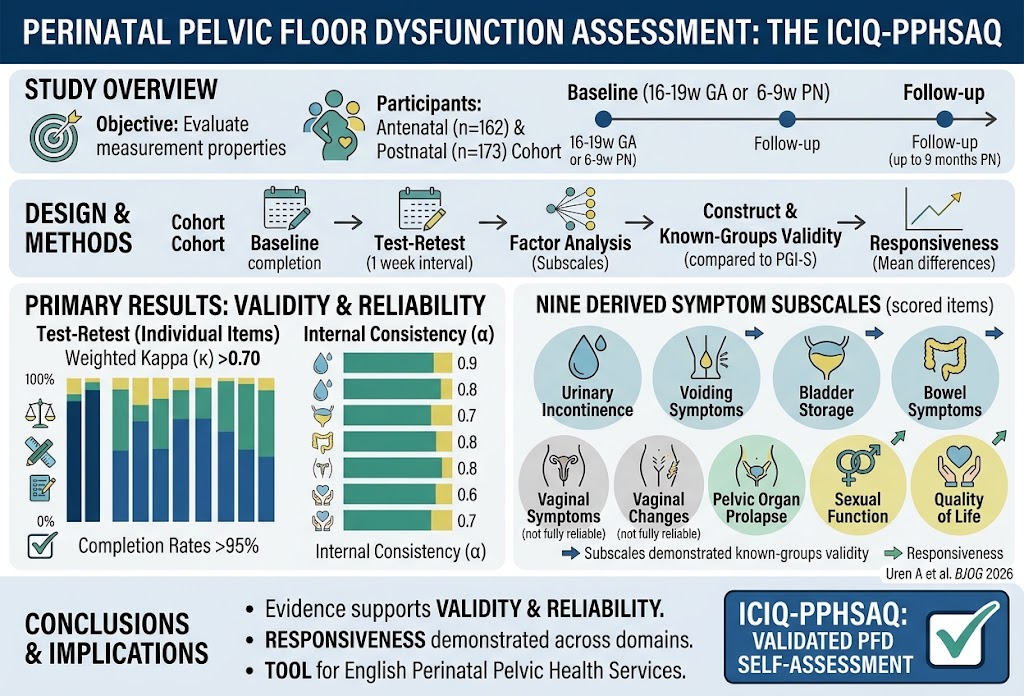
This study establishes the International Consultation on Incontinence-Perinatal Pelvic Health Self-Assessment Questionnaire (ICIQ-PPHSAQ) as a valid and reliable instrument for evaluating symptoms and risk factors of pelvic floor dysfunction in perinatal women. Nine symptom subscales were identified, seven showing acceptable reliability, and the tool demonstrated responsiveness across multiple domains over nine months postpartum. These findings support the use of ICIQ-PPHSAQ in routine perinatal pelvic health care within NHS services in England.
Study Background
Pelvic floor dysfunction (PFD) affects a substantial proportion of women during and after pregnancy, presenting as urinary incontinence, vaginal symptoms, and other pelvic floor-related complaints. These symptoms can significantly impair quality of life, yet standardized tools for assessing PFD risk factors and symptom severity in the perinatal population have been limited. The International Consultation on Incontinence (ICI) developed the ICIQ-PPHSAQ to offer a patient-centered, self-assessment instrument to monitor pelvic floor health throughout pregnancy and the postpartum period. Validating such a tool is critical for facilitating early identification, tailored interventions, and longitudinal tracking of pelvic floor health outcomes.
Study Design
The study was conducted at nine NHS trusts in England involving two cohorts: 162 antenatal women between 16-19 weeks gestation and 173 women at 6-9 weeks postnatal. Participants completed the ICIQ-PPHSAQ at baseline and up to three additional timepoints extending to nine months postpartum. The study incorporated descriptive analyses, exploratory factor analysis (EFA) to identify symptom subscales, and robust psychometric assessments including internal consistency (Cronbach’s α), test-retest reliability (weighted Kappa and intraclass correlation coefficients [ICC]), construct validity, known-groups validity (comparing groups by Patient Global Impression of Severity [PGI-S]), and responsiveness to clinical change over time.
Key Findings
Exploratory factor analysis identified nine distinct symptom subscales within the questionnaire. Among these, seven subscales demonstrated acceptable internal consistency and reliability metrics, with Cronbach’s alpha values indicating good internal coherence for the majority. The vaginal symptom and vaginal changes subscales were exceptions, showing lower reliability which suggests potential areas for refinement.
Test-retest reliability analyses, employing an approximate one-week interval following baseline completion, indicated that nearly all diary items maintained acceptable stability, and completion rates for scored items exceeded 95%, reflecting strong participant engagement and instrument feasibility.
Construct validity was effectively supported by meaningful correlations with the PGI-S, and known-groups validity was demonstrated across all nine subscales, distinguishing between patients based on symptom severity as perceived by participants. Six of the nine subscales showed significant responsiveness to change over the study duration (p < 0.05), indicating the tool’s capability to detect clinically relevant improvements or deteriorations in pelvic floor symptoms and risk factors.
Clinical Implications
The validated ICIQ-PPHSAQ offers healthcare providers a practical, reliable, and patient-oriented instrument for assessing pelvic floor dysfunction in women during the perinatal period. Its subscale structure facilitates nuanced evaluation of symptom domains, enabling targeted clinical decisions, improved risk stratification, and personalized management strategies. Responsiveness to change supports its use in monitoring symptom trajectory and treatment outcomes longitudinally.
Expert Commentary
These findings align with the growing emphasis on patient-reported outcome measures (PROMs) to complement clinical assessments in perinatal pelvic health. While the psychometric rigor of the ICIQ-PPHSAQ is commendable, the lower reliability in vaginal symptom subscales highlights the complex nature of these symptoms and the challenge of self-report measures capturing them fully. Future work might focus on refining these components, integrating objective assessments, and validating the tool in diverse populations beyond the NHS trusts sampled. Nonetheless, this study significantly advances the standardization of pelvic floor dysfunction assessment and facilitates broader implementation of consistent pelvic health monitoring during and after pregnancy.
Conclusion
The ICIQ-PPHSAQ is a validated, reliable, and responsive self-assessment tool suitable for routine use in perinatal care to assess pelvic floor dysfunction symptoms and risk factors. Adoption of this instrument in English pelvic health services promises to enhance early identification, individualized care, and longitudinal outcome tracking in women, addressing a critical gap in perinatal pelvic health management. Further research to optimize subscales and extend validation across other populations will strengthen its clinical utility globally.
Funding and ClinicalTrials.gov
The study was conducted under the auspices of NHS trusts in England. Specific funding sources and trial registration numbers were not detailed in the referenced article.
Reference
Uren A, Fee A, Abrams P, Avery K, Sucha E, Barrowman N, Bale N, Draycott T, Elhodaiby M, Emkes J, Hashim H, Knowles C, Lough K, Madhu C, McCarthy K, Norrie J, Pinkstone J, Soodeen S, Ward K, Cotterill N. Assessment of Perinatal Pelvic Floor Dysfunction Symptoms and Risk Factors: Measurement Properties of the International Consultation on Incontinence-Perinatal Pelvic Health Self-Assessment Questionnaire (ICIQ-PPHSAQ). BJOG. 2026 Sep;133(10):1876-1884. doi: 10.1111/1471-0528.70236. Epub 2026 Apr 8. PMID: 41947746; PMCID: PMC13485451.