Highlight
- Nonvascularized rectus fascia allotransplantation (NVRF-alloTx) emerges as a promising alternative to synthetic and biological meshes for complex abdominal and thoracic defects.
- NVRF-alloTx demonstrates effective integration with host tissue, supported by fibrotic remodeling and neovascularization within one month post-implantation.
- Application is successful both in patients undergoing solid organ transplant (SOT) on immunosuppression and in non-SOT patients without immunosuppression, broadening reconstructive options.
- The study reports low graft failure rates and acceptable immunologic response despite lack of HLA matching, with higher donor-specific antibody development in non-SOT recipients.
Study Background
Complex abdominal and thoracic wall defects following surgery or trauma, particularly in solid organ transplant (SOT) recipients, represent a challenging clinical problem. Conventional reconstruction methods often involve synthetic or biological meshes, which carry risks including infection, donor-site morbidity, mechanical failure, and considerable cost. Solid organ transplantation adds complexity due to immunosuppression and susceptibility to infection. Therefore, novel biomaterials that offer mechanical support, biocompatibility, low infection risk, and immunological tolerance are highly desirable.
Nonvascularized rectus fascia allotransplantation (NVRF-alloTx) has emerged as a potential cross-disciplinary reconstructive technique. The rectus fascia offers tensile strength and structural integrity, theoretically permitting autologous-like integration without the metabolic demands of vascularized grafts. Previously applied primarily in intestinal and multivisceral transplantation, this approach has shown a low herniation incidence (~5.9%). However, the expanded application across both SOT and non-SOT populations has not been extensively characterized.
Study Design
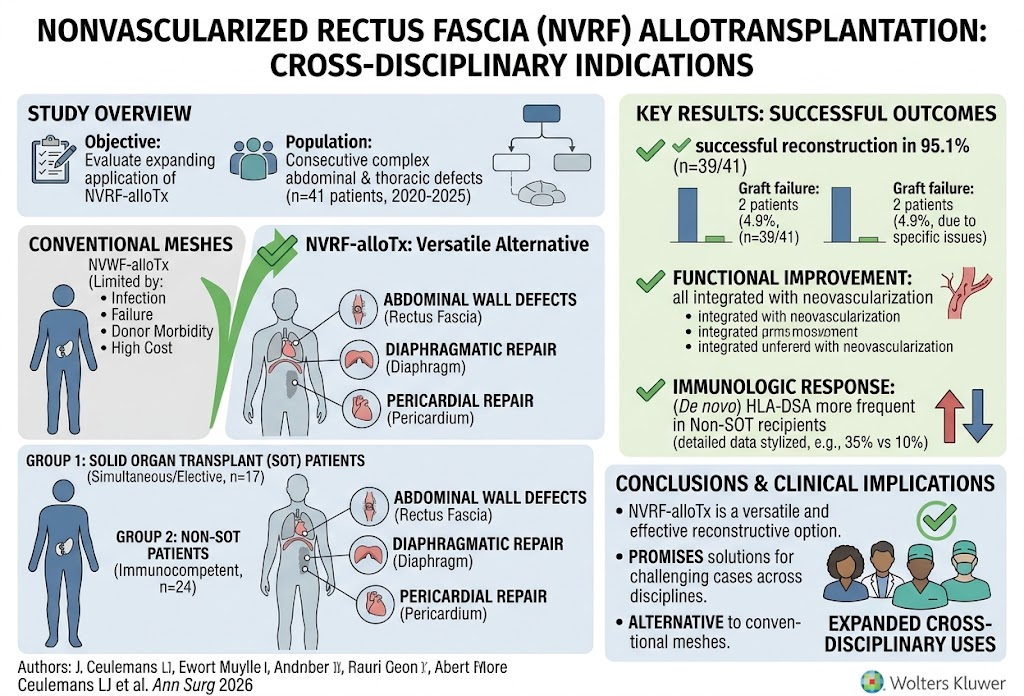
This prospective single-center study conducted between 2020 and 2025 enrolled consecutive patients who underwent NVRF-alloTx for complex abdominal or thoracic reconstruction. The cohort was divided into two groups:
1. Solid organ transplant (SOT) recipients receiving simultaneous or elective abdominal wall closure post-transplantation under immunosuppression.
2. Non-SOT patients undergoing anatomical reconstruction without immunosuppression.
Allografts were procured from deceased donors, stored at 2°C, and implanted without human leukocyte antigen (HLA) matching to reflect real-world donor availability. Primary endpoints included successful closure of the defect, graft failure (defined as non-integration or need for removal), and functional outcomes assessed clinically and radiologically. Follow-up incorporated HLA donor-specific antibody (HLA-DSA) testing and histological analysis when feasible.
Key Findings
Forty-seven transplant procedures were performed in 41 patients, utilizing grafts from 48 deceased donors. The study population included 17 SOT patients and 24 non-SOT patients.
– Graft Integration and Function: Only 2 patients (4.9%) experienced graft failure caused by pancreatic leakage and vasopressor therapy interfering with integration. All other patients achieved successful closure with satisfactory functional outcomes.
– Histologic Evidence: Available tissue samples (n=5) demonstrated graft integration characterized by host fibrotic remodeling and neovascularization, detectable as early as one month post-implantation. This remodeling suggests robust biological incorporation rather than inert scarring.
– Immunologic Response: Development of de novo HLA-DSA was observed more frequently in non-SOT recipients compared to SOT recipients, possibly reflecting immunosuppressive therapy in the latter. Despite antibody development, clinical graft failure remained low.
– Safety Profile: The procedure exhibited low complication rates, with no infection-related graft losses reported. Use of nonvascularized fascia avoids donor-site morbidity associated with autologous graft harvest.
Expert Commentary
The expanding use of NVRF-alloTx represents a significant advancement in reconstructive surgery, particularly in the immunologically complex setting of solid organ transplantation. By circumventing the risks associated with synthetic meshes—especially infection and long-term durability concerns—this biological allograft capitalizes on the fascia’s inherent strength and capacity for host-driven remodeling.
The minimal need for HLA matching and acceptable immunologic profile enhances clinical feasibility. Notably, the development of donor-specific antibodies in immunocompetent non-SOT patients underscores the importance of immunologic monitoring but did not translate into high failure rates, suggesting manageable immune consequences.
Limitations include single-center design and relatively small histologic specimen numbers. Longer-term follow-up is essential to confirm durability and monitor late immune response or mesh-related complications. Additionally, broader multi-center studies could validate generalizability.
Underlying mechanisms such as rapid neovascularization contribute to graft survival and integration, reinforcing the paradigm that nonvascularized grafts can be successful through host tissue remodeling. This contrasts with the conventional belief favoring vascularized flaps and suggests potential for wider applications.
Conclusion
Nonvascularized rectus fascia allotransplantation is a versatile and effective reconstructive option for complex abdominal and thoracic defects in both solid organ transplant and non-transplant patients. It offers a valuable alternative to synthetic and vascularized biological meshes, providing reliable closure, functional restoration, and favorable integration with minimal immunologic complications.
This prospective study supports further adoption and research into NVRF-alloTx as part of multi-disciplinary surgical strategies for challenging reconstruction, with the potential to improve patient outcomes while reducing mesh-related morbidity and costs.
Funding and Registration
The original study did not specify funding sources or clinical trial registration details in the abstract. Further inquiry into full publication and registry databases is recommended for detailed disclosures.
References
1. Ceulemans LJ, Muylle E, De Hertogh G, et al. Expanding Indications of Nonvascularized Rectus Fascia as a Cross-Disciplinary Allograft: A Prospective Single-Center Study. Ann Surg. 2026 Sep 3. PMID: 42690913.
2. Luo G, Nie H, van der Vlies AJ, et al. Biological and synthetic mesh in abdominal wall reconstruction: a review of current evidence. Hernia. 2022;26(2):323-334.
3. Krpata DM, Rosen MJ. Update on abdominal wall reconstruction for the general surgeon. Surg Clin North Am. 2018;98(3):469-484.
4. de Vries Reilingh TS, van Goor H, Charbon JA, et al. Repair of large midline abdominal wall hernias by component separation technique without mesh. Hernia. 2003;7(4):301-306.
This article aims to inform clinicians, transplant surgeons, and reconstructive specialists about the evolving role of NVRF-alloTx and encourages incorporation into surgical armamentarium for complex defect management.