Highlights
- Changes in emergency department (ED) pediatric readiness significantly influence pediatric mortality rates.
- Hospitals losing or lacking high pediatric readiness and inpatient services show marked increases in excess child deaths.
- Improvement in ED pediatric readiness and expansion of inpatient pediatric services may substantially reduce pediatric mortality.
Study Background
The provision of high-quality pediatric emergency and inpatient care remains an essential factor in reducing childhood mortality, especially in acute medical and injury scenarios. Although many hospitals have implemented changes in their emergency department pediatric readiness and expanded pediatric inpatient services, the direct relationship of these changes over time with pediatric mortality outcomes has not been well quantified. Understanding this association is critical given the persistent disparity between the availability of pediatric-specific resources and the unique needs posed by pediatric emergencies across hospitals in the United States.
Study Design
This cohort study retrospectively examined data from 759 hospitals across 11 U.S. states between January 1, 2012, and December 31, 2021. Eligible participants comprised children aged 0 to 17 years receiving emergency department care that led to hospital admission, interhospital transfer, or death. Pediatric readiness was assessed via the National Pediatric Readiness Program’s weighted Pediatric Readiness Score (wPRS), ranging from 0 to 100. Hospitals were categorized by changes in ED readiness from 2013 to 2021 into four groups: sustained high readiness (wPRS ≥88 at both time points), gained readiness, lost readiness, or never had high readiness. Pediatric inpatient services were similarly grouped based on whether they were sustained, gained, lost, or never offered during this period. The primary outcome was in-hospital mortality, including deaths in both the ED and inpatient settings. Risk adjustment accounted for demographic and clinical variables.
Key Findings
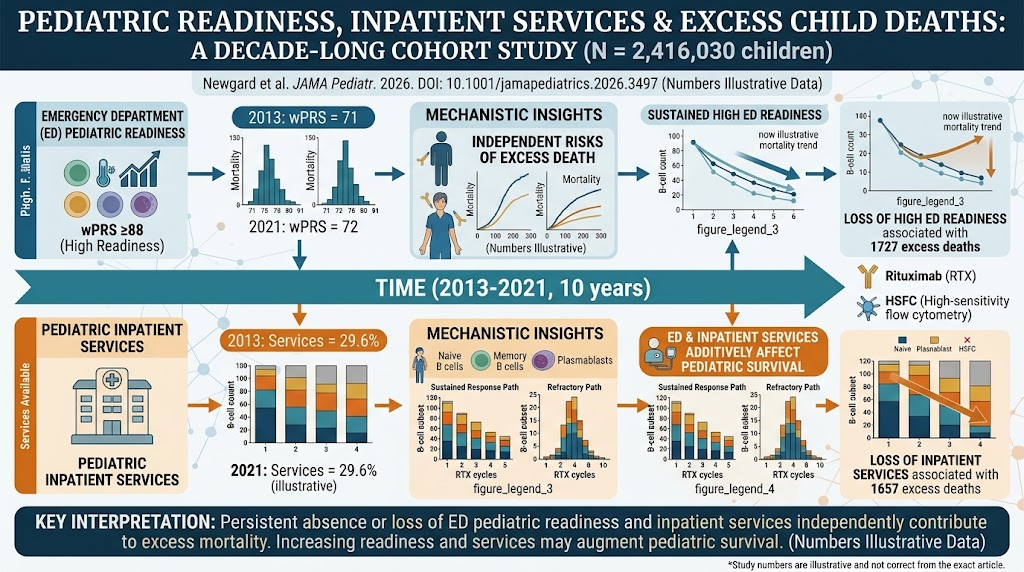
The cohort consisted of 2,416,030 pediatric patients, including 337,167 injured children (median age 10 years, interquartile range [IQR] 4–15) with 4,642 deaths (1.38%) and 2,078,863 medically ill children (median age 6 years, IQR 1–14) with 18,576 deaths (0.89%). The median wPRS across the 759 hospitals was 71 in 2013 (IQR 58–86) and 72 in 2021 (IQR 62–88), indicating modest improvement over time.
Regarding ED readiness: 13.0% of hospitals sustained high readiness, 11.2% gained readiness, 10.3% lost readiness, and 65.5% never had high readiness. For inpatient services, 29.6% sustained services, 4.7% gained services, 15.8% lost services, and 49.8% never had inpatient pediatric services.
After adjusting for confounders, hospitals that lost high ED readiness or never achieved it were associated with an estimated 1,727 (95% CI, 751–2,646) and 3,776 (95% CI, 2,327–5,143) excess child deaths, respectively. Similarly, loss or lack of inpatient pediatric services correlated with 1,657 (95% CI, 1,214–2,067) and 3,745 (95% CI, 3,127–4,328) excess deaths, respectively. These excess mortality estimates underline the independent and additive risks of deficits in both emergency readiness and inpatient care capacity for pediatric patients.
Expert Commentary
This comprehensive evaluation highlights the importance of consistent pediatric readiness in emergency departments coupled with available pediatric inpatient services to optimize outcomes for children requiring urgent hospital care. The weighted Pediatric Readiness Score serves as a robust metric reflecting the multidisciplinary preparedness of EDs to manage pediatric patients effectively. The findings corroborate previous smaller studies and guideline recommendations emphasizing that specialized pediatric expertise, equipment, and protocols within EDs substantially improve survival. Furthermore, the data underscore the need for inpatient pediatric facilities to continue appropriate care beyond the emergency period. Healthcare policymakers and hospital administrators should prioritize investments that maintain or enhance pediatric readiness and inpatient capabilities to address this preventable excess mortality.
Limitations of the study include its observational design and potential residual confounding factors. The study reflects outcomes from hospitals within 11 states and may not fully account for regional variation in healthcare delivery or social determinants of health. Additionally, the Pediatric Readiness Score cutoff of 88, while validated, might warrant further nuanced evaluation in different hospital settings.
Conclusion
In summary, this decade-long cohort study establishes that the loss or persistent absence of high emergency department pediatric readiness and pediatric inpatient services independently contribute to significant excess mortality in children. Interventions aimed at sustaining or increasing pediatric readiness in emergency care settings and expanding pediatric inpatient service availability have important potential to reduce pediatric deaths across the U.S. healthcare system. Advocating for standardized pediatric emergency readiness and inpatient capacity should be a clinical and policy priority to improve pediatric survival outcomes.
Funding and ClinicalTrials.gov
The study was reported by Newgard et al. (2026) and published in JAMA Pediatrics. Specific funding sources and clinical trial registrations were not detailed in the provided abstract.
References
- Newgard CD, Lin A, Goldhaber-Fiebert JD, et al. Changes in Emergency Department Pediatric Readiness, Inpatient Services, and Excess Child Deaths. JAMA Pediatr. 2026; PMID: 42606885. doi:10.1001/jamapediatrics.2026.680685
- American Academy of Pediatrics Committee on Pediatric Emergency Medicine. Pediatric readiness in emergency departments: clinical and operational considerations. Pediatrics. 2013;131(4): e1662-e1669.
- Gausche-Hill M, Ely M, Schmuhl P, et al. A national assessment of pediatric readiness of emergency departments. JAMA Pediatr. 2015;169(6):527-534.
- Wittkopf PG, et al. Inpatient pediatric services and pediatric emergency care outcomes: a systematic review. Pediatr Emerg Care. 2020;36(11):523-529.