Patient Information
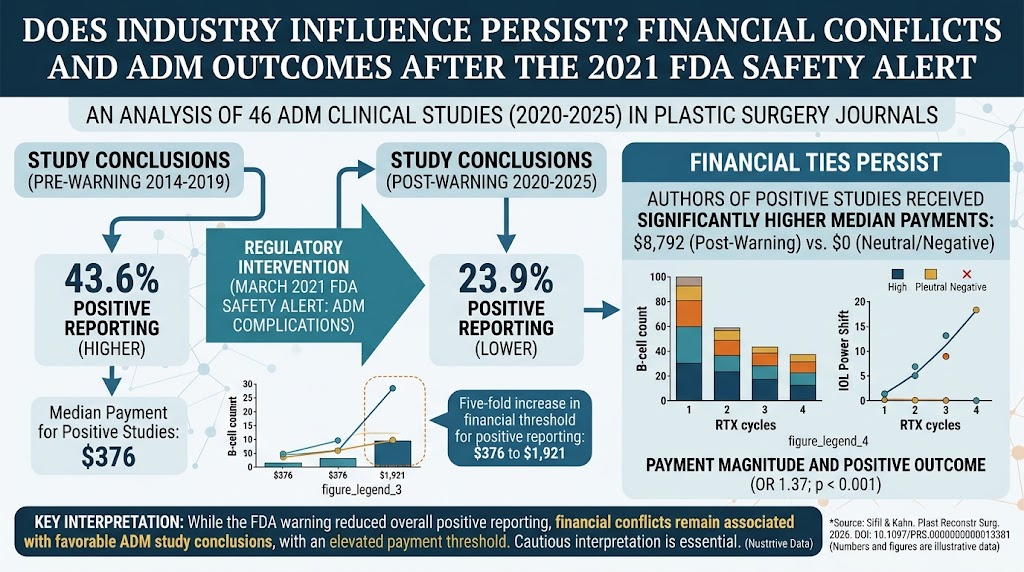
This case report is not centered on a patient but focuses on the clinical literature surrounding acellular dermal matrix (ADM) use in breast reconstruction following the 2021 FDA safety alert. The primary subject is the analysis of ADM-related clinical studies and the influence of financial conflicts of interest on reported outcomes.
Diagnosis
Not applicable as this is a literature analysis case report. However, the diagnosis area correlates with evaluating the validity and bias of ADM outcomes reported in the context of breast reconstructive surgery post-mastectomy.
Differential Diagnosis
The differential consideration involves determining whether reported study conclusions favoring ADM use are influenced by industry financial ties or represent unbiased clinical evidence. It assesses the competing possibility that positive ADM outcomes are independent of author payments.
Treatment and Management
While no direct clinical treatment is described, the management involves a rigorous literature review and quantitative analysis comparing ADM study outcomes before and after the FDA safety communication issued in March 2021 regarding ADM complications.
Outcome and Prognosis
The analysis included 46 ADM studies published between 2020 and 2025. Key findings: 23.9% of these studies reported positive conclusions regarding ADM use post-warning, a decline from 43.6% before the warning (2014–2019). Despite reduced positive reporting, authors with financial ties to industry demonstrated significantly higher median payments (median $8,792) than those authoring neutral or negative reports (median $0; p < 0.001). Logistic regression showed an odds ratio (OR) of 1.37 for association between increasing payments and favorable ADM reporting (p < 0.001). Furthermore, the financial payment threshold linked to positive conclusions increased fivefold from $376 in the pre-warning era to $1,921 post-warning, suggesting a persistence of influence with an elevated payment bar.
Discussion
This case report analyzes the pertinence of industry financial influence on ADM clinical research outcomes following a pivotal FDA safety alert in 2021. The FDA had cautioned against certain complications with ADM use in breast reconstruction, which seemingly led to fewer positively concluded ADM studies. Nevertheless, data indicate that financial conflicts remain significantly associated with favorable ADM outcome reporting even after regulatory warnings.
These findings raise important considerations for clinicians, researchers, and policymakers about the complex dynamics of scientific integrity amidst financial relationships. The association is correlational, and it does not imply causation at the individual study level. However, these patterns underscore the necessity for heightened transparency and critical appraisal when interpreting ADM literature, especially given the increasing financial payment threshold for reported favorable outcomes.
This report supports the importance of rigorous conflict of interest disclosures, independent research funding, and cautious interpretation by journal reviewers and readers. The persistence of industry influence highlights ongoing challenges in maintaining unbiased evidence synthesis and clinical guideline development in surgical specialties.
Future research should explore mechanisms to mitigate financial bias and its impact on surgical innovation assessments, ensuring patient safety and evidence-based practice remain paramount.
References
1. Sifil MK, Kahn DM. Does Industry Influence Persist? Financial Conflicts and ADM Outcomes After the 2021 FDA Safety Alert. Plastic and Reconstructive Surgery. 2026 Aug 14. PMID: 42606309. Available at: https://pubmed.ncbi.nlm.nih.gov/42606309/
2. U.S. Food and Drug Administration. Safety Communication on Acellular Dermal Matrix (ADM) Use in Breast Reconstruction. March 2021.
3. Open Payments Data. Centers for Medicare & Medicaid Services. https://openpaymentsdata.cms.gov/
4. Loder RT. Conflicts of Interest and Bias in Surgery Research. J Bone Joint Surg Am. 2021;103(18):1701-1705. doi:10.2106/JBJS.21.00415