Highlight
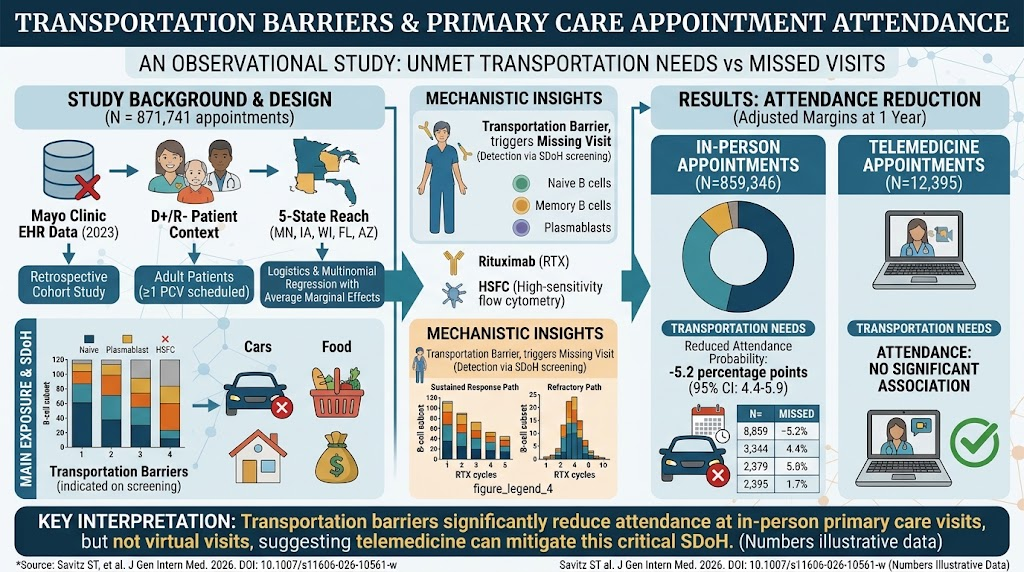
- Unmet transportation needs significantly reduce attendance at in-person primary care visits.
- Transportation barriers are more strongly associated with missed in-person appointments than other social determinants of health (SDoH).
- Transportation needs do not significantly affect attendance at telemedicine visits, suggesting it mitigates this barrier.
- Incorporating telemedicine could improve healthcare access among patients facing transportation challenges.
Study Background
Primary care is foundational for preventive health, chronic disease management, and overall wellbeing. However, missed appointments pose a significant challenge by delaying diagnosis, interrupting continuity of care, and increasing healthcare costs. Social determinants of health (SDoH), including food insecurity, housing instability, and financial stress, influence healthcare utilization, but transportation remains a critical and often under-recognized barrier. Reliable transportation is essential for attending scheduled in-person visits; unmet transportation needs have been linked to poor health outcomes and reduced healthcare engagement. Understanding the extent to which transportation barriers contribute to missed appointments, and evaluating telemedicine’s potential to mitigate these challenges, is crucial in evolving patient-centered care models.
Study Design
This retrospective cohort study analyzed electronic health record data from Mayo Clinic primary care clinics across five U.S. states—Minnesota, Iowa, Wisconsin, Florida, and Arizona—during 2023. Adult patients with at least one scheduled primary care visit (either in-person or virtual) were included. The primary exposure was documented unmet transportation needs based on standardized SDoH screening performed nearest to appointment dates. Additional exposures assessed included food insecurity, financial/utility needs, housing stability, and the HOUsing-based SocioEconomic Status (HOUSES) Index.
The main outcomes were attendance versus missed or canceled appointments, differentiated by visit type: in-person and telemedicine. Statistical analyses utilized logistic and multinomial logistic regression models with patient-level clustered standard errors. Results were reported as average marginal effects with 95% confidence intervals (CI).
Key Findings
Out of 871,741 scheduled primary care appointments examined, 859,346 were in-person and 12,395 were virtual visits. Patients reporting transportation barriers were 5.2 percentage points less likely to attend scheduled in-person visits compared to those without such barriers (95% CI: 4.4 to 5.9 percentage points). This indicates a statistically and clinically meaningful association between transportation needs and missed care.
In contrast, transportation barriers did not significantly impact attendance at telemedicine appointments, suggesting that virtual care can circumvent transportation-related impediments. When compared with other SDoH, transportation needs exhibited the greatest magnitude effect on missed in-person visits, underscoring their pivotal role as a barrier.
Other social determinants such as food insecurity, financial strain, and housing instability also influenced appointment attendance but with smaller effect sizes than transportation. The study further controlled for socioeconomic status using the HOUSES Index to isolate transportation effects.
Expert Commentary
The findings confirm the critical impact of transportation barriers on missed healthcare appointments, reinforcing transportation as a key SDoH needing targeted intervention. These results align with prior research linking transportation issues to delayed care and increased emergency room utilization. Crucially, this study highlights telemedicine as a promising modality to enhance healthcare access for patients facing transportation challenges, particularly in geographically dispersed or underserved communities.
Nevertheless, the reliance on retrospective electronic health records and self-reported SDoH screening may introduce reporting bias. The study population, drawn from Mayo Clinic patients, may limit generalizability to other health systems or regions lacking integrated SDoH assessment frameworks. Additionally, missed telemedicine visits might have different underlying causes warranting further investigation.
This study emphasizes the importance of integrating transportation and social needs assessments into primary care workflows and leveraging telemedicine when appropriate. Future work should focus on tailored interventions such as providing transportation services, rideshares, or community collaborations to reduce no-show rates and improve health outcomes.
Conclusion
Unmet transportation needs represent a significant barrier to attending in-person primary care appointments, more so than other social determinants studied. Telemedicine effectively mitigates the challenge of transportation barriers, maintaining appointment attendance rates. Healthcare systems should consider enhanced SDoH screening, transportation assistance programs, and expanded telehealth offerings to promote equitable access to primary care. Addressing transportation issues is crucial to reduce missed appointments, optimize health outcomes, and control healthcare costs.
Funding and ClinicalTrials.gov
The original publication does not report specific funding sources or clinical trial registration.
References
1. Savitz ST, Harper SB, Glasgow AE, Sosso JL, Westfall EC. Relationship Between Unmet Transportation Needs and Missed Primary Care Appointments: An Observational Study. J Gen Intern Med. 2026 Aug 17. PMID: 42608519.
2. Syed ST, Gerber BS, Sharp LK. Traveling Towards Disease: Transportation Barriers to Health Care Access. J Community Health. 2013 Oct;38(5):976-93.
3. Vehko T, Rhodes K, Kazis L. Telemedicine and the Social Determinants of Health: Lessons from COVID-19. NEJM Catalyst Innovations in Care Delivery. 2021.
4. Arcury TA, Quandt SA. Delivery of health services to rural minority populations: prevention and screening issues. Am J Preventive Medicine. 2007.