Introduction
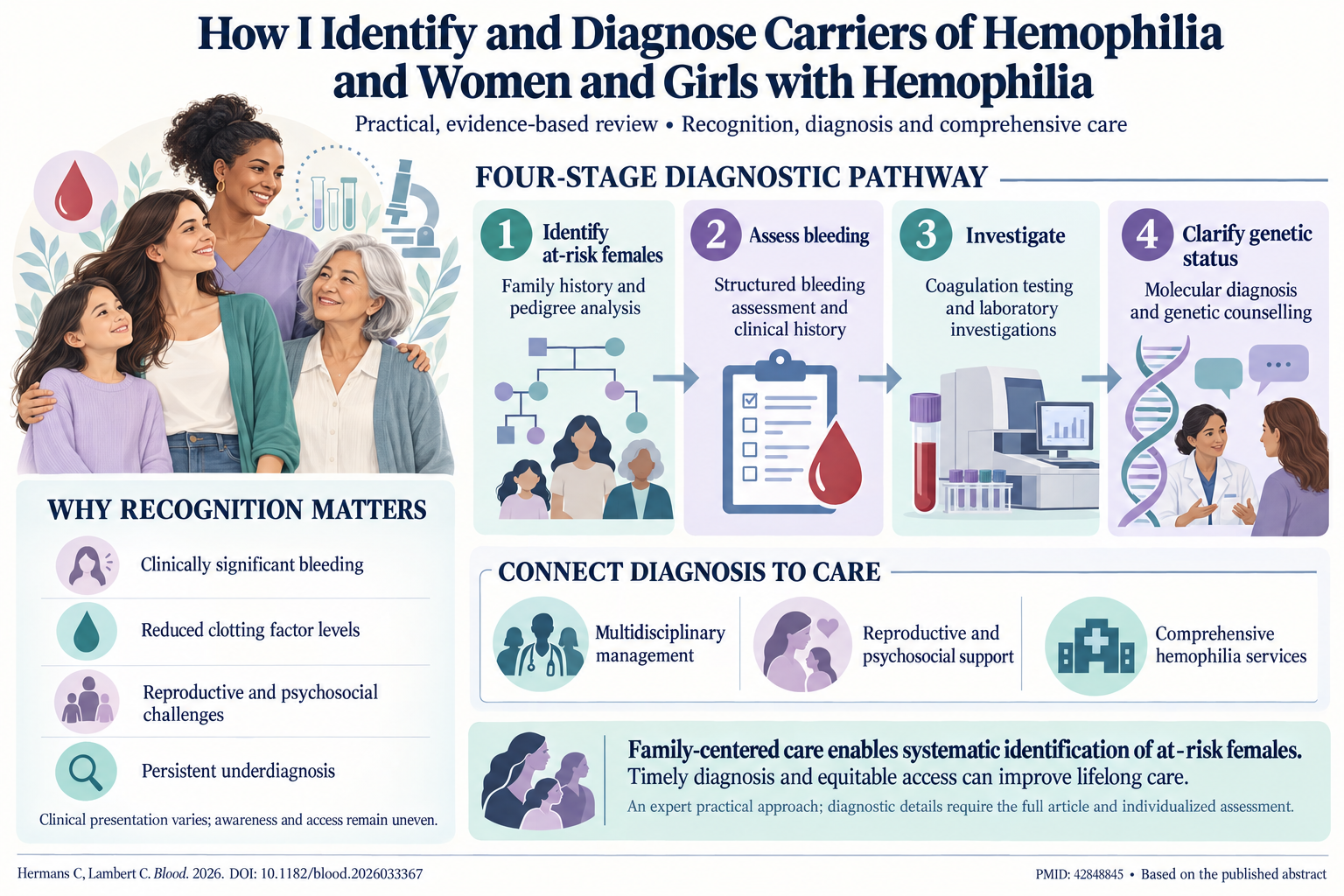
Carriers of hemophilia and females affected by hemophilia represent an often under-recognized group within bleeding disorders. Traditionally perceived as asymptomatic carriers, growing evidence demonstrates that these females may experience clinically significant bleeding, factor VIII or IX deficiency, and face unique psychosocial and reproductive challenges. Despite advances in diagnostic technologies and international guidelines, underdiagnosis and delayed diagnosis persist globally, especially in resource-constrained settings. This article outlines an evidence-based, pragmatic framework for healthcare professionals to enhance detection, diagnosis, and management of hemophilia carriers as well as women and girls with hemophilia to optimize their health outcomes.
Disease Background and Clinical Context
Hemophilia A and B are X-linked recessive bleeding disorders characterized by deficiencies in clotting factor VIII and IX, respectively. While males with pathogenic mutations typically express the full disease phenotype, females may be carriers with normal or low factor levels, or, less commonly, manifest symptomatic hemophilia due to lyonization or other genetic mechanisms. Carriers can experience bleeding phenotypes ranging from mild to severe, including mucocutaneous bleeding, menorrhagia, and hemorrhagic complications during surgery or childbirth.
The diagnostic challenge lies in the heterogeneity of clinical presentations and factor levels among females. Historical focus on affected males and misconceptions that carriers are asymptomatic have contributed to inadequate recognition and management. Furthermore, reproductive decisions and psychosocial well-being in carrier women necessitate specialized counseling and multidisciplinary care.
Identification and Pedigree Analysis
A thorough family history remains pivotal in suspecting carrier status. Detailed pedigree analysis should ideally extend to three generations, documenting bleeding symptoms, male hemophilia diagnoses, and any female relatives with unusual bleeding or low factor levels. Close collaboration with genetic counselors can aid in constructing informative pedigrees and identifying at-risk females for further evaluation.
Systematic family-based screening, rather than solely patient-initiated testing, is essential in capturing undiagnosed carriers. Awareness campaigns and education of primary care and obstetric providers contribute to identifying women who may benefit from hematologic assessment.
Bleeding Assessment Tools
Quantification of bleeding symptoms using standardized bleeding assessment tools (BATs) such as the ISTH-BAT facilitates objective evaluation of bleeding severity. These tools help differentiate symptomatic carriers or affected females from asymptomatic individuals and guide decisions on further testing and management.
Laboratory Investigations
Initial screening comprises measurement of clotting factor activity levels (FVIII or FIX), activated partial thromboplastin time (aPTT), and platelet function tests when indicated. Factor activity levels can fluctuate due to hormonal status, age, inflammation, or blood type; thus, repeat testing and inclusion of von Willebrand factor levels help contextualize results.
Advanced coagulation assays, including chromogenic factor assays, may offer improved sensitivity and specificity. Global assays such as thrombin generation tests provide insights into overall hemostatic potential but are currently more research-centric.
Molecular Genetic Testing
Genetic analysis confirms carrier status and elucidates mutation type, crucial for diagnosis, counseling, and prenatal considerations. Common approaches include targeted gene sequencing, multiplex ligation-dependent probe amplification (MLPA) to detect large deletions/duplications, and next-generation sequencing panels.
Detecting mutations enables prenatal diagnosis and preimplantation genetic diagnosis, facilitating reproductive decision-making. Limitations include mosaicism and variants of uncertain significance, which require expert genetic interpretation.
Genetic Counseling and Multidisciplinary Management
Multidisciplinary teams including hematologists, geneticists, obstetricians, psychologists, and specialized nurses play critical roles in managing carriers and affected females. Genetic counseling should cover inheritance patterns, bleeding risks, reproductive options, and psychological support.
Management strategies are individualized based on bleeding phenotype and factor levels. Prophylactic factor replacement, antifibrinolytics, and hormonal therapies address bleeding and menorrhagia. Education on bleeding risk during surgery, delivery, and invasive procedures is essential.
Diagnostic Challenges and Pitfalls
Women with intermediate factor levels often pose diagnostic dilemmas due to overlap with normal ranges. Misclassification of carrier status can impact clinical care and psychological well-being. Awareness of lyonization effects, acquired inhibitors, and concurrent bleeding disorders is important.
Limited access to advanced diagnostics and specialist care in low-resource regions further contributes to underrecognition. Implementation of consensus guidelines and training programs aims to reduce these disparities.
Future Directions and Research Needs
Improved diagnostic algorithms integrating genetic, biochemical, and clinical data are needed. Research on the natural history and optimal management of symptomatic carriers and affected females continues to evolve. Enhanced data registries will inform evidence-based practice.
Conclusion
Recognition of the clinical significance of hemophilia carriers and women and girls with hemophilia is imperative for timely diagnosis and care. A family-centered approach incorporating detailed pedigree analysis, bleeding assessment, laboratory and genetic testing, and multidisciplinary management optimizes outcomes. Addressing diagnostic and care disparities worldwide remains a priority to ensure equitable health services for this underserved population.
Reference
Hermans C, Lambert C. How I Identify and Diagnose Carriers of Hemophilia and Women and Girls with Hemophilia. Blood. 2026 Oct 8:blood.2026033367. doi: 10.1182/blood.2026033367. Epub ahead of print. PMID: 42848845.