Highlights
- Medical interpreters perform nuanced roles beyond language translation, contributing significantly to healthcare resilience and patient safety in ambulatory settings.
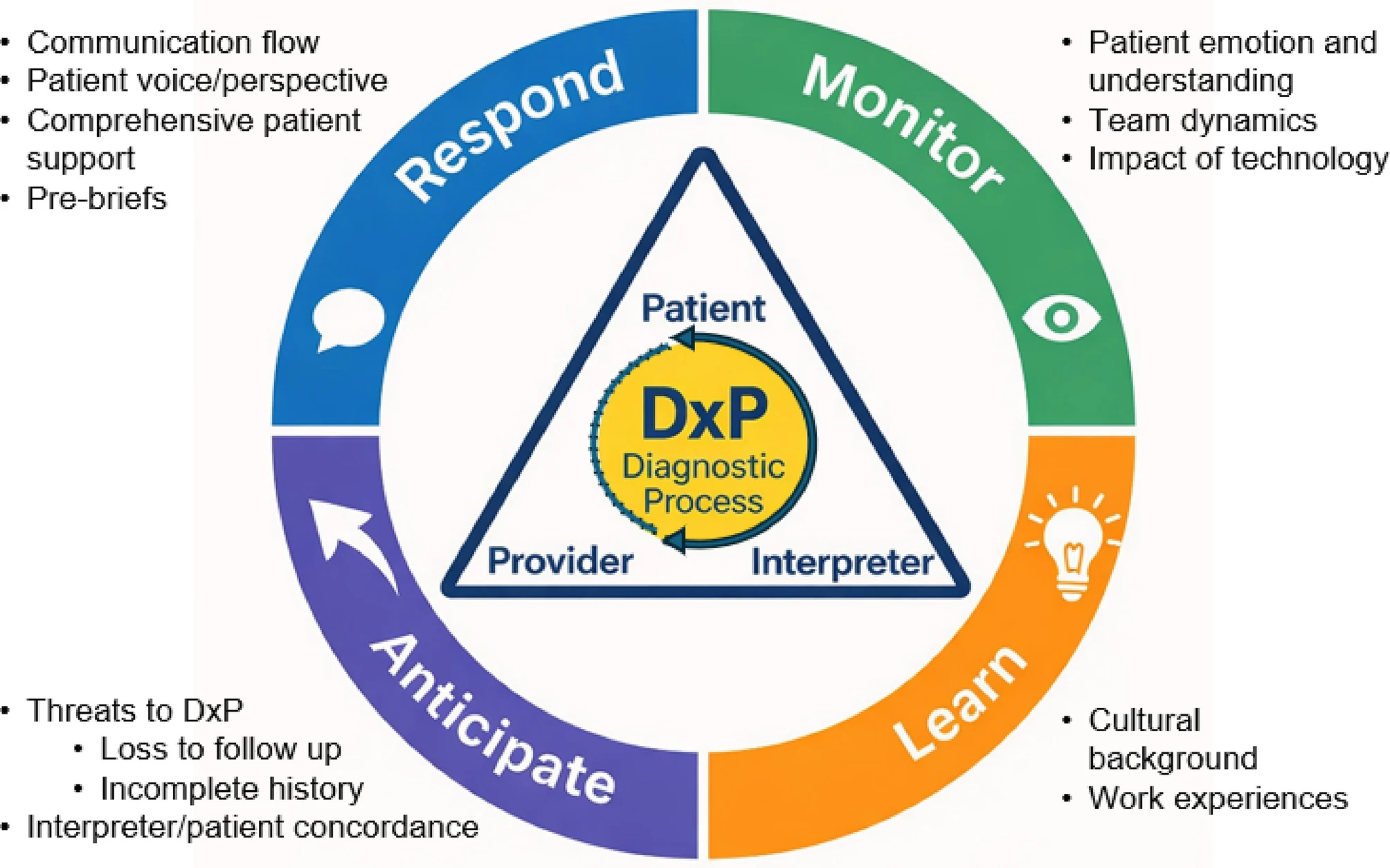
- Interpreters’ behaviors align with Hollnagel’s resilience potentials: responding, monitoring, learning, and anticipating, encompassing communication management, cultural mediation, and system awareness.
- Current AI interpretation tools primarily focus on direct language translation, lacking support for resilience-enhancing behaviors exhibited by human interpreters.
- Integrating AI in clinical interpretation workflows requires careful design to preserve interpreter roles that promote resilience and to mitigate safety risks.
Background
Globally, millions of patients with a non-English language preference (NELP) face substantial barriers navigating healthcare systems, often experiencing fragmented care and increased risks of diagnostic errors. Medical interpreters are foundational in facilitating communication between patients and clinicians, particularly in ambulatory diagnostic pathways where multiple encounters and complex symptom assessment increase vulnerability to misdiagnosis and adverse outcomes. As artificial intelligence (AI) tools for language interpretation rapidly evolve and gain adoption, understanding the broader roles of interpreters beyond direct translation—especially their contribution to healthcare resilience—is imperative. This knowledge is crucial to guide the development and deployment of AI solutions that do not undermine critical resilience functions and patient safety.
Key Content
Understanding Interpreter Roles through Resilience Engineering
Resilience engineering, as conceptualized by Hollnagel, identifies four key potentials essential for adaptive performance in complex systems: the potentials to respond, monitor, learn, and anticipate. Applying this framework to medical interpreters offers a structured approach to decode their multifaceted influence on patient safety beyond verbal communication.
Behaviors Supporting the Potential to Respond
Interpreters actively manage communication flow, ensuring clarity and completeness of information exchange between patients and clinicians. By strengthening the patient’s voice, they empower patients to express concerns and preferences effectively, critical for accurate symptom characterization and shared decision-making. Interpreters view their role broadly, often acting as cultural brokers and advocates, and engage in pre-briefings with healthcare teams to prepare for encounters, enhancing readiness and adaptability.
Behaviors Supporting the Potential to Monitor
Monitoring extends beyond linguistic accuracy to include attunement to patients’ emotional states and comprehension levels, which can influence engagement and recall. Interpreters also monitor team dynamics, facilitating mutual understanding between clinical members and navigating interpersonal or system-level tensions. Additionally, they observe the impact of technological tools used during encounters, identifying disruptions or facilitators in communication.
Behaviors Supporting the Potential to Learn
Interpreters leverage their cultural backgrounds to interpret nuanced expressions and social contexts, bridging gaps between medical concepts and patients’ lived experiences. Learning from repeated clinical exposures enhances their situational awareness and capability to identify subtle signals or discrepancies that may indicate diagnostic or safety concerns.
Behaviors Supporting the Potential to Anticipate
Experienced interpreters predict possible threats to patient safety such as communication breakdowns or misunderstandings that could lead to errors. They also recognize potential system improvements, suggesting workflow modifications or advocating for protocols that safeguard against recurrent issues.
Implications for Artificial Intelligence Interpretation Tools
While AI interpretation platforms offer scalability and accessibility benefits, current iterations primarily address direct translation and lack capacity for resilience-related behaviors. Notably, AI does not yet replicate emotional intelligence, cultural nuance, or dynamic monitoring of team interactions. Therefore, exclusive reliance on AI may inadvertently create safety gaps by omitting these critical functions. Hybrid models combining AI with human interpreter oversight could harness efficiencies while maintaining resilience.
Research and Implementation Landscape
Empirical studies including qualitative analyses of interpreter experiences underscore the complexity of their roles but remain limited in scope and longitudinal assessment. There is a critical need for mixed-method research to evaluate how AI tools influence resilience potentials in real-world ambulatory settings. Implementation science frameworks should guide the integration of AI to preserve non-translation interpreter functions and align workflows accordingly.
Expert Commentary
This synthesis reinforces that medical interpreters serve as integral agents of resilience within healthcare systems, navigating linguistic, cultural, emotional, and systemic factors to promote patient safety. Their roles transcend simple transmission of words and encompass adaptive behaviors that respond to dynamic clinical contexts. The current rush to adopt AI-powered interpretation risks discounting these nuanced contributions, with potential unintended consequences for vulnerable NELP populations. Clinicians, health system leaders, and AI developers should collaborate to refine AI tools that augment rather than replace interpreter functions. Moreover, interpreter training programs should evolve to codify resilience-enhancing practices, while AI systems require advancement toward more context-aware, interactive capacities.
Structural integration of interpreters into multidisciplinary teams and workflows remains an ongoing challenge, often compounded by resource constraints. Long-term, establishing standards that recognize and reward resilience-enhancing behaviors is essential. Furthermore, attention to ethical, privacy, and equity considerations in AI interpretation deployment will safeguard trust and uptake.
Conclusion
Medical interpreters critically sustain resilience in ambulatory diagnostic care for patients with language barriers through behaviors that facilitate communication flow, cultural bridging, emotional attunement, team coordination, and proactive safety anticipation. Current AI tools lack these resilience-supporting capabilities, necessitating a hybrid approach that preserves and amplifies human expertise. Future research must empirically evaluate AI’s impact on resilience and develop implementation strategies that integrate AI without compromising patient safety. Addressing these gaps will ensure equitable, safe, and effective communication for NELP patients in increasingly digitalized healthcare environments.
References
- Samost-Williams A, Wermuth P, Fernández Castillo G, et al. The Role of Interpreters in Supporting Resilience and Implications for Artificial Intelligence. J Gen Intern Med. 2026; PMID: 42834288.
- Hollnagel E. Resilience Engineering in Practice: A Guidebook. Ashgate Publishing; 2011.
- Karliner LS, Jacobs EA, Chen AH, Mutha S. Do Professional Interpreters Improve Clinical Care for Patients with Limited English Proficiency? A Systematic Review of the Literature. Health Serv Res. 2007;42(2):727-754.
- Flores G. The Impact of Medical Interpreter Services on the Quality of Health Care: A Systematic Review. Med Care Res Rev. 2005;62(3):255-299.
- Inamori A, Naito T, Fukui T, et al. Development of an AI-Based Medical Interpreter System: Perspectives and Challenges. JAMIA Open. 2023;6(1):ooac100.
- Agency for Healthcare Research and Quality. Improving Patient Safety for Limited English Proficient Patients: Challenges and Strategies. AHRQ White Paper. 2022.