Introduction and Context
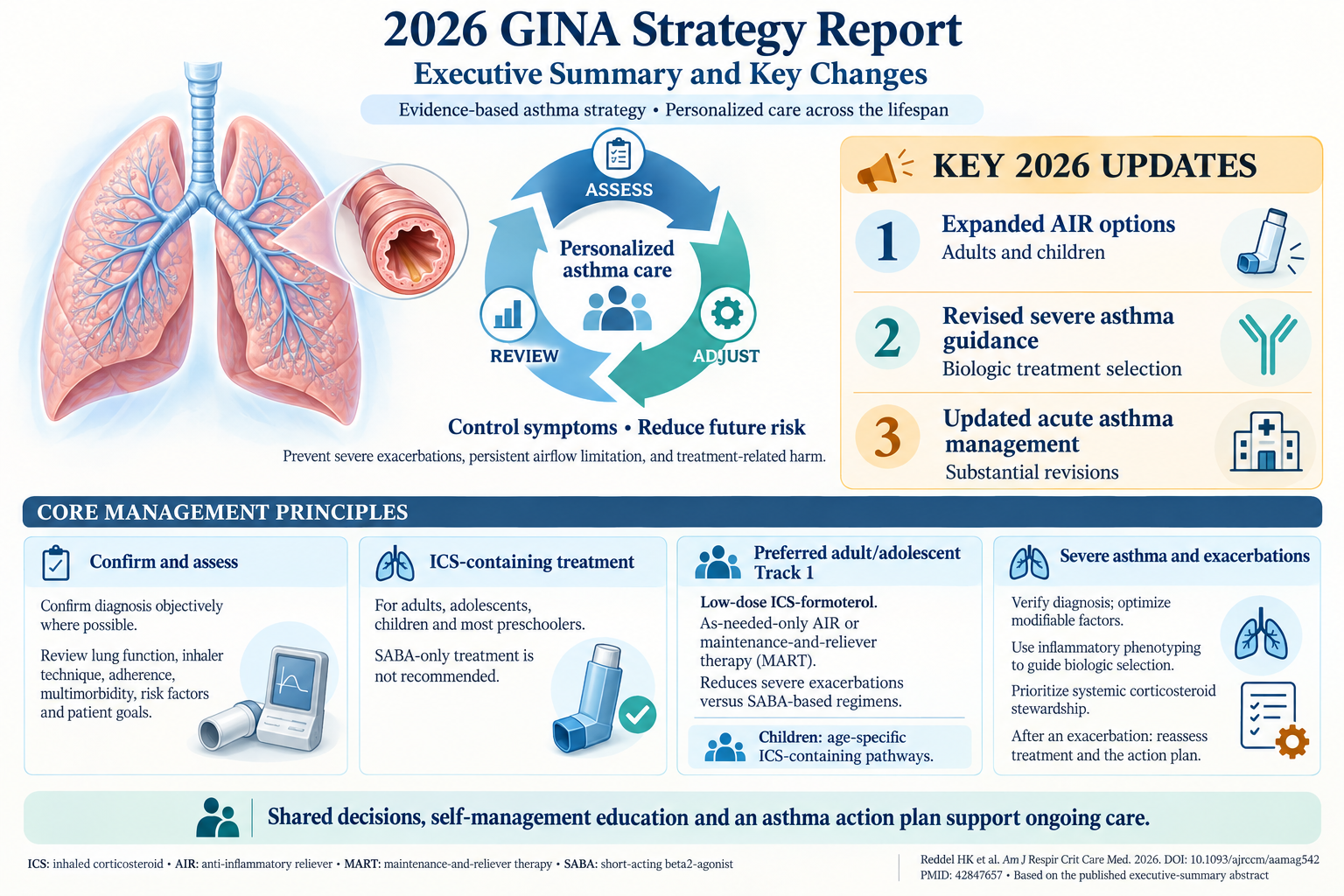
The Global Initiative for Asthma (GINA) publishes an annual, evidence-based strategy report that synthesizes the latest clinical trials, observational studies, and expert consensus to guide diagnosis, management, and prevention of asthma across the lifespan. The 2026 GINA Strategy Report (Reddel et al., 2026) refines prior recommendations with new data on anti-inflammatory reliever (AIR) options, expanded age-specific guidance, updated approaches to severe asthma and biologic selection, and substantial revisions to acute care and post-exacerbation management. The update is intended to reduce preventable exacerbations and corticosteroid-related harms while supporting personalized, shared decision-making in routine practice.
Why an update now
– Persistent gaps in asthma outcomes worldwide: underuse of inhaled corticosteroids (ICS), overreliance on short-acting beta2-agonists (SABA), and rising morbidity in some regions.
– Accumulating randomized-trial and real-world evidence showing that as-needed or maintenance-and-reliever strategies using low-dose ICS-formoterol reduce severe exacerbations compared with SABA-based approaches.
– New biologic agents and biomarker data informing tailored severe asthma therapy.
– Evidence and implementation lessons supporting structured corticosteroid stewardship and better post-discharge care.
New Guideline Highlights
Major themes and takeaways
– Universal emphasis on ICS-containing treatment: GINA strongly recommends that almost all patients (adults, adolescents, children, and most preschoolers) with asthma receive some form of ICS-containing therapy to address airway inflammation and reduce exacerbation risk.
– Against SABA-only treatment: GINA continues to recommend against SABA-only management for asthma due to increased exacerbation risk.
– Track 1 preferred strategy for adults/adolescents: Low-dose ICS-formoterol as an anti-inflammatory reliever (AIR) is the preferred approach for most adults and adolescents. AIR can be used as as-needed-only (AIR-only) in patients with infrequent symptoms or as maintenance-and-reliever therapy (MART) when daily controller therapy is also prescribed.
– Age-specific pathways: Pediatric recommendations maintain focus on ICS-containing regimens tailored to age and severity, with expanded AIR options for selected children.
– Severe asthma: The 2026 report provides structured, stepwise guidance—confirm diagnosis, optimize modifiable factors, phenotype inflammatory biology (Type-2 biomarkers where available), and use biologics guided by phenotype and evidence. Emphasis on minimizing systemic corticosteroid exposure (steroid stewardship).
– Acute exacerbations: Substantial updates reinforce early use of preventive ICS-containing strategies, specify in-hospital management priorities, and mandate post-discharge reassessment, action-plan review, and timely follow-up.
Key practice change: For clinicians who previously permitted SABA-only regimens in mild asthma, GINA 2026 makes clear that an ICS-containing approach (preferably ICS-formoterol AIR for adults/adolescents) is now the standard of care to reduce severe exacerbations.
Updated Recommendations and Key Changes (Compared with prior GINA versions)
Summary of major 2026 updates
– Expanded AIR options: Broader endorsement of low-dose ICS-formoterol as both as-needed-only and maintenance-and-reliever (MART) options for adults and adolescents; expanded, evidence-based AIR guidance for selected children and preschoolers where data support use.
– Severe asthma and biologics: New, clearer algorithms for biomarker-guided selection of biologic agents (anti-IgE, anti-IL5/IL5R, anti-IL4R, and others), with updated evidence summaries and practical stepwise selection guidance.
– Acute care overhaul: Greater emphasis on linking acute exacerbation treatment to long-term preventive care (including starting or stepping up controller therapies at discharge), and stronger recommendations for early post-discharge review (within 1–4 weeks).
– Systemic corticosteroid stewardship: New operational guidance to minimize cumulative oral corticosteroid (OCS) exposure—limits on maintenance OCS use, structured tapering, and prioritization of biologics where appropriate.
– Diagnostics and monitoring: Reinforced recommendation for objective diagnostic confirmation (spirometry, bronchodilator response, FeNO where available) and routine reassessment of lung function, inhaler technique, adherence, comorbidities, and patient goals.
Evidence driving the updates
– Randomized controlled trials and meta-analyses showing reduced severe exacerbations with ICS-formoterol reliever strategies versus SABA reliever regimens.
– Emerging biomarker and phenotype data improving selection and expected benefit from biologic therapies in severe asthma.
– Observational and implementation studies revealing gaps in post-exacerbation follow-up and high OCS burden in many populations.
Topic-by-Topic Recommendations
Diagnosis and initial assessment
– Objective confirmation: Wherever possible, confirm variable airflow limitation with spirometry demonstrating reversible obstruction (increase in FEV1 after bronchodilator) or other validated tests (peak flow variability, bronchodilator response, FeNO supporting Type-2 inflammation).
– Baseline assessment: document symptom control, exacerbation history, comorbidities (rhinosinusitis, obesity, reflux, anxiety), inhaler technique, adherence, exposures (tobacco, occupational), and patient goals.
Treatment strategies for adults and adolescents
– Track 1 (Preferred): Low-dose ICS-formoterol as an anti-inflammatory reliever (AIR)
– AIR-only: For patients with infrequent symptoms and low maintenance need, prescribe low-dose budesonide-formoterol to be used as-needed for symptom relief.
– MART (Maintenance-and-Reliever Therapy): For patients requiring daily controller therapy, use low-dose or medium-dose maintenance budesonide-formoterol with the same inhaler used as needed for symptom relief.
– Why preferred: Consistent reduction in severe exacerbations compared with SABA-based reliever strategies; simplifies therapy by using one inhaler for both relief and anti-inflammatory action.
– Track 2 (Alternative): Daily low-dose ICS with SABA reliever may be used if ICS-formoterol is unavailable or unsuitable. However, SABA-only treatment is strongly discouraged.
– Dosing and stepping: Use the Assess–Adjust–Review cycle: step up for poor control/exacerbations after checking adherence and inhaler technique; step down after sustained good control and low exacerbation risk.
Pediatric recommendations (children and preschoolers)
– Emphasis remains on ICS-containing therapy tailored by age and severity.
– For school-age children, low-dose ICS-formoterol AIR options are expanded where evidence and regulatory approvals allow; alternative is daily low-dose ICS with SABA reliever.
– For preschool children: most should receive ICS-containing maintenance therapy, with attention to viral-triggered wheeze phenotypes and frequent reassessment.
Management of acute exacerbations
– In-hospital and emergency management prioritizes rapid bronchodilator therapy, systemic corticosteroids for moderate–severe exacerbations, oxygen to maintain SpO2 targets, and monitoring for deterioration.
– Crucial change: Ensure that exacerbation care is linked to long-term prevention—start or step-up controller therapy (ideally an ICS-containing regimen) before discharge, provide a written action plan, arrange prompt follow-up (recommended within 1–4 weeks), and reassess inhaler technique and adherence.
Difficult-to-treat and severe asthma
– Structured, stepwise approach:
1. Ensure diagnosis is correct and comorbidities are optimized.
2. Optimize inhaler technique, adherence, smoking cessation, and treat modifiable contributors (sinusitis, obesity, GERD).
3. Phenotype assessment: measure blood eosinophils, FeNO, IgE, and consider sputum eosinophils where available to classify Type-2 inflammation.
4. Consider add-on biologic therapy when uncontrolled despite optimized high-dose inhaled therapy and after multidisciplinary review.
– Biologic selection: Choose therapy based on dominant phenotype and biomarkers (examples: anti-IgE for allergic phenotypes with elevated IgE; anti-IL5/IL5R for eosinophilic asthma; anti-IL4R for Type-2 inflammation with allergic or non-allergic eosinophilic features). The 2026 report provides updated evidence summaries for each class and pragmatic selection pathways.
– OCS stewardship: Strong recommendation to avoid long-term maintenance oral corticosteroids where possible; use biologics and nonpharmacologic optimization to reduce cumulative OCS exposure.
Follow-up and monitoring
– Regular reassessment using the Assess–Adjust–Review cycle: symptom control, exacerbation frequency, inhaler technique, adherence, spirometry, comorbidities, and patient goals.
– Post-exacerbation review within 1–4 weeks and revision of the action plan and controller therapy as needed.
Special populations and implementation notes
– Pregnancy and breastfeeding: Maintain anti-inflammatory asthma treatment; controlled asthma is safer than uncontrolled disease. Specific regimen choices should weigh safety data for ICS and biologics.
– Low-resource settings: GINA provides pragmatic options when access to ICS-formoterol or biomarkers is limited—prioritize affordable ICS-containing regimens and essential self-management education.
– Implementation tools: GINA emphasizes shared decision-making, inhaler technique training, written action plans, digital adherence supports, and health-system interventions to ensure access to controller therapies.
Expert Commentary and Insights
Committee perspectives
– The GINA panel underscores a shift from symptom-only management to prevention-focused care: “Avoiding exacerbations is now a central outcome, and ICS-containing reliever strategies are pivotal,” the authors note (Reddel et al., 2026).
– The working group highlights the balance between simplifying care (one-inhaler AIR strategies) and ensuring individualization—some patients may still need alternative regimens due to comorbidities, inhaler availability, preference, or age-based contraindications.
Controversies and debate
– AIR for children: While evidence for adults/adolescents is robust, the evidence base in younger children is still evolving—GINA expands cautious AIR options for children where data and approvals exist, but stresses age-appropriate decision-making.
– Biomarker access and equity: Widespread use of biomarker-guided biologic prescribing is limited by availability and cost in many regions. GINA calls for pragmatic approaches and advocacy for equitable access.
– OCS reduction vs. immediate access to biologics: In settings where biologics are unavailable, clinicians face difficult trade-offs when considering long-term OCS; GINA encourages alternative strategies and system-level changes to reduce OCS reliance.
Future directions
– Need for implementation research to translate AIR strategies and post-exacerbation pathways into diverse clinical settings, and for head-to-head comparisons of biologics in real-world populations.
Practical Implications for Clinicians
What to do this week
– Review your patients on SABA-only regimens and discuss transitioning to an ICS-containing reliever strategy, ideally low-dose ICS-formoterol for eligible adults/adolescents.
– Reinforce inhaler technique, adherence, and provide or update written asthma action plans.
– For patients with frequent exacerbations or high OCS use, pursue a structured severe asthma review: verify diagnosis, phenotype with biomarkers, and consider referral for biologic evaluation.
– Ensure that every patient discharged after an exacerbation has a review appointment within 1–4 weeks and that controller therapy is optimized before leaving hospital.
Clinic- and system-level changes
– Update formularies and prescribing pathways to broaden access to ICS-formoterol where evidence supports benefit.
– Train staff in inhaler technique assessment and shared decision-making.
– Monitor OCS prescriptions and establish steroid stewardship programs.
Case vignette (illustrative)
John Davis, a 34-year-old office worker, presents with two steroid-treated exacerbations in the past year and daily albuterol use. He reports poor inhaler technique and occasional missed doses of a once-daily ICS. After spirometry confirms reversible airflow limitation and blood eosinophils are elevated, the clinician switches him to a low-dose budesonide-formoterol MART strategy, provides inhaler technique coaching, gives a written action plan, and schedules follow-up in 2 weeks. Over 6 months he reports fewer rescue inhaler uses and no exacerbations—demonstrating how GINA 2026’s emphasis on AIR, adherence, and post-exacerbation planning can reduce risk.
References
– Reddel HK, Allan K, Bacharier LB, Bonini M, Bourdin A, Brightling C, Buhl R, Chakaya J, Cruz AA, Ducharme FM, Duijts L, Fleming L, Inoue H, Kaplan A, Ko FWS, Krishnan JA, Levy ML, Masekela R, Pitrez PM, Salvi S, Yorgancioğlu A, Zhang M, Brusselle G. 2026 Global Initiative for Asthma (GINA) Strategy Report: Executive Summary and Key Changes. American Journal of Respiratory and Critical Care Medicine. 2026 Oct 8. PMID: 42847657.
– Global Initiative for Asthma (GINA). Global Strategy for Asthma Management and Prevention, 2026. Available at: https://ginasthma.org/ (accessed 2026).
– Chung KF, Wenzel SE, Brozek JL, et al. International ERS/ATS guidelines on definition, evaluation and treatment of severe asthma. European Respiratory Journal. 2014;43(2):343-373.
– Centers for Disease Control and Prevention. Asthma. https://www.cdc.gov/asthma/ (accessed 2026).
– World Health Organization. Asthma. https://www.who.int/news-room/fact-sheets/detail/asthma (accessed 2026).
(For full trial-level evidence supporting AIR strategies and biologic therapies, see the detailed evidence tables and references in the full GINA 2026 Strategy Report at ginasthma.org.)