GLP-1 Receptor Agonists May Reduce Hospital Admissions for Alcohol and Substance Use Disorders: Insights from a Swedish Nationwide Study

Highlight

This large within-individual observational study conducted in Sweden finds that treatment with glucagon-like peptide-1 (GLP-1) receptor agonists is significantly associated with a lower risk of hospital admissions related to alcohol use disorder (AUD) and other substance use disorders (SUDs) during active treatment periods. The protective association persists up to six months after stopping GLP-1 therapy for alcohol-related hospitalisations but not for other substance use disorder events. In contrast, dipeptidyl peptidase-4 (DPP-4) inhibitors, another class of diabetes medications, show no consistent effect on such hospitalisations.


Study Background

Alcohol use disorder and substance use disorders contribute substantially to global morbidity, mortality, and healthcare utilization. These chronic relapsing conditions often coexist with somatic diseases like type 2 diabetes mellitus. GLP-1 receptor agonists, traditionally used for glycemic control in diabetes and obesity management, have shown promise in preclinical and early clinical studies for modulating reward pathways involved in addictive behaviors. However, robust population-level evidence regarding their impact on substance use outcomes and the durability of such effects after discontinuation remains sparse.

Study Design

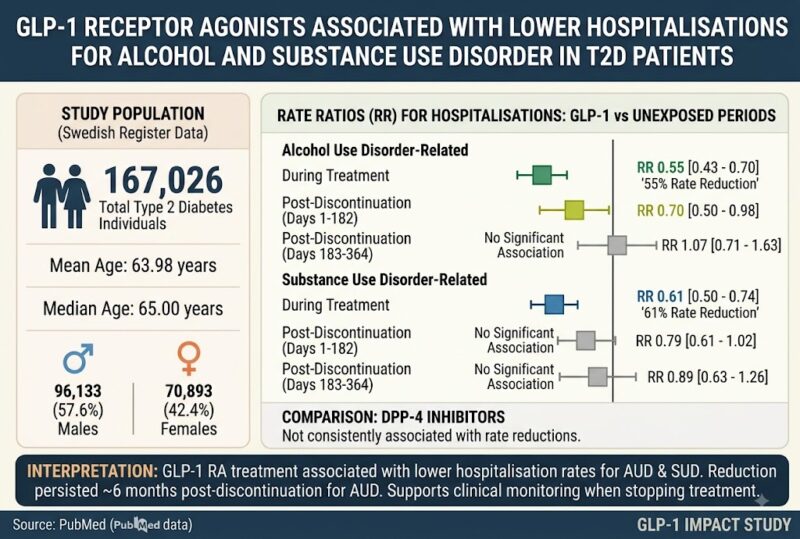
This Swedish register-based, within-individual observational study included 167,026 residents of Stockholm County diagnosed with type 2 diabetes between January 1, 2005, and December 31, 2024. Among these, 41,109 patients were treated with GLP-1 receptor agonists, and 23,666 with DPP-4 inhibitors. Active follow-up began from either January 1, 2015, or date of first diabetes diagnosis, whichever came later, and continued until December 31, 2024.

The primary outcomes were hospital admissions related to alcohol use disorder and broader substance use disorder, encompassing alcohol-related events. Using fixed-effects Poisson regression models, the study compared rates of hospitalisation during exposed periods (on GLP-1 or DPP-4 therapy) and two post-exposure windows (1-182 days and 183-364 days after treatment cessation) against unexposed periods within the same individuals. This within-individual design controls for time-invariant confounders.

Key Findings

The cohort had a mean age of approximately 64 years, with a slight male predominance (57.6%). Among patients treated with GLP-1 receptor agonists, 0.7% had at least one alcohol use disorder-related hospitalisation, and 1.1% had at least one substance use-related hospitalisation during follow-up. Most substance use-related admissions (66.1%) involved alcohol use disorder.

During GLP-1 exposure, hospitalisation rates dropped by 45% for alcohol use disorder (rate ratio [RR] 0.55, 95% confidence interval [CI] 0.43-0.70) and by 39% for substance use disorder (RR 0.61, 95% CI 0.50-0.74) compared with unexposed periods. This protective association extended into the first 182 days post-discontinuation for alcohol use disorder (RR 0.70, 95% CI 0.50-0.98), but not beyond six months (RR 1.07, 95% CI 0.71-1.63). For substance use disorder, no statistically significant rate reductions were observed after GLP-1 cessation.

Conversely, periods of DPP-4 inhibitor treatment did not show consistent associations with lower hospitalisation rates for either alcohol or substance use disorders.

Expert Commentary

These findings underscore a potentially novel therapeutic benefit of GLP-1 receptor agonists beyond glycemic control. The observed reduction in hospital admissions related to alcohol and substance use disorders aligns with preclinical evidence suggesting that GLP-1 pathways modulate central reward circuits implicated in addiction. The within-individual methodology strengthens causal inference by accounting for individual-level confounders. However, the study’s observational design cannot fully exclude residual confounding, such as differences in healthcare engagement or behavioral risk factors concurrent with therapy initiation.

The persistence of benefit for up to six months after GLP-1 discontinuation in alcohol use disorder suggests potential biological or behavioral conditioning effects, though the lack of sustained effect on other substance use disorders indicates heterogeneity in response. The absence of effect with DPP-4 inhibitors, which also target incretin pathways but differ mechanistically, further supports a specific role for GLP-1 receptor activation in modulating addiction-related outcomes.

Limitations include reliance on hospitalisation data, which capture severe cases but not milder or outpatient-managed substance use issues. Ethnicity data were unavailable, limiting assessment of potential disparities. Unmeasured confounding factors such as concurrent psychosocial interventions were not accounted for. Future randomized controlled trials and mechanistic studies are warranted to confirm causality and elucidate underlying pathways.

Conclusion

This comprehensive Swedish register study adds compelling real-world evidence that GLP-1 receptor agonist therapy in patients with type 2 diabetes is associated with a markedly lower risk of hospital admissions related to alcohol and substance use disorders. The protective effect on alcohol-related admissions persists for up to six months after treatment cessation, highlighting the importance of continued clinical monitoring during therapy discontinuation. These findings open avenues for repurposing GLP-1 receptor agonists as adjunctive treatments in managing substance use disorders, especially alcohol use disorder. Integration of substance use assessments in diabetes care and further research into GLP-1 receptor agonists’ neuropsychiatric effects are warranted.

Funding

This study was supported by Forte, Karolinska Institutet, and Region Stockholm.

References

    1. Bach P, Franck J, Hällgren J, et al. Association of GLP-1 receptor agonists with alcohol use disorder-related and substance use disorder-related hospital admissions during treatment and after discontinuation: a Swedish register-based within-individual observational study. Lancet Psychiatry. 2026 Aug;13(8):669-677. PMID: 42456704.

<li.Egli M, Koob GF. Role of GLP-1 receptor agonists in addiction: preclinical evidence and clinical implications. Trends Pharmacol Sci. 2022;43(1):30-42.

<li.Thomas SA et al. GLP-1 receptor agonists and modulation of addictive behaviors: potential for new therapeutic approaches. CNS Drugs. 2023;37(4):311-324.

Comments

No comments yet. Why don’t you start the discussion?

Leave a Reply