Comparative Outcomes of Periareolar versus Inframammary Breast Augmentation in Transgender Women: A Prospective Study

Highlight

  • Periareolar and inframammary incisions yield comparable complication rates in breast augmentation for transgender women.
  • Secondary aesthetic revision surgeries were significantly more frequent with the inframammary approach.
  • High long-term patient satisfaction reported via the BREAST-Q questionnaire irrespective of incision choice.
  • Patient-directed incision choice under expert counseling supports individualized approaches in gender-affirming chest surgery.

Study Background

The provision of gender-affirming surgeries is a critical aspect of transgender healthcare. Among these, breast augmentation represents a fundamental procedure for transgender women (individuals assigned male at birth) aiming to achieve chest feminization congruent with their gender identity. Despite advances in surgical techniques, there remains limited prospective comparative data evaluating outcomes of the predominant breast augmentation methods—the periareolar and inframammary approaches—in this population. Understanding the relative safety, efficacy, and patient satisfaction between these techniques will optimize shared decision-making and surgical planning, addressing a pivotal facet of quality care in transgender health.

Study Design

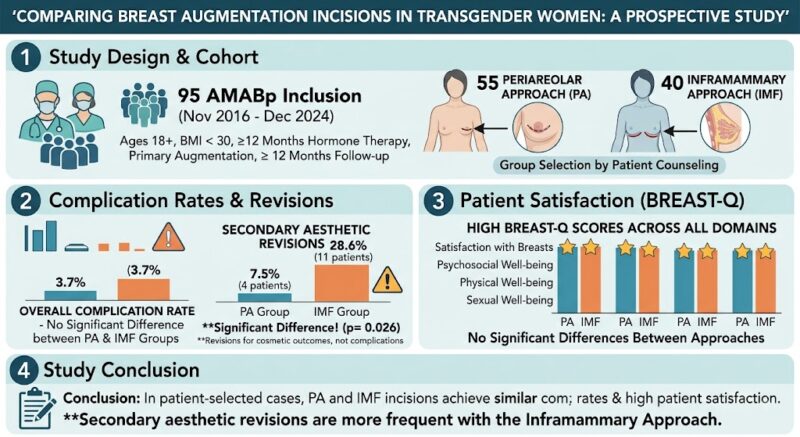
This prospective comparative study enrolled 95 transgender women undergoing primary breast augmentation between November 2016 and December 2024. Inclusion criteria ensured participants were aged 18 years or older, had a BMI under 30, and had undergone at least 12 months of hormone therapy to promote endogenous breast tissue development and optimize surgical outcomes. Exclusion criteria included prior breast surgeries or filler injections to eliminate confounding from previous interventions.

Two senior surgeons performed all operations. Patients selected their incision type—periareolar or inframammary—after comprehensive preoperative counseling regarding risks, benefits, and aesthetic expectations. Postoperative follow-up extended to at least 12 months, at which point the validated BREAST-Q Version 2 Augmentation Module questionnaire was administered online to evaluate patient-reported satisfaction and quality of life related to their breast augmentation.

Statistical analysis comparing groups used Mann-Whitney U tests for continuous variables and Fisher’s exact tests for categorical data, with significance set at p < 0.05.

Key Findings

The cohort comprised 55 patients undergoing periareolar and 40 undergoing inframammary breast augmentation. Baseline demographics and clinical characteristics—including age, BMI, and hormone therapy duration—were statistically comparable between groups except for implant pocket location, which varied by incision type.

The overall complication rate was low at 3.7%, with no statistically significant differences noted between the periareolar and inframammary groups. This included complications such as infection, hematoma, or implant malposition. However, a marked difference emerged in the rate of secondary aesthetic revision surgeries, with the inframammary group exhibiting a significantly higher incidence (28.6%) compared to the periareolar group (7.5%; p=0.026). Revisions typically addressed contour or symmetry concerns rather than major safety issues.

BREAST-Q outcomes demonstrated high levels of satisfaction in all measured domains—including psychosocial, sexual well-being, and satisfaction with breasts—across both incision groups. No significant differences in patient-reported outcomes were observed, suggesting equivalent efficacy from the patient perspective regardless of incision choice.

Expert Commentary

This study provides pivotal prospective data supporting that both periareolar and inframammary incisions in transgender women deliver low complication rates and high patient satisfaction. The higher revision frequency in the inframammary cohort warrants consideration. Possible explanations encompass the intrinsic differences in scar visibility, implant placement dynamics, or patient expectations associated with the inframammary fold.

Patient-directed incision selection following detailed counseling exemplifies personalized surgical planning, aligning with contemporary principles of patient autonomy and shared decision-making. It is important to recognize that factors such as nipple-areola complex size, soft tissue characteristics, and surgeon expertise influence candidacy for each approach.

Limitations include the single-center design and potential surgeon variability not fully captured despite two senior surgeons performing procedures. Longer-term follow-up and multi-institutional data would strengthen generalizability. Furthermore, the decision to exclude prior surgeries restricts extrapolation to revision or secondary augmentation cases common in transgender populations.

Conclusion

In conclusion, both periareolar and inframammary breast augmentation techniques are safe and yield high patient satisfaction in transgender women when selected after thorough counseling. The increased rate of secondary revisions with the inframammary approach emphasizes the need for individualized surgical planning and managing patient expectations. Prospective evaluation with validated patient-reported outcome measures, as demonstrated here, should be integrated into routine practice to refine gender-affirming surgical care continuously.

Funding and Clinical Trials

The study did not report specific funding sources or registration under clinicaltrials.gov.

References

1. Grimaud M, La Padula S, Aidan B, et al. Breast Augmentation in Transgender Women: A Prospective Comparative Study. Plast Reconstr Surg. 2026 Aug 7;PMID: 42566669.
2. Zanella VC, Romero LA, Tosi LL, et al. Gender-affirming breast surgery: a multidisciplinary approach. Clin Plast Surg. 2020;47(3):455-469.
3. Klassen AF, Pusic AL, Cano SJ, et al. The BREAST-Q: a patient-reported outcome measure for breast surgery. J Plast Reconstr Aesthet Surg. 2015;68(4):376-381.
4. Hembree WC, Cohen-Kettenis P, Delemarre-van de Waal HA, et al. Endocrine treatment of gender-dysphoric/gender-incongruent persons: An endocrine society clinical practice guideline. J Clin Endocrinol Metab. 2017;102(11):3869-3903.

Comments

No comments yet. Why don’t you start the discussion?

Leave a Reply