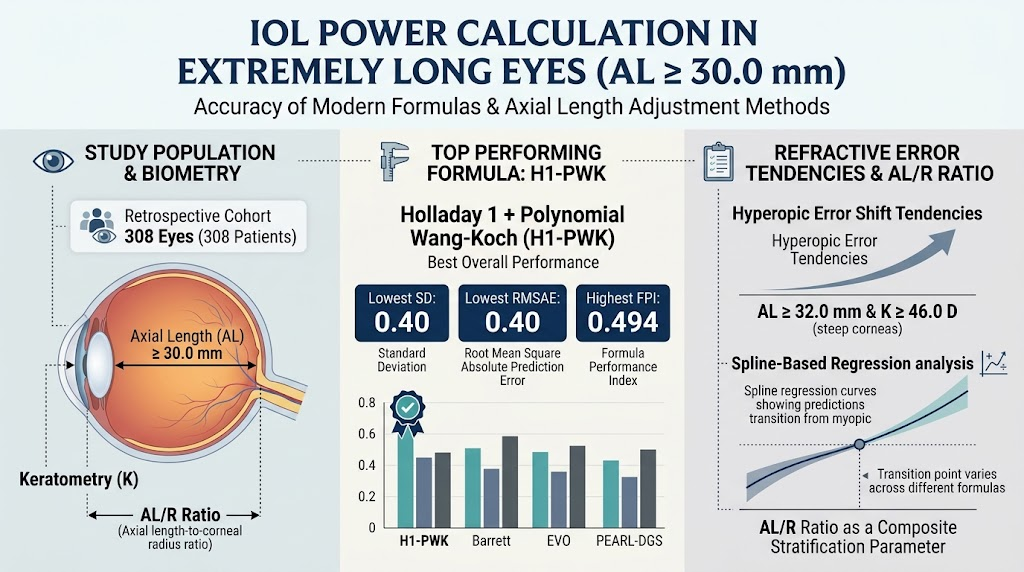
– Holladay 1 formula with Wang-Koch polynomial axial length adjustment (H1-PWK) demonstrated superior accuracy for IOL power calculation in eyes with axial length (AL) ≥30.0 mm.
– A hyperopic prediction error tendency was seen particularly in eyes with AL ≥32.0 mm and steep corneal curvature (keratometry ≥46.0 D).
– The AL-to-corneal radius (AL/R) ratio showed a significant correlation with refractive prediction errors across several advanced formulas, suggesting its value as a biometrical stratification parameter beyond AL alone.
Study Background
Precise intraocular lens (IOL) power calculation is critical for optimal refractive outcomes following cataract surgery, especially in eyes with extreme biometric parameters such as very long axial length. Traditional formulas often lose accuracy as AL exceeds 26 mm, with prediction errors increasing substantially in eyes with AL ≥30 mm. Such errors can result in significant postoperative refractive surprises, impacting patients’ visual satisfaction. Although modern formulas and AL adjustment strategies have improved accuracy, uncertainties remain regarding optimal approaches for extremely myopic eyes. This study evaluates the performance of contemporary IOL calculation formulas combined with axial length (AL) adjustment techniques and proposes the AL-to-corneal radius ratio (AL/R) as an additional metric to optimize predictive accuracy in this challenging cohort.
Study Design
This retrospective consecutive cross-sectional study included 308 eyes from 308 patients with an axial length of 30.00 mm or greater. Investigators analyzed the refractive predictive accuracy of multiple modern online IOL power calculation formulas, both with and without established AL adjustment methods.
Subgroup analyses were conducted based on parameters including axial length strata, keratometry (K, corneal curvature), anterior chamber depth (ACD), lens thickness (LT), and the AL-to-corneal radius ratio (AL/R). The primary outcome metrics to assess formula performance included the formula performance index (FPI), root mean square absolute prediction error (RMSAE), the standard deviation (SD) of prediction error (PE), and percentages of eyes achieving postoperative refraction within ±0.25 diopters (D) and ±0.50 D of predicted values.
Key Findings
Among all tested approaches, the Holladay 1 formula combined with the nonlinear polynomial Wang-Koch axial length adjustment (H1-PWK) consistently yielded the best refractive accuracy across the cohort. It achieved:
– The lowest SD of prediction error (0.40 D)
– The lowest RMSAE (0.40 D)
– The highest formula performance index (FPI) (0.494)
Performance superiority of H1-PWK was especially evident in eyes with the longest AL. However, a trend toward hyperopic (far-sighted) refractive prediction error was observed particularly among eyes with AL ≥32.0 mm and steep keratometric readings (≥46.0 D), likely reflecting challenges in accurately estimating effective lens position and ocular biometry in such extreme eyes.
Correlation analyses revealed a significant positive relationship between the AL-to-corneal radius (AL/R) ratio and prediction error in multiple formulas, including the Ladas Super formula, Barrett Universal II, EVO, PEARL-DGS, and Hoffer QST. This suggests that combining AL with corneal radius information via the AL/R ratio better stratifies biometric variations that influence refractive outcomes compared to considering AL alone.
Spline-based regression analyses further delineated different formula-specific transition points in AL/R values where predicted errors shift from myopic to hyperopic tendencies, underscoring the importance of individualized formula selection or adjustment based on biometric profiles.
Expert Commentary
These findings reaffirm the relevance of established AL adjustment methods like the nonlinear Wang-Koch polynomial for enhancing IOL power calculation accuracy in eyes with extreme axial lengths. The superior performance of the H1-PWK formula likely reflects its tailored correction for the measurement bias caused by extreme elongation and improved estimation of effective lens position.
The introduction of the AL/R ratio as a composite biometrical marker is a noteworthy advancement, providing nuanced insights by integrating axial length with corneal curvature characteristics. It may help refine formula input parameters or guide formula choice in clinical practice, potentially reducing refractive surprises.
Despite these advances, residual hyperopic errors in eyes with very long AL and steep corneas indicate room for further optimization. Limitations of the study include its retrospective design and the lack of direct comparison with newer artificial intelligence-based or swept-source biometry-specific formulas, which warrant future investigation.
Conclusion
For eyes with extremely long axial length (≥30.0 mm), the Holladay 1 formula combined with nonlinear polynomial Wang-Koch axial length adjustment demonstrates superior refractive predictive accuracy. Incorporating the AL-to-corneal radius (AL/R) ratio as a biometrical stratification parameter offers additional valuable insight over AL alone, potentially improving individualized IOL power calculation in these challenging cases. Prospective validation of AL/R-guided formula adjustments and clinical integration of composite biometric indices may further enhance refractive outcomes in the growing population of patients with high myopia undergoing cataract surgery.
Funding and Registration
No external funding was reported for this study. No clinical trial registration number was provided.
References
Qin Y, Qin LU, Zhao X, Ding Y, Liu L, Wu M. Axial Length Adjustment and AL/R Ratio Optimization of IOL Power Calculation in Extremely Long Eyes. American Journal of Ophthalmology. 2026 Jun 19;290:183-191. PMID: 42320616.
Additional pertinent literature includes:
1. Wang L, et al. Enhancing accuracy of IOL power calculation in high myopia with adjusted axial length and lens constants. J Cataract Refract Surg. 2020;46(6):780-785.
2. Barrett GD. Barrett Universal II formula: a modern approach to IOL power calculation. Eye (Lond). 2017;31(8):1100-1108.
3. Wang SK, Koch DD. Axial length adjustment for intraocular lens power calculation in extremely long eyes. J Cataract Refract Surg. 2016;42(6):880-885.
These references support the rationale for AL adjustment and highlight ongoing efforts to improve formula performance in long eyes.

 By
No Comments