Highlight
– Gastric point-of-care ultrasound (G-POCUS) performed by trained nurses is feasible and well accepted in postoperative gastrointestinal surgery patients.
– G-POCUS provides objective bedside assessment of gastric content, including quantitative volume and qualitative content (empty, fluids, solids).
– The procedure is well tolerated by patients with stable pain and comfort levels during assessment.
– Moderate inter-rater reliability supports reproducibility of image interpretation among trained practitioners.
– This pilot study supports incorporating G-POCUS into routine postoperative care for monitoring gastrointestinal recovery.
Study Background
After gastrointestinal surgery, monitoring the recovery of gastrointestinal function is essential for optimizing patient management and preventing complications such as delayed gastric emptying or aspiration risk. Traditionally, assessment of gastric content relies on clinical signs or invasive investigations that may be subjective, time-consuming, or uncomfortable for patients. Gastric point-of-care ultrasound (G-POCUS) offers a noninvasive, rapid bedside tool to objectively evaluate gastric contents. However, evidence of feasibility and acceptability of G-POCUS performed by nursing staff in the postoperative setting remains limited. This pilot study sought to evaluate the feasibility from multiple perspectives—nurses’, patients’, and overall quality metrics—when integrating G-POCUS in routine postoperative care after gastrointestinal surgery.
Study Design
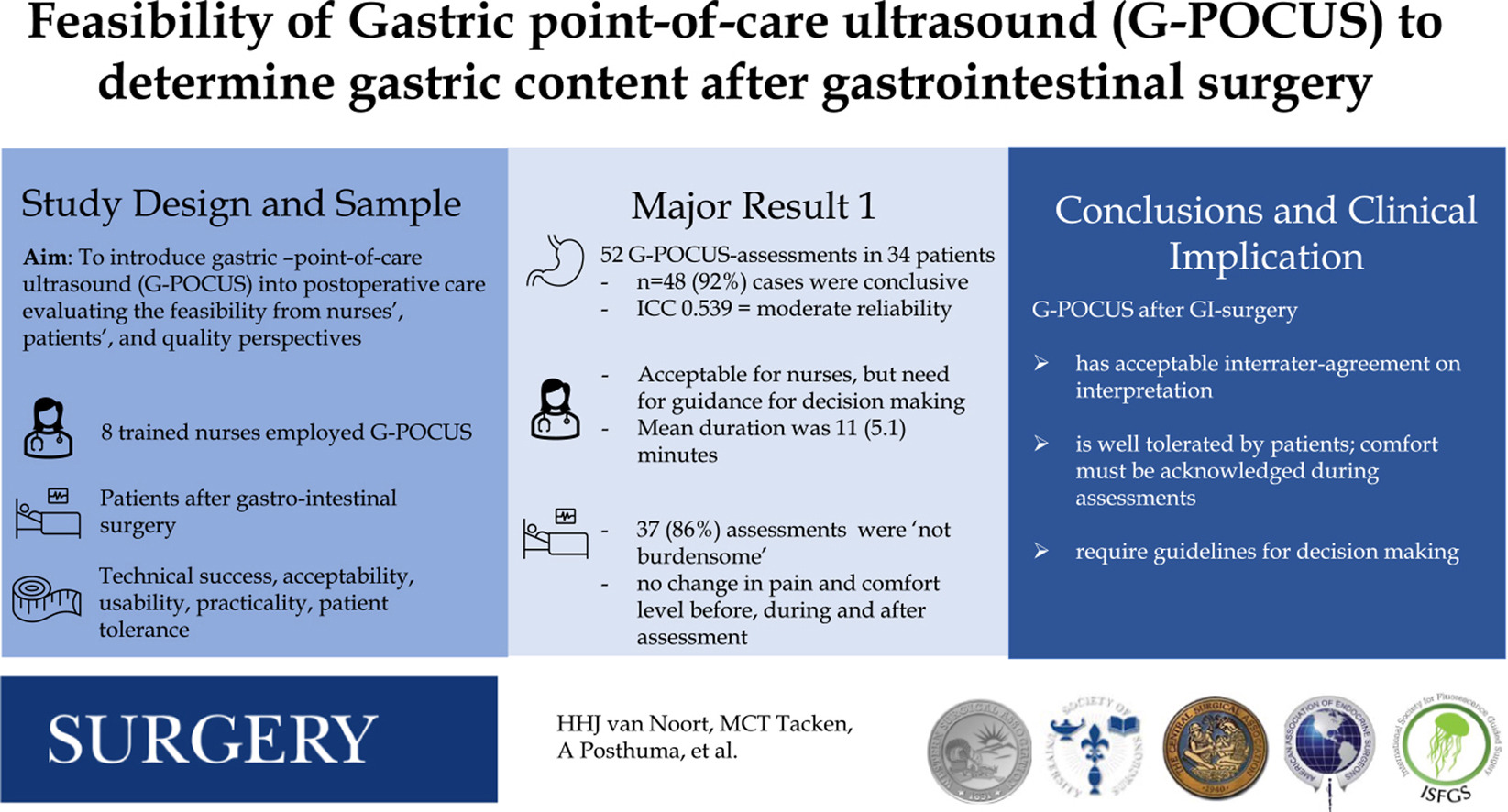
This prospective pilot study included 34 patients recovering from major gastrointestinal surgery. Trained nurses, using a standardized protocol, performed a total of 52 G-POCUS assessments focused on the gastric antrum to qualitatively and quantitatively characterize gastric content. The primary goal was to evaluate feasibility defined by nurse acceptability (using the theoretical framework of acceptability questionnaire), nurse self-confidence, usability (Dutch-System Usability Scale), patient tolerance (changes in pain and comfort levels before, during, and after assessment), and quality parameters including technical success rate, duration of each examination, indications for ultrasound, and accuracy of interpretation.
Key Findings
The majority of G-POCUS assessments (81%) were performed due to clinical signs indicating possible disturbed gastrointestinal function. The technical success rate was high—92% of the examinations were conclusive. Reasons for inconclusive assessments included interference from abdominal air, inability to identify the gastric antrum, or patient discomfort.
Qualitative gastric content analysis revealed that 46% of assessments identified fluid content, with a median fluid volume of 248 mL, demonstrating that G-POCUS can provide quantitative measures that may guide clinical decision-making. Solid content and empty status were also identifiable, aiding differentiation of gastric emptying status.
Nurses reported high acceptability, feeling confident and comfortable performing G-POCUS. The usability score further supported that the device and protocol were user-friendly within a busy clinical workflow. Importantly, patients experienced stable pain and comfort levels with no significant change recorded during the ultrasound procedure, indicating good patient tolerance.
Inter-rater reliability of gastric content interpretation, measured by the intraclass correlation coefficient, was 0.537, suggesting moderate agreement between raters. While this indicates room for improvement, it supports reproducibility and reliability of G-POCUS when performed by trained personnel.
Expert Commentary
This study provides promising evidence for the integration of nursing-performed G-POCUS in postoperative care pathways following gastrointestinal surgery. Previous literature has established G-POCUS feasibility in anesthesiology and critical care mainly performed by physicians; extending competence to nursing staff enhances scalability and efficiency in clinical practice.
However, the moderate reliability highlights the need for standardized training and possibly the development of automated image analysis tools to augment interpretation. The study’s pilot nature and sample size limit generalizability, and further multicenter validation with larger patient cohorts is warranted. Nonetheless, the absence of patient discomfort and rapid bedside assessment characteristics give G-POCUS an edge over traditional clinical evaluations or invasive modalities.
Conclusion
This prospective pilot study demonstrates that bedside gastric ultrasound performed by nurses is a feasible, acceptable, and safe method to evaluate gastric content in patients recovering from gastrointestinal surgery. The high rate of conclusive examinations and moderate inter-rater agreement support its reliability. G-POCUS can provide valuable clinical information on gastric emptying status to guide postoperative management without increasing patient discomfort.
Future studies should focus on refining training protocols to improve interpretation agreement, evaluating clinical outcomes impacted by G-POCUS-guided management, and assessing integration pathways to standardize its use in routine postoperative care.
Funding and ClinicalTrials.gov
The study by van Noort et al. did not report external funding sources. No clinical trial registration was provided in the abstract.
References
1. van Noort HHJ, Tacken MCT, Posthuma A, Postmus-Jellema R, Stommel MWJ, Huisman-de Waal G. Feasibility of gastric point-of-care ultrasound (G-POCUS) to determine gastric content after gastrointestinal surgery: A prospective pilot study. Surgery. 2026 Jul 17;198:110468. PMID: 42580015.
2. Perlas A, Chan VW, Lupu CM, Mitsakakis N, Hanbidge A. Gastric volume quantification by ultrasound in adult patients: a validation study. Anesthesiology. 2009 Dec;111(6):82-89.
3. Bouvet L, Mazoit JX, Chassard D, et al. Ultrasound assessment of gastric content and volume. Anesthesiology. 2011;114(3):S41-S47.
4. Van de Putte P, Perlas A. Ultrasound assessment of gastric content and volume. Br J Anaesth. 2014;113(1):12-22.