Highlight
Adolescent and young adult (AYA) women with breast cancer represent a demographically distinct group more frequently undergoing mastectomy, including in metastatic settings, yet experience comparable 30-day postoperative complication rates to older women despite longer surgeries.
The study leverages a large multi-institutional surgical quality database spanning 2013-2023 with over 240,000 breast cancer surgeries, uniquely focusing on the understudied AYA population.
Study Background
Breast cancer in adolescent and young adult women aged 18 to 39 accounts for a small yet clinically significant subset of breast cancer cases. These patients face unique clinical challenges, including more aggressive disease phenotypes, a distinct psychosocial landscape, and reproductive concerns. Existing literature primarily addresses outcomes in older cohorts, leaving a knowledge gap regarding perioperative surgical patterns and short-term postoperative outcomes in this younger demographic. Understanding these trends is essential for tailored counseling, surgical decision-making, and optimizing care in this group.
Study Design
This retrospective cohort study analyzed data from the American College of Surgeons National Surgical Quality Improvement Program (ACS NSQIP) between 2013 and 2023. The cohort included women with a breast cancer diagnosis undergoing breast-conserving surgery (lumpectomy) or mastectomy, with or without axillary procedures. Patients were stratified into two groups based on age: adolescent and young adult (18-39 years) and older adults (≥40 years). Baseline demographic and clinical variables, operative characteristics, and 30-day postoperative outcomes were compared between groups using chi-square tests for categorical variables and t-tests for continuous variables.
Key Findings
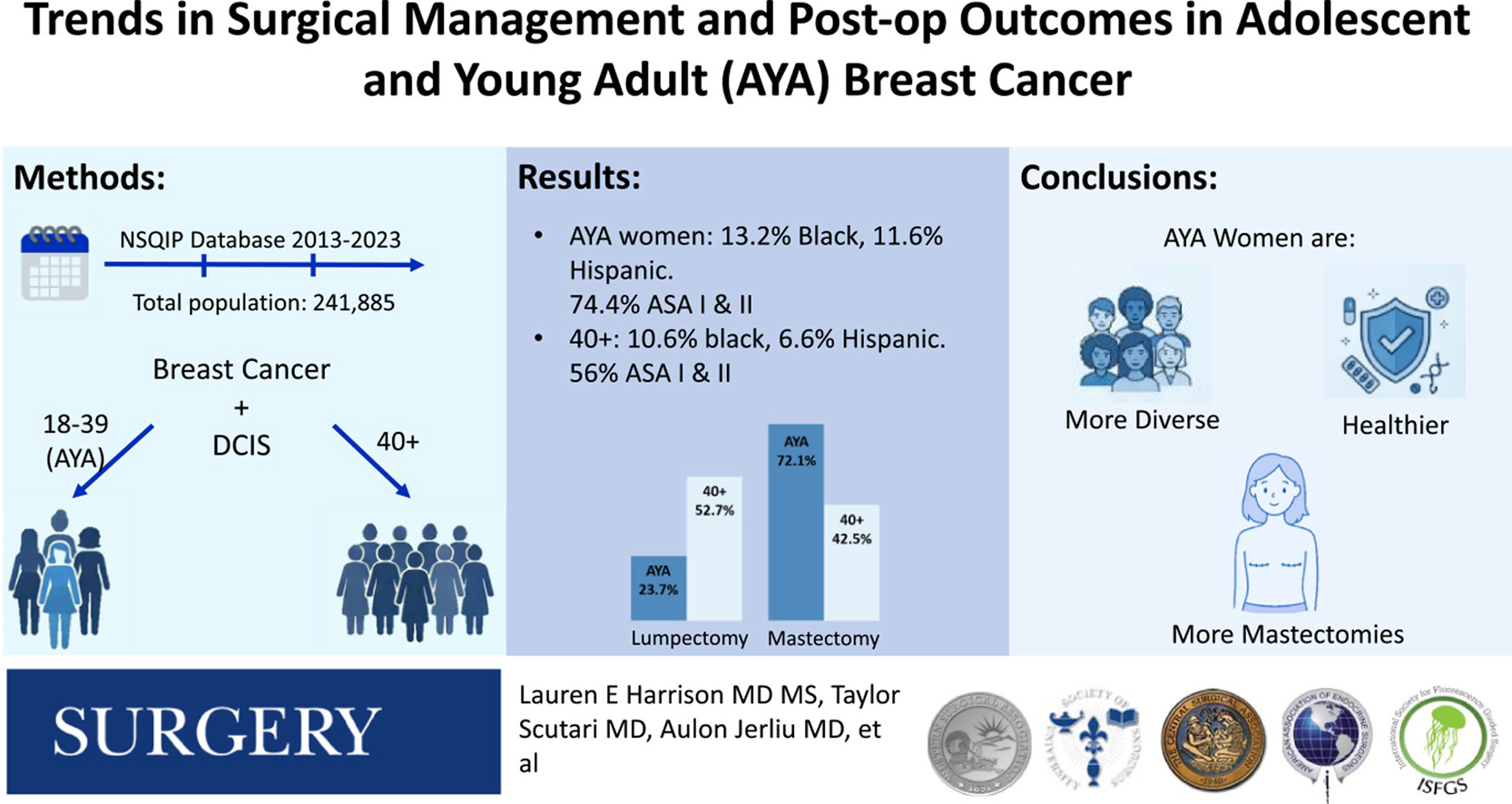
A total of 241,885 patients met inclusion criteria; of these, 11,544 (4.8%) were adolescents and young adults (AYA). Ethnic composition differed between groups, with the AYA cohort having higher proportions of Hispanic (11.6% vs 6.6%) and Black women (13.2% vs 10.6%), indicating demographic disparities consistent with epidemiological data.
Despite generally being healthier with fewer comorbidities, AYAs presented more frequently with disseminated (metastatic) cancer (3.2% vs 1.8%, P < .001), corroborating reports that younger patients often have more advanced disease at diagnosis.
Significantly, AYAs were more likely to undergo mastectomy, including modified radical mastectomy (72.1% and 20.2% respectively) compared to older women (42.5% and 10.6%, P < .001). This preference for more extensive surgery in younger women may reflect tumor biology, patient choice, genetic risk factors, or clinical practice patterns.
The increased complexity of surgical management in AYAs was reflected in operative times (177 ± 108 min vs 110 ± 83 min) and longer hospital stays (median 1.0 vs 0.6 days, P < .001). Despite these differences, 30-day postoperative complication rates were remarkably similar between groups (4.0% in AYAs vs 3.9% in older women, P = .69).
Reoperation rates were slightly higher in the younger group (4.0% vs 2.8%, P < .001), though overall mortality was exceedingly low in both cohorts (<0.1%). These findings suggest that aggressive surgical management in AYAs does not translate into increased short-term morbidity or mortality at the population level.
Expert Commentary
This study provides robust population-level data supporting the safety of aggressive surgical approaches, such as mastectomy, in young women with breast cancer. The higher frequency of mastectomy in AYAs may relate to multiple factors, including higher rates of genetic predisposition (e.g., BRCA mutations), heightened patient preference for risk reduction, or tumor characteristics.
Limitations inherent to the NSQIP dataset include lack of detailed oncologic staging beyond disseminated disease coding, absence of long-term oncologic outcomes, and missing data on neoadjuvant therapies or genetic testing status. Additionally, psychosocial outcomes and quality of life measures, critical in young patients, were not captured.
Future research should integrate molecular tumor profiling, genetic risk assessment, and patient-reported outcomes to inform individualized surgical decision-making. Also, exploration into racial and ethnic disparities observed in this dataset is essential to ensure equitable care delivery.
Conclusion
Adolescent and young adult women with breast cancer represent a small but distinct patient population with unique clinical characteristics and surgical treatment patterns. Despite higher rates of mastectomy and metastatic disease at presentation, perioperative morbidity and mortality are comparable to those seen in older women, supporting the safety of aggressive surgical management when clinically indicated.
These contemporary data offer clinicians a valuable benchmark for counseling young women regarding surgical options and underscore the need for multidisciplinary care approaches that address the complex needs of this population.
Funding and Clinical Trials Information
No specific funding or clinical trial registrations were reported for this analysis.
References
1. Harrison LE, Scutari T, Jerliu A, Connors C, McLoughlin RJ. Trends in surgical management and postoperative outcomes in adolescent and young adult breast cancer. Surgery. 2026 Jul 17;198:110467. doi:10.1016/j.surg.2026.110467
2. Hayes-Lattin B, Anderson B. Adolescent and young adult oncology: The adolescent and young adult hematology/oncology progress review group report. J Natl Cancer Inst Monogr. 2007;(38):1-124.
3. Bleyer A, Barr R, Hayes-Lattin B, et al. The distinctive biology of cancer in adolescents and young adults. Nat Rev Cancer. 2008 Apr;8(4):288-98. doi:10.1038/nrc2349
4. National Comprehensive Cancer Network. NCCN Clinical Practice Guidelines in Oncology: Breast Cancer. Version 6.2024.