Highlight
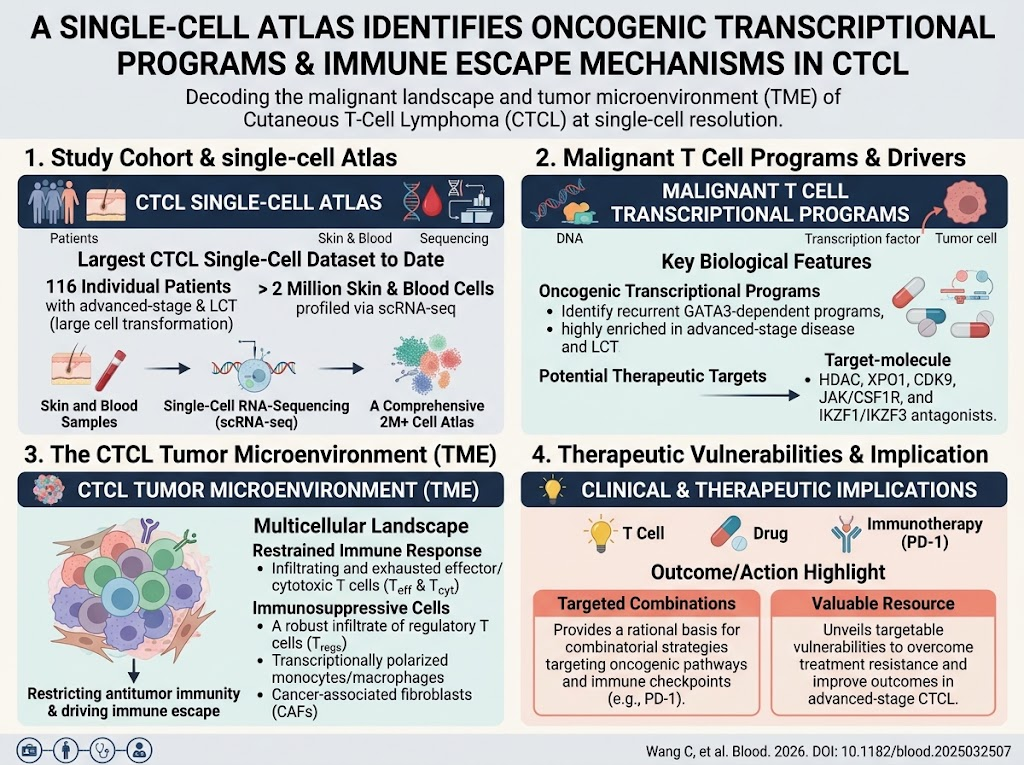
- Largest single-cell RNA-sequencing (scRNA-seq) atlas for CTCL created, covering over 2 million cells from 116 patients.
- Identified recurrent oncogenic transcriptional programs in malignant T cells, including GATA3-dependent signatures linked to disease severity and large cell transformation.
- Therapeutic vulnerabilities found related to HDAC, XPO1, CDK9, JAK/CSF1R, and IKZF1/IKZF3 pathways.
- CTCL tumor microenvironment (TME) is characterized by extensive infiltration of exhausted effector T cells, regulatory T cells, polarized myeloid cells, and cancer-associated fibroblasts, underscoring immune escape strategies.
Study Background
Primary cutaneous T-cell lymphomas (CTCL) constitute a diverse and challenging subset of extranodal non-Hodgkin lymphomas characterized predominantly by malignant expansion of skin-homing T cells. Clinically, patients with advanced-stage CTCL face poor prognosis due to inadequate durable responses with existing therapies. Conventional systemic and skin-directed treatments often yield transient remission, highlighting an unmet need to elucidate the molecular drivers and immune landscape of CTCL. Comprehensive understanding of oncogenic transcriptional programs within malignant T cells and their interplay with the tumor microenvironment (TME) is vital. Such insights promise the uncovering of novel therapeutic targets to overcome immune escape and improve patient outcomes.
Study Design
This study compiled the largest single-cell RNA-seq dataset focused on CTCL to date. It incorporated over 2 million individual transcriptomes derived from skin and blood samples of 116 patients representing a range of CTCL disease stages, including cases with large cell transformation and advanced clinical presentations. This expansive single-cell atlas enabled high-resolution profiling of malignant T-cell transcriptional states and detailed characterization of diverse immune and stromal cell populations within the CTCL TME. Computational analyses identified recurrent transcriptional programs and putative regulatory pathways linked to oncogenesis and immune regulation.
Key Findings
Oncogenic Transcriptional Programs in Malignant T Cells
The authors uncovered several recurrent transcriptional signatures within malignant T cells. Notably, GATA3-dependent transcriptional programs were enriched particularly in cases exhibiting large cell transformation and advanced-stage disease, indicating a role for GATA3-driven oncogenic transcriptional regulation in CTCL progression. These programs include regulators influencing cell cycle, survival, and differentiation pathways.
Several identified transcriptional pathways align with clinically targetable molecular nodes. These include histone deacetylase (HDAC) enzymes, nuclear export protein XPO1, cyclin-dependent kinase 9 (CDK9), Janus kinase (JAK)/colony-stimulating factor 1 receptor (CSF1R) axis, and transcription factors IKZF1/IKZF3. These molecular insights suggest repurposing or prioritizing agents active against these targets may improve therapeutic efficacy.
Tumor Microenvironment Composition and Immune Escape Mechanisms
The CTCL TME revealed a dominating presence of infiltrating effector and cytotoxic T cells displaying signs of exhaustion, presumably limiting their anti-tumor functionality. This immunosuppressive environment was maintained by an abundance of regulatory T cells (Tregs) that dampen effector responses.
In addition, myeloid populations including transcriptionally polarized monocytes and macrophages contributed to a tumor-supportive niche through immunomodulatory cytokines and growth factors. Furthermore, cancer-associated fibroblasts were key constituents influencing tumor architecture and leukemia-immune cell crosstalk.
These observations underscore complex immune escape pathways in CTCL, where exhausted T cells and suppressive elements such as Tregs and myeloid cells create resistance to immune checkpoint interventions, including programmed cell death protein 1 (PD-1) blockade.
Therapeutic Implications
Based on mapping oncogenic and immune escape pathways, the study suggests rational design of combinatorial therapeutic strategies targeting both malignant intrinsic transcriptional programs and the immunosuppressive TME. Combining HDAC inhibitors with agents targeting nuclear export or JAK/CSF1R signaling could directly impair malignant T-cell survival and transcriptional aberrations. Concurrent modulation of immune checkpoints and depletion or reprogramming of regulatory and myeloid cell populations might restore effective anti-tumor immunity.
Expert Commentary
This comprehensive single-cell atlas represents a substantial advance in understanding CTCL pathobiology. The identification of GATA3-driven transcriptional programs linked to aggressive disease phenotypes aligns with prior knowledge but extends it by revealing additional targetable nodes within these networks. The extensive mapping of the TME confirms its critical role in fostering immune evasion and identifies multiple non-T-cell stromal elements that constitute potential intervention points.
Despite these strengths, translation into clinical application requires further validation in prospective cohorts and functional interrogation of candidate pathways. While immune checkpoint inhibition strategies hold promise, the complexity highlighted here indicates monotherapy is unlikely to succeed fully, emphasizing a need for biomarker-guided combinatorial regimens.
Conclusion
The construction of the largest scRNA-seq atlas for CTCL has elucidated key oncogenic and immune escape mechanisms shaping disease pathogenesis and therapeutic resistance. This resource offers a foundational framework for future translational and clinical studies seeking to refine precision medicine approaches. Targeting both intrinsic malignant T-cell transcriptional programs and the immunosuppressive CTCL microenvironment holds significant promise to improve outcomes for patients with this challenging malignancy.
Funding and Clinical Trial Registration
Details regarding funding sources and clinical trial registrations were not specified in the original publication.
References
1. Wang C, Geng X, Abdelrahman S, et al. A single-cell atlas identifies oncogenic transcriptional programs and immune escape mechanisms in CTCL. Blood. 2026 Oct 1;148(14):1816-1832. PMID: 42378251.
2. Olsen EA. Cutaneous T-cell lymphoma: 2020 update on diagnosis, risk-stratification, and management. Am J Hematol. 2020;95(3):328-340.
3. Kim EJ, Hess S, Richardson SK, et al. Immunopathogenesis and immunotherapy of cutaneous T cell lymphoma. J Clin Invest. 2021;131(5):e142916.
4. Querfeld C, Rosen ST. Cutaneous T-cell lymphoma: management of advanced disease. Hematology Am Soc Hematol Educ Program. 2019;2019(1):342-350.
5. Whittaker SJ, Marsden JR, Spittle M, et al. Prognostic factors for survival in mycosis fungoides/Sézary syndrome: validation of the ISCL/EORTC staging proposal. J Clin Oncol. 2003;21(7):1147-1150.