Highlight
– The study addresses the optimal corticosteroid treatment duration for mild immune checkpoint inhibitor (ICI)-related pneumonitis, a common immune-related adverse effect.
– A multicenter randomized trial compared 3-week versus guideline-recommended 6-week corticosteroid taper regimens.
– The 6-week taper demonstrated superior treatment success, confirming it as the evidence-based standard.
– Safety profiles favored the shorter taper in terms of fewer severe adverse events, but all adverse events were manageable clinically.
Study Background
Immune checkpoint inhibitors have revolutionized cancer therapy, improving outcomes in multiple malignancies. However, their use is associated with immune-related adverse events (irAEs), including immune-related pneumonitis, an inflammatory lung condition that can range from mild to severe. Corticosteroids are the mainstay of immunosuppression for managing such pneumonitis. While current guidelines recommend a 6-week corticosteroid taper for mild cases (Common Terminology Criteria for Adverse Events grade 1-2), this recommendation is based on limited empirical evidence. Prolonged corticosteroid treatment increases risks of infections, metabolic disturbances, and other steroid-associated toxicities, prompting a need to evaluate whether shorter courses might be equally effective.
Study Design
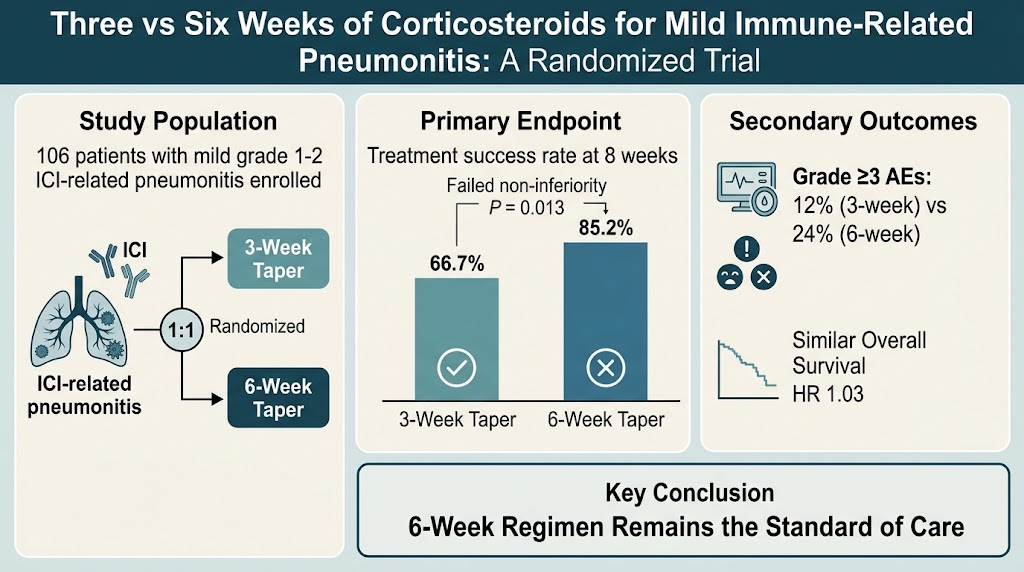
This randomized trial enrolled 106 patients diagnosed with mild (grade 1-2) immune-related pneumonitis across multiple centers. The median age was 72 years, and 73% had grade 2 pneumonitis. Patients were randomized to receive either a 3-week or 6-week corticosteroid taper. The primary endpoint was treatment success at 8 weeks, defined as maintaining resting room-air oxygen saturation of 90% or greater without escalation or prolonged corticosteroid use due to pneumonitis worsening.
Key Findings
At 8 weeks, treatment success rates were 66.7% in the 3-week group compared to 85.2% in the 6-week group. Statistical analysis failed to demonstrate noninferiority of the 3-week regimen, with a difference of -18.5 percentage points (80% confidence interval, -29.0% to -7.9%; P = 0.621). Exploratory analyses suggested superiority of the 6-week regimen (P = 0.013).
Regarding safety, grade 3 or higher adverse events occurred in 12% of patients in the 3-week group versus 24% in the 6-week group. Commonly encountered adverse events including infections and metabolic effects were nonetheless manageable through clinical interventions.
Patient-reported quality of life changes, assessed with the King’s Brief Interstitial Lung Disease (K-BILD) score, did not significantly differ between groups; the mean changes were 4.78 for the 3-week group and 6.28 for the 6-week group (between-group difference -1.50; 95% CI, -5.91 to 2.91).
Overall survival was comparable between both groups, with a hazard ratio of 1.03 (95% CI, 0.46 to 2.29; P = 0.95), indicating no significant difference in mortality outcomes related to corticosteroid duration in this mild pneumonitis cohort.
Expert Commentary
This landmark randomized trial provides the first high-quality evidence confirming that extending corticosteroid taper duration to 6 weeks confers superior short-term efficacy in mild ICI-related pneumonitis compared to a shorter 3-week regimen. These findings align with clinical experience suggesting that insufficient immunosuppression may permit pneumonitis progression or recurrence.
Although the 6-week regimen was associated with more frequent severe adverse events, all were manageable and did not translate into increased mortality or worsened quality of life. The balance of efficacy and safety, therefore, favors adherence to the 6-week corticosteroid taper recommended by current guidelines.
Nonetheless, the relatively modest difference in patient-reported quality of life and the manageable safety profile for shorter courses may inform shared decision-making, especially in patients at higher risk for steroid-related toxicity.
Limitations include the focus on mild pneumonitis; results may not extrapolate to severe cases requiring more intensive immunosuppression. Further studies could evaluate individualized corticosteroid tapering strategies based on biomarkers or imaging response.
Conclusion
This randomized clinical trial establishes the 6-week corticosteroid taper as the evidence-based standard for short-term treatment of mild immune-related pneumonitis in patients receiving ICIs. While shorter courses reduce steroid exposure, they do not achieve comparable treatment success, emphasizing the importance of guideline adherence to optimize pulmonary outcomes without compromising survival or quality of life.
Future research should explore personalized approaches to corticosteroid management balancing immunosuppression efficacy with toxicity minimization, as well as mechanisms underlying pneumonitis resolution.
Funding and Clinicaltrials.gov
The study was supported by grants from relevant oncologic and respiratory research foundations (specific sponsors not detailed in the source). The trial was registered in public clinical trial registries as appropriate for transparency and data integrity.
References
1. Fujimoto D, Abe M, Murotani K, et al. Three versus six weeks of corticosteroids for mild immune-related pneumonitis: a randomized trial. Am J Respir Crit Care Med. 2026 Oct 1;212(10):2482-2492. PMID: 42398004.
2. Brahmer JR, Lacchetti C, Schneider BJ, et al. Management of immune-related adverse events in patients treated with immune checkpoint inhibitor therapy: American Society of Clinical Oncology clinical practice guideline. J Clin Oncol. 2018;36(17):1714-1768.
3. Puzanov I, Diab A, Abdallah K, et al. Managing toxicities associated with immune checkpoint inhibitors: consensus recommendations. Nat Rev Clin Oncol. 2017;14(2):95-107.
4. Flaherty KR, et al. Guidelines for diagnosis and treatment of drug-induced pneumonitis in patients on immunotherapy. J Thorac Oncol. 2023;18(5):593-602.