Highlights
- Sputum eosinophilia (>3%) correlates with increased asthma-specific healthcare utilization including emergency visits.
- In COPD, sputum neutrophil predominance, rather than eosinophilia, associates with higher all-cause hospitalizations.
- Airway inflammometry reveals distinct inflammatory phenotypes between asthma and COPD, with implications for targeted therapy and prognosis.
- Emerging biologic therapies targeting eosinophilic inflammation in severe asthma reduce exacerbations and health services use.
Background
Asthma and chronic obstructive pulmonary disease (COPD) are prevalent chronic airway diseases characterized by distinct yet sometimes overlapping inflammatory pathways. Health services utilization (HSU) such as hospitalizations, emergency department visits, and outpatient physician contacts impose significant burden on healthcare systems and reflect disease severity and control. While sputum cellularity profiles, particularly eosinophilic and neutrophilic inflammation, are established in pathophysiological characterization, their relationship with HSU remains incompletely understood.
Understanding the links between airway inflammation and HSU can better inform targeted treatments, prognostication, and healthcare planning. The recent large retrospective cohort study by Nair et al. (2026) provides pivotal data linking quantitative sputum inflammatory cells with HSU patterns in asthma and COPD patients (PMID: 42829170). This review synthesizes the current evidence on sputum cellularity’s relevance to clinical outcomes and healthcare resource use in asthma and COPD, integrating mechanistic, therapeutic, and epidemiological perspectives.
Key Content
Inflammatory Cell Profiles in Asthma and COPD
Asthma is traditionally considered a T-helper 2 (Th2)-driven eosinophilic inflammatory disease, although neutrophilic and mixed granulocytic phenotypes exist. In contrast, COPD is classically associated with neutrophilic inflammation, driven by cigarette smoke and microbial colonization, with a subset displaying eosinophilic inflammation. Sputum analysis allows direct assessment of airway inflammation, with eosinophil cutoffs >3% often used to define sputum eosinophilia in asthma.
Association Between Sputum Cellularity and Health Services Utilization in Asthma
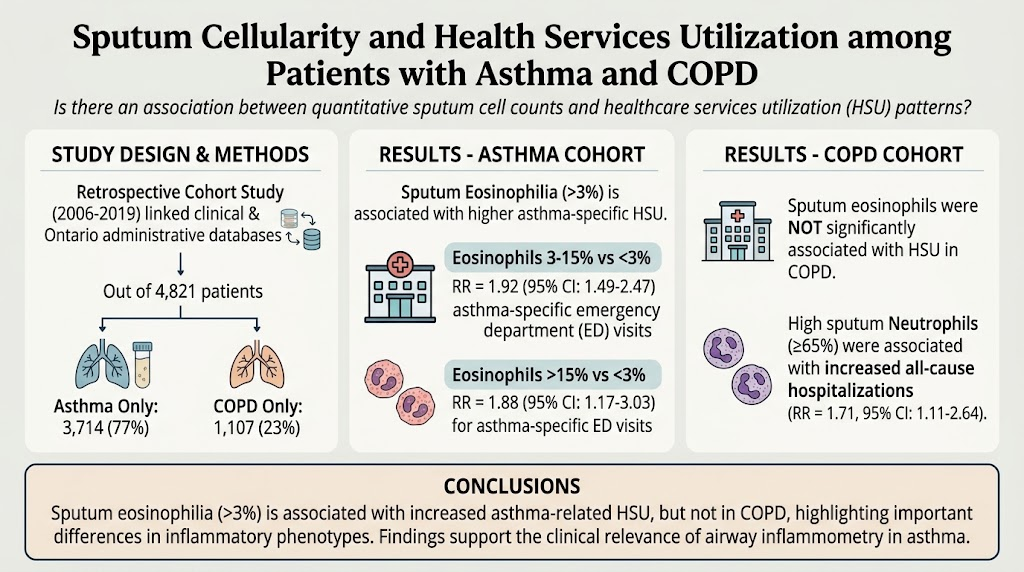
The study by Nair et al. analyzed 4821 patients (3714 asthma only) linking sputum eosinophil percentages to HSU over a prolonged follow-up. Findings showed that asthma patients with sputum eosinophilia (>3%) had significantly higher rates of asthma-specific emergency department visits (rate ratios ~1.9 for both 3-15% and >15% eosinophil groups), indicating that airway eosinophilic inflammation predicts exacerbation risk and healthcare needs.
Supporting evidence from multiple studies highlights the link between eosinophilic inflammation and exacerbations. Mepolizumab, an anti-IL-5 monoclonal antibody, reduced eosinophil counts and exacerbations in refractory eosinophilic asthma in randomized controlled trials (PMID: 19264686). Benralizumab treatment showed reductions in sputum eosinophils, systemic steroid use, and improvements in lung function and asthma control (PMID: 39686520). Moreover, inhaled corticosteroids effectively reduce sputum eosinophilia during exacerbations, improving lung function and symptoms (PMID: 16289980).
Macrolide antibiotics, despite anti-inflammatory properties and reductions in peripheral eosinophil counts, showed only modest benefit in asthma control without definitive evidence for reducing hospitalizations (PMID: 38296770). Fevipiprant, a CRTH2 antagonist, showed inconsistent efficacy in reducing exacerbations despite lowering sputum eosinophils (PMID: 32979986).
Sputum Cellularity and HSU in COPD
Among 1107 COPD patients in Nair et al.’s cohort, sputum eosinophil counts were not significantly associated with increased health services utilization, contrasting with asthma. Instead, high sputum neutrophil counts (>65%) were associated with increased all-cause hospitalizations (RR=1.71). This aligns with COPD pathobiology dominated by neutrophilic inflammation and frequent bacterial infections driving exacerbations.
Several studies affirm the prognostic role of blood and sputum neutrophils and neutrophil-related markers in AECOPD. For instance, neutrophil CD64 expression correlated with bacterial pneumonia diagnosis in hospitalized COPD patients (PMID: 26174093). High neutrophil-to-lymphocyte ratios relate to exacerbation severity and length of hospitalization (PMID: 37355971).
However, blood eosinophil counts serve as biomarkers for predicting response to corticosteroids and therapies like roflumilast and azithromycin in COPD, with higher eosinophils linked to reduced exacerbation rates on these treatments (PMIDs: 29763572, 31203097). Furthermore, elevated blood eosinophils predict risk of COPD readmissions after severe exacerbations (PMID: 27746201).
Mechanistic and Clinical Implications
The distinct sputum cellular profiles correspond to differential inflammatory pathways and clinical phenotypes. Asthma inflammation driven predominantly by eosinophils may respond better to anti-eosinophilic biologics and corticosteroids, while neutrophilic inflammation in COPD may reflect infective or irritant-driven disease less responsive to these therapies.
The observed association of sputum eosinophilia with increased asthma-related HSU underscores the utility of airway inflammometry for phenotype-driven management. Conversely, in COPD, sputum neutrophilia’s correlation with hospitalizations highlights the importance of infection control and anti-inflammatory strategies targeting neutrophilic pathways.
Emerging data also suggest that sputum eosinophil counts, while less predictive of HSU in COPD overall, may identify subgroups benefiting from targeted therapies. Thus, multi-modal clinical and biological assessment remains essential.
Health Services Utilization and Predictive Modeling
Predictive models incorporating sputum characteristics, clinical symptoms, and patient-reported outcomes have been developed to forecast exacerbation outcomes and HSU, facilitating risk stratification and personalized interventions (PMID: 34415919).
Expert Commentary
The compelling evidence from Nair et al. and corroborative studies reaffirms sputum eosinophilia as a robust marker for increased asthma exacerbations necessitating healthcare encounters. This supports guideline-endorsed strategies advocating airway inflammation assessment to guide corticosteroid and biologic therapy in severe asthma.
In COPD, the role of eosinophils remains complex; although blood eosinophils inform therapeutic decisions, sputum eosinophils show limited correlation with HSU, suggesting differing compartmental inflammatory dynamics. Neutrophilic dominance in sputum aligns with infectious exacerbations and systemic inflammation driving admissions, emphasizing the need for biomarker-guided antibiotic and anti-inflammatory use.
Despite clear associations, clinical implementation of sputum cellularity measurement has practical barriers including labor-intensive processing and variability. Advances in non-invasive biomarkers and machine learning may facilitate integration into clinical pathways.
Further longitudinal and mechanistic studies are warranted to elucidate causal pathways, optimize biomarker thresholds, and expand personalized management in airway diseases. Integration of sputum inflammometry with blood biomarkers and imaging may enhance predictive accuracy for exacerbations and HSU.
Conclusion
Sputum eosinophilia is a significant predictor of increased asthma-related health services utilization, underscoring the clinical importance of airway inflammometry for patient stratification and tailored therapy. In COPD, sputum neutrophilia rather than eosinophilia correlates with higher hospitalization risk, reflecting distinct inflammatory mechanisms. These insights reinforce differential approaches to asthma and COPD management based on inflammatory phenotyping. Continued research is needed to refine biomarker-guided therapies and reduce healthcare burden.
References
- Nair P et al. Sputum cellularity and health services utilization among patients with asthma and COPD. Chest. 2026 Oct 3; PMID: 42829170.
- Mepolizumab in refractory eosinophilic asthma. N Engl J Med. 2009 Mar 5;360(10):973-84. PMID: 19264686.
- Benralizumab effect on inflammation in severe asthma. Ther Adv Respir Dis. 2024;18:17534666241304685. PMID: 39686520.
- Inhaled fluticasone propionate reduces sputum eosinophilia in asthma exacerbations. Pulm Pharmacol Ther. 2006;19(5):353-60. PMID: 16289980.
- Macrolides in asthma management: systematic review and meta-analysis. Allergol Int. 2024 Jul;73(3):382-389. PMID: 38296770.
- Blood eosinophil counts predict azithromycin response in COPD patients. Respir Med. 2019 Jul-Aug;154:27-33. PMID: 31203097.
- Roflumilast reduces exacerbations in severe COPD with eosinophilia. Am J Respir Crit Care Med. 2018 Nov 15;198(10):1268-1278. PMID: 29763572.
- Eosinophils associate with COPD exacerbation readmissions. Chest. 2017 Feb;151(2):366-373. PMID: 27746201.
- Neutrophil CD64 as a marker for bacterial infection in COPD exacerbations. Lung. 2015 Oct;193(5):717-24. PMID: 26174093.
- Prediction of asthma and COPD exacerbation treatment outcomes. PLoS One. 2021 Aug 20;16(8):e0254425. PMID: 34415919.