Highlight
- Patient-physician sex concordance does not significantly affect diagnostic accuracy in primary care settings across diverse clinical cases.
- Female primary care physicians demonstrated superior diagnostic accuracy compared to male physicians, notably in identifying conditions like postural orthostatic tachycardia syndrome (POTS) and syphilis.
- This female physician diagnostic advantage was especially pronounced when evaluating Black female patient cases, suggesting important sex- and race-related dimensions to clinical assessment.
- The findings underscore the need to address physician-level factors and promote diagnostic equity within primary care practice.
Study Background
Accurate diagnosis in primary care is critical for effective patient management and outcomes. Prior research exploring patient-physician sex concordance—when the patient and physician share the same sex—has primarily focused on patient perceptions, communication quality, and clinical outcomes such as treatment adherence or satisfaction. However, the impact of sex concordance on the fundamental step of diagnostic accuracy remains underexplored. Given that sex and gender can influence disease presentation, communication styles, and clinical decision-making, investigating their role in diagnostic precision is essential. This study addresses an unmet need by rigorously examining whether patient-physician sex concordance influences diagnostic accuracy across a spectrum of medically diverse and challenging clinical conditions frequently encountered in primary care.
Study Design
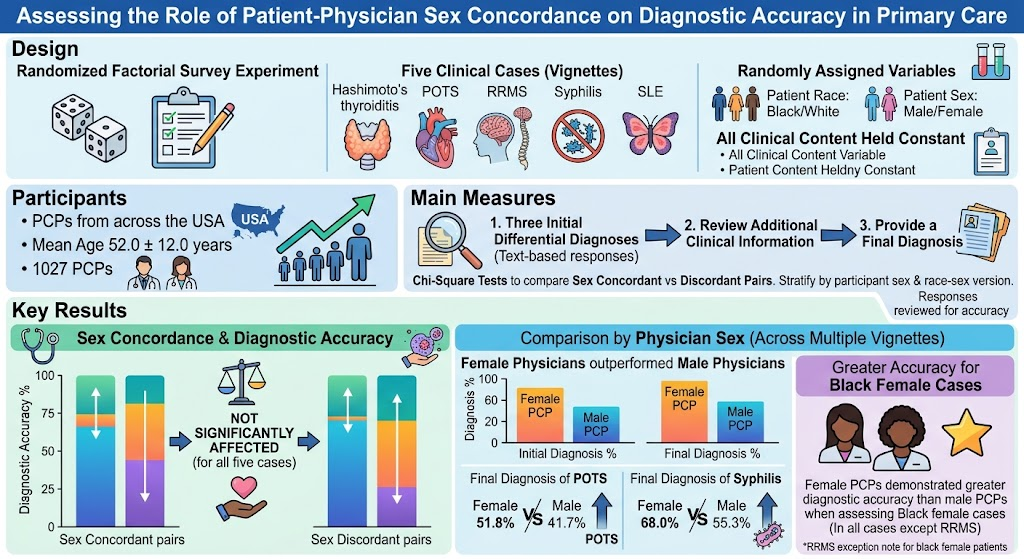
This investigation employed a randomized factorial vignette-based survey experiment conducted among 1027 primary care physicians (PCPs) across the United States, with a mean age of 52 years and 42.8% female participants. The survey utilized five clinical case vignettes representing diagnostically complex conditions: Hashimoto’s thyroiditis, postural orthostatic tachycardia syndrome (POTS), relapsing-remitting multiple sclerosis (RRMS), syphilis, and systemic lupus erythematosus (SLE). Each vignette was systematically varied by patient race (Black or White) and sex (male or female), creating randomized patient profiles while all clinical content remained constant, thus isolating the effects of patient sex and race.
Participants first provided three initial differential diagnoses based on the vignette and subsequently, after receiving additional clinical information, rendered a final diagnosis. Text responses were reviewed for diagnostic accuracy. The primary comparison was between sex concordant (same sex) and sex discordant physician-patient pairs using chi-square tests. Analyses were further stratified by physician sex and the assigned patient race-sex combination.
Key Findings
The primary outcome demonstrated no statistically significant difference in diagnostic accuracy between sex concordant and discordant patient-physician pairs across all five clinical conditions. This suggests that matching patient and physician sex does not enhance diagnostic precision in the typical primary care setting.
However, a notable and consistent finding was that female physicians outperformed male physicians in diagnostic accuracy across multiple vignettes. For example, female PCPs identified the final diagnosis of POTS correctly 51.8% of the time, compared to 41.7% among male PCPs. Similarly, for the syphilis vignette, female physicians achieved a 68.0% diagnostic accuracy versus 55.3% among males.
Further subgroup analysis highlighted that this female physician advantage was particularly evident in the assessment of Black female patient cases, except in the RRMS vignette, reinforcing the intersectional importance of sex and race in diagnostic evaluation. These findings raise important questions about potential sex-related differences in medical knowledge, clinical reasoning, or communication approaches that might influence diagnostic performance.
No safety concerns were relevant to this survey-based study.
Expert Commentary
The absence of an effect of patient-physician sex concordance on diagnostic accuracy contrasts somewhat with literature suggesting sex concordance can improve patient satisfaction and trust. Here, the findings emphasize that diagnostic accuracy—a complex cognitive task—may be less influenced by sex concordance and more dependent on physician-level attributes. The superior diagnostic performance by female physicians could reflect differences in training, clinical approach, cognitive processing, or attentiveness to subtle clinical details, as suggested in prior literature highlighting female physicians’ communication skills and adherence to guidelines.
However, this study’s vignette-based design, while methodologically rigorous, cannot replicate the full complexity of live clinical encounters, including nonverbal cues and patient narratives. Additionally, participant self-selection and familiarity with the vignettes could influence results. Future research should investigate mechanisms underlying sex differences in diagnostic reasoning and explore interventions to enhance diagnostic equity irrespective of patient or physician sex.
Clinically, these findings argue against prioritizing sex concordance alone in patient-physician matching to improve diagnostic accuracy, and instead encourage strategies to support all physicians in refining diagnostic skills, particularly addressing gaps apparent between male and female doctors.
Conclusion
In a large, representative sample of U.S. primary care physicians, patient-physician sex concordance did not affect diagnostic accuracy across multiple complex disease vignettes. Female physicians consistently outperformed their male counterparts in diagnostic precision, notably in conditions such as POTS and syphilis and within Black female patient cases. These insights highlight the importance of focusing on physician-level factors rather than patient-physician sex matching to promote diagnostic equity. Targeted educational and systemic approaches may be necessary to address sex-based disparities in diagnostic performance and improve primary care outcomes.
Funding and ClinicalTrials.gov
Not specified in the source abstract.
References
1. Sediqi S, Tran Q L, Hawa S, et al. Assessing the Role of Patient-Physician Sex Concordance on Diagnostic Accuracy in Primary Care: A Randomized Factorial Survey Experiment. J Gen Intern Med. 2026 Aug 20. PMID: 42624998.
2. Roter DL, Hall JA. Physician gender and patient-centered communication: a critical review of empirical research. Annu Rev Public Health. 2004;25: 497-517.
3. Tsugawa Y, Jena AB, Figueroa JF, et al. Comparison of hospital mortality and readmission rates for Medicare patients treated by male vs female physicians. JAMA Intern Med. 2017;177(2):206-213.
4. Kaatz A, Gutierrez B, Carnes M. Threats to objectivity in peer review: the case of gender. Trends Pharmacol Sci. 2014;35(8):371-373.